




Object ID
X65.9088
Edo designations
English designations
Altar Tableau
Categories
Altar & Shrine Objects
Location
308 Charles E Young Dr N, Los Angeles, CA 90024, United States
Loading...
Altar Tableau
Altar Tableau

Iconographies

14 annotations
Fan
Ẹzuzu
Hand fan

Ẹzuzu (round hand fans) are usually carried by attendants to the Ọba or Iy’Ọba. On the Ama-Ẹrọnmwọn (bronze relief plaques), male attendants to the Ọba carry fans, whereas on Urhotọ (altar tableaux), female attendants carrying fans are depicted flanking the Iy’Ọba. Ẹzuzu connote the status of both the person being fanned and the holder, who is usually an attendant fanning the superior Ọba or Iy’Ọba. Usually, male attendants—members of the Emada—would be represented with the Ọba, while young women would attend to the Iy’Ọba. Ẹzuzu have an important function in cooling; however, the wafting of the fans can also calm spiritual energy, thus making the fan a symbol of peace ( ).

A further symbolic use for the Ẹzuzu includes blowing medicine across the surface of a fan and using mirrored fans by ritual specialists to make predictions about the future ( ). The symbolic importance of fans in Edo belief is reflected in their use as one of a small group of inanimate objects that are the focal subjects of some Ama-Ẹrọnmwọn.

1 annotation
Ẹzuzu
Udahae
Beaded forehead band

The Udahae is a forehead band made from coral beads and worn by chiefs. Sometimes a white Igan (feather) from the Oɛɣohɔ (vulturine fish eagle) is tucked into the left side of the Udahae. According to Benin oral tradition, the Udahae was introduced by Ọba Ezoti, the first son of Ọba Ewuare I. During his coronation, Ezoti was shot in the forehead with a poisoned arrow. To stop the bleeding, a band of red beads was wrapped around his forehead while he made public appearances. Fourteen days later, he died from his wound. Since then, Benin chiefs have worn the red-beaded Udahae around their foreheads to commemorate the cap used by Ezoti to stop the bleeding (Egharevba 1968, p. 21).

1 annotation
Udahae
Ẹbẹn
Ceremonial Sword

Ẹbẹn are a type of ceremonial sword of significant importance in the Benin Kingdom. During ceremonies, titled chiefs would hold them or toss them during dances, thereby paying homage to the Ọba at these public events, particularly when a chief receives a certain status. It is forbidden for Ẹbẹn to touch the ground, so the chief must take extra precautions to avoid dropping the Ẹbẹn during the dance. Therefore, the Okae-Odionmwan (head of executioners) dances with the Umozo (warfare or executioner’s sword) behind the dancing chief.

There are two central ceremonial swords used in the royal court of the Benin Kingdom, one of which is the Ẹbẹn, along with the Ada (ceremonial swords). They are distinguished by their blades: the Ẹbẹn blade reflects the shape of a leaf or an oar. Sometimes, it is decorated with openwork designs and/or brass inlays, most commonly shaped as small Ẹbẹn and Ẹkpẹn (leopards). The handle of the Ẹbẹn also has an unusual ring-shaped form, which further differentiates it from the Ada.

1 annotation
Ẹbẹn
TBC ov-ene obo
Trunk hand

The trunk hand motif, comprising an elephant’s trunk ending in a fist, is believed to have complex and varied symbolic meanings. During the 15th and 16th centuries, the era of the warrior kings, the motif appeared only occasionally. During the 18th century, it was revived to honour the richest of all Ọbas, Ọba Akenzua I. This was particularly the case on the Aken'ni Elao (carved tusks), and the trunk hand motif commonly appears on these ivories from the 18th century and throughout the 19th and into the 20th centuries ( ). In her PhD thesis, Barbara Blackmun ( ) identified eight different kinds of motifs of this type on the Aken’ni Elao alone, indicating that the form itself is variable. In addition to the ivory Aken’ni Elao, the motif also commonly appears on the flanges of Uhunmwu-Elao (commemorative heads), the bases of Urhotọ (altar tableaux), and some ornately decorated bronze Ukhurhẹ (ancestral staffs).

The elephant trunk hand has been interpreted as a symbol of physical power ( ) and strength ( ), and as the “ultimate Hand of Hands” ( ). A past Ihama n’Igun-Ẹrọnmwọn ( ) interpreted the motif as a symbol of “taking life”. On some Emwin Arhe (royal treasures) where the trunk hand motif is present, depictions of human sacrifices are also present, representing the ultimate power held by the divine Ọbas. The potent nature of the trunk hand motif is further emphasised by Barbara Blackmun through the combination of “the head of one of the most powerful animals with a hand that grasps with enormous strength”; together, these signify “the acquisition of great wealth for the kingdom” ( ).

1 annotation
TBC ov-ene obo
Round Neck Bead
Ikele
Coral bead circlet

Ikele is a single stiff string or circlet of coral beads. It is worn by chiefs, such as senior chiefs who have been made Enigie (Inneh 2007, p.107), and is a sign of nobility and rank. The Ikele may only be worn once the Ọba has conferred a person with the right to wear the beads, and the Ikele must always be worn when appearing before the Ọba. According to Ekhaguosa Aisien (in Plankensteiner 2007, cat. nr. 301, p.512) when a chief is wearing the Ikele, they may not eat nor drink in public, and they “constitute an embassy of the Benin Palace wherever he might be.”

1 annotation
Ikele
Ukpẹ ọkhọkhọ
Curved conical hairstyle worn by Iy'Ọba

The Ukpẹ ọkhọkhọ is a distinctive hairstyle and coral-beaded headdress worn by the Iy’Ọba. The headdress includes a projection called the ‘ede Iy’Ọba’, which indicates that “her spiritual potentialities are closer in quality to those of her ruling son than they are to the powers of the nobles” (Aigbe Eson and Ihama Iguneronmwon in Blackmun 1991, p. 60). The Iy’Ọba’s hairstyle and headdress are meant to resemble ukpe-okhue, or the curved parrot’s beak (Kaplan 1993).

Barbara Blackmun (1991, p. 60) argued that “Benin art is multivocal, and any depiction of the Iye Ọba [sic] is a reference to Idia. Every woman who holds the office of lye Ọba plays the part of Idia, the ideal model of an Ọba’s mother.” Wearing the Ukpẹ ọkhọkhọ is one of the ways the Iy’Ọba plays the role of Idia.

1 annotation
Ukpẹ ọkhọkhọ
Asa
Shield

Asa (shields) are a crucial attribute of warriors and warrior chiefs, forming part of their ceremonial and battle attire as represented on the Emwin Arhe (royal treasures). Asa were usually made from elephant or crocodile skin and used by warriors for protection during hand-to-hand combat (Osadolor 2001, p. 102). Interestingly, the form of Asa depicted on historic royal artefacts differs from those found in museum collections today, reflecting changes in shield shapes and designs over time.

1 annotation
Asa
Ubanu'hi / Obanu'hi
Ubanu'hi / Obanu'hi
Inifinity Symbol

The Ubanu'hi (infinity symbol) is a kind of guilloche or interlaced strapwork motif that can be angular or rounded. It was used by Edo artists in the decoration of many Emwin Arhe (royal treasures) and is ubiquitous in Benin royal arts. Ubanu'hi is a shortened form of “uba no Ọba ya de agbon ke ehimwin yi”, which means “the rope with which the Ọba ties the heaven and earth together” (pers. comm. Chief John Igbineweka Inneh n’Igbesawman, 2022). Similarly, Paula Ben-Amos Girshick (in Plankensteiner 2007, pp. 339, 341) described this as “Ọba n’iri agbon”, or the “rope of the world” pattern.

According to Ọbabanmu Ineh (in Blackmun 1984, p. 51), the use of this motif indicates that objects were carved by members of the Igbesanmwan. However, the motif is found on all types of Emwin Arhe (royal treasures), not only those made of ivory or wood. On the flanges of the Ama (relief plaques) alone, Kathryn Gunsch (2018, pp. 75–77) identified three different versions of the Ubanu'hi and, through her analysis of over 850 plaques, found that these different Ubanu'hi forms align with other characteristics, such as dimensions, the prevalence of ornamental motifs, and stylistic qualities. Together, these provide evidence, she argues, of different production groups among the plaque makers .

Kate Ezra (1992, pp. 209, 264) went on to argue that the use of these motifs indicates that certain objects were used in a “royal context” and were associated with “royal patronage”.

1 annotation
Ubanu'hi / Obanu'hi
cattle (dwarf mutu cow)
Ẹmila
Cattle (dwarf mutu cow)

Ẹmila are used mainly for social functions. Although, they maybe used by some affluent chiefs and the royal palace for ceremonial purposes

1 annotation
Ẹmila
tribal marks
Iwu
Facial and Body Markings

Iwu are facial and body markings (scarifications) that were historically worn by Edo men and women. However, since the 1960s, the practice has been nearly extinct (Aisien 2011). In the past, Iwu were used as a way of proving that one was an Edo citizen, and the ceremony of having Iwu completed was an important rite of passage for men and women. The Osiwu, who also practised circumcision and other surgical procedures, would carry out the procedure of adding Iwu. There are different types of Iwu: ‘blades’ worn on the torso (Iwu-eko), and those worn on the face, such as Ikharo (three or four markings above the eyebrows), Irho (two narrow ‘blades’ worn on each cheek), Ovbihue (nasal ‘blades’), Ovbi-agbanmwen (chin ‘blade’), and Igho-okpa/Ukpgho (three forehead ‘blades’) (Aisien 2011, p. 22).

The number of Iwu also varied depending on the identity of the person wearing them. For example, royal men would wear six ‘blades’ on their torso, whilst men who were not royal would wear seven ‘blades’. Meanwhile, the Ọba’s female children would wear fifteen ‘blades’, and all other women would wear sixteen (Aisien 2011).

1 annotation
Iwu
Colar Bead
Odigba
Coral beaded collar

Odigba (coral-beaded collar) is a rigid neck collar made of coral beads, worn as part of ceremonial attire only by senior princes who have been made Enigie (Inneh 2007, p. 107). Although Ibafe (2007, p. 43) argued that the Odigba was introduced during the Ogiso period (c. 900–c. 1170 AD) by Ogiso Ere, along with other symbolically important Emwin Arhe, such as the Ada (ceremonial sword) and the Ẹbẹn (ceremonial sword), this seems unlikely, as coral was only introduced in the late 15th century through trade with Portuguese merchants.

1 annotation
Odigba
Ititi ako
Star beads

The Ititi ako is a cluster of coral beads, usually three or four, attached to a pin and used to embellish the royal crowns on Uhunmwu-Elao (commemorative heads) and Uhunmwu-Ẹkuẹ (pendant masks). These bead clusters are also known as star beads, which indicate the prosperous destiny of an individual or wearer. Apart from enhancing the appearance of the wearer, they also represent the individual’s high social status. Judging from their presence on a variety of head sculptures, both men and women wore Ititi ako.

1 annotation
Ititi ako
Ukpan obọ eva
Crossed Beaded Baldrics

The Ukpan obọ eva (coral-bead crossed baldrics) were worn as part of the ehaingbehia, the full ceremonial regalia, by only high-ranking members of the palace, including the Ọba himself, the Iy’Ọba, the Edaiken, and the Ezọmọ (Ben-Amos 1999, pp. 68, 141; Osadolor in Plankensteiner 2007, cat. no. 70, pp. 322–323).

1 annotation
Ukpan obọ eva
Iy'Ọba
Queen Mother

In the 16th century, Ọba Ẹsigie established the title of Iy'Ọba (Queen Mother) in honour of his mother, Iy'Ọba Idia, for the crucial role she played in the Benin–Idah War (1515–16). She is often described as “the only woman who went to war” ( ).

The Iy'Ọba can usually be identified by her distinctive curved, conical hairstyle, known as Ukpẹ ọkhọkhọ, which is said to have been introduced by Iy'Ọba Idia (Kaplan 1993, p. 58). In addition, the Iy'Ọba was permitted to wear certain items of attire otherwise reserved for the Ọba, such as the Ewu ivie (coral-beaded shirt) and Ukpan obọ eva (crossed coral-beaded baldrics), as well as regalia associated with senior chiefs, including the Odigba (coral-beaded collar) and Udahae (coral-beaded forehead band) ( ).

Representations of the Iy'Ọba appear on ivory Emwin Arhe (royal treasures), including the five famous Uhunmwu-Ẹkuẹ (pendant masks) believed to depict Iy'Ọba Idia, as well as on a number of Aken'ni Elao (carved altar tusks). She is also represented in brass and bronze, including on Ikẹgobọ (altars to the hand) and Urhotọ (altar tableaux) made for Iy'Ọba shrines and altars ( ). In these representations, the Iy'Ọba is often accompanied by female attendants who form part of her retinue.

1 annotation
Iy'Ọba

Provenance

4 events
Production
unknown to February 22, 1897 (day approximate)
The object was produced by Unknown member(s) of the Igun-Ẹrọnmwọn guild in Benin City.
Looted
February 22, 1897 (day approximate) to June 1899 (year approximate)
The object was looted by George William Neville from Benin Kingdom.
Purchase
May 1, 1930
The object was purchased by the Wellcome Collection, London Wellcome Institute for the History of Medicine and Henry Solomon Wellcome from George William Neville through Foster's and A. L. Dean from London.
Gift
1965
The object was given as a gift by Wellcome Trust to the Fowler Museum at UCLA from London to Los Angeles.

Institution data

Fowler Museum at UCLA
The data was transferred directly by the institution.
Last updated: 2021-07-30
Language: english
Institution fieldValue
Object ID
object id
X65.9088
description
description
brass tableau
Materials
material
BRASS?
Dimensions
dimensions
H: 33.02 cm, W: 29.00 cm, L: 34.00 cm
Object Name
object type
FIGURE GROUP
Date
date made
before 1897, 1897, 5/1/1930
Geographical area
production place
BENIN KINGDOM, NIGERIA
Party
prior source
George William Neville, Messrs. Foster, A. L. Dean, Sir Henry Wellcome, Wellcome Trust
Evidence 1
provenance
Back of wellcome card: "Part of collection of late G. N. Neville Esq. (Weybridge). A member of the punitive , who himself removed them after the capture of the city in 1897."
Evidence 2
provenance
From Fos. auction lot 5/1/30: "G. W. Neville, Esq. of Benin Punitive "
Country Culture
ethnic attribution
Benin
Culture Group
ethnic attribution
EDO (NIGERIAN)
Party Notes
notes
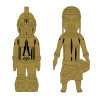
"A FINE GROUP OF NINE FIGURES IN A PROCESSION, representing the chief with eight male and female attendants; the chief clasping the hands of two attendants, and wearing a high-tapered headdress, and sheltered by two shields, upheld by attendants, on square-shaped based with guilloche design and horse and ox heads and human arms in relief" The entire Foster sale lists “By direction of the Executors of the late G. W. Neville, Esq” and the catalog is called “of the Highly important Bronzes, Ivory and Wood Carvings from the Walled City of Benin, West Africa.” The foreword, “Benin, ‘the City of Blood’” describes the .
summary of curatorial notes archival research thus far summer 2021
notes
Unclear who exactly carried the looted material away from Benin, and whose collection(s) it was in until 1930 when it was sold at a Mess. Foster auction May 1, 1930, lot number 56. The lot description states, “"A FINE GROUP OF NINE FIGURES IN A PROCESSION, representing the chief with eight male and female attendants; the chief clasping the hands of two attendants, and wearing a high-tapered headdress, and sheltered by two shields, upheld by attendants, on square-shaped based with guilloche design and horse and ox heads and human arms in relief." The entire Foster sale lists “By direction of the Executors of the late G. W. Neville, Esq” and the catalog is called “of the Highly important Bronzes, Ivory and Wood Carvings from the Walled City of Benin, West Africa.” The foreword, “Benin, ‘the City of Blood’” describes the . Back of Wellcome card (“flimsy card”) further explains: "Part of collection of late G. N. Neville Esq. (Weybridge). A member of the punitive , who himself removed them after the capture of the city in 1897."
status
legal status
looted 1897
Old Numbers
R76/1937, 79243A
Party Lot Number
56
provenance list known dates
1897, looted from Benin City 1930 (May 1): Sold at a Mess. Foster auction [lot #56], “A fine group of nine figures in a procession…” This specific Foster sale lists “By direction of the Executors of the late G. W. Neville, Esq.” 1965 Gift of the Wellcome Trust to Fowler Museum (then Museum and Laboratories of Ethnic Arts and Technology)
Sensitive Content

Digital Benin collates digital material from institutions, and some of this material is inherently colonial and contains words, terms and phrases that are inaccurate, derogatory and harmful towards African and African diasporic communities. Catalogue transcriptions, book titles, exhibition titles and museum titles may contain harmful terms. We recognise the potential for the material to cause physical and mental distress as well as evoke strong emotions. Owing to the scale of the collection’s data, a process to implement sensitive-content warnings in the displayed data is still incomplete. The material within the catalogue does not represent Digital Benin’s views. Digital Benin maintains a strong anti-colonial, anti-racist position and affirms its support for centring the humanity of historically marginalised and disenfranchised communities. Read more about the background of this statement here