
Urhotọ
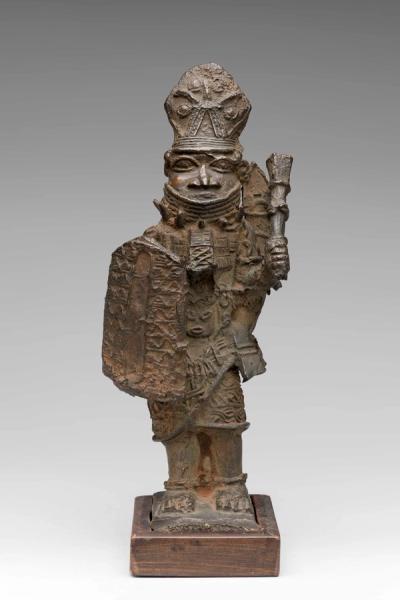
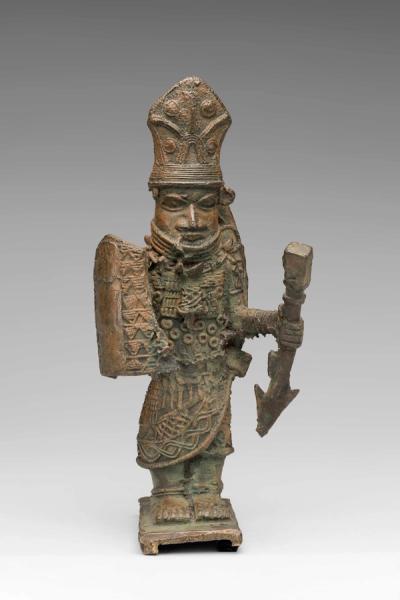
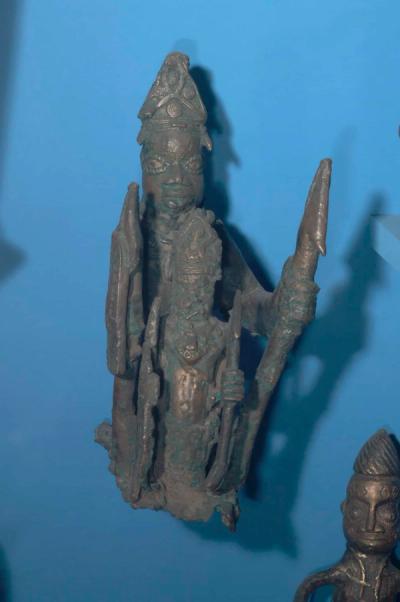
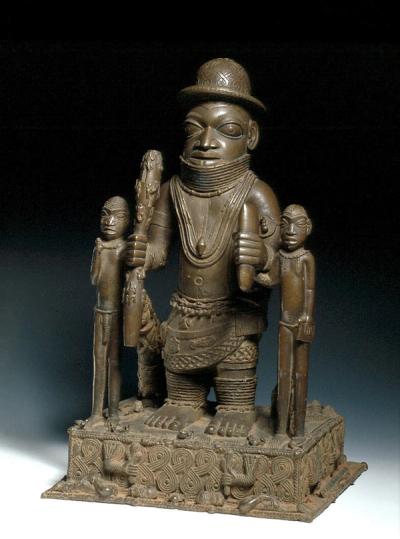
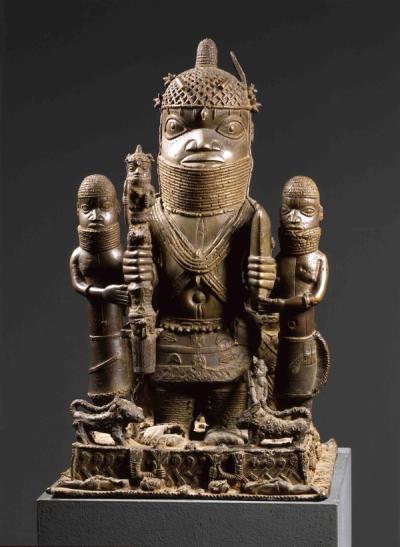
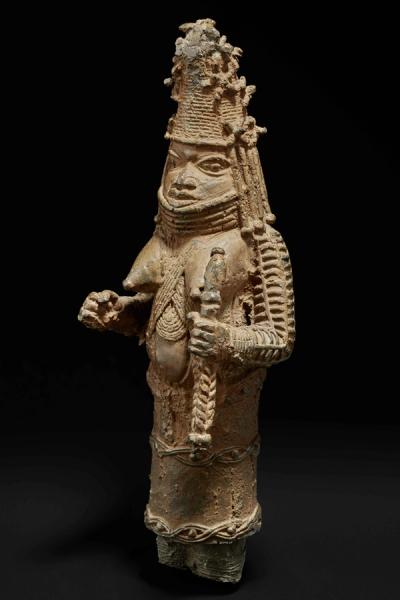
Urhotọ is used here to describe both Altar Tableaux and Altar Rings, despite their different forms. Altar Tableaux consist of a square or rectangular cast base with a square opening at the centre. The commemorated Ọba or Iy'Ọba is placed centrally, while attendants, courtiers, and chiefs flank them on either side. The bases are usually decorated with the guilloche motif found throughout the arts of the Benin royal court, as well as iconographic motifs such as elephant trunks ending in fists, mudfish, and ram heads. By contrast, Altar Rings are, as their English name suggests, ring-shaped brass cast objects measuring between 20 and 26 cm in diameter.
The function of Altar Tableaux is much better understood than that of Altar Rings. They are placed on the ancestral altars of the Ọba or Iy'Ọba, alongside other typical altar objects, such as Uhunmwu-Elao (commemorative heads), Ẹroro (bells), and Aken'ni Elao (carved altar tusks). Through our research in Benin City, it is now understood that Altar Rings were also used on ancestral altars. The similarities, however, end there, as the visual language differs greatly from that of Altar Tableaux and is often related to sacrifice, death, as well as "sacred kingship and magical medicine" ( ).
Educational Material
Digital Benin collates digital material from institutions, and some of this material is inherently colonial and contains words, terms and phrases that are inaccurate, derogatory and harmful towards African and African diasporic communities. Catalogue transcriptions, book titles, exhibition titles and museum titles may contain harmful terms. We recognise the potential for the material to cause physical and mental distress as well as evoke strong emotions. Owing to the scale of the collection’s data, a process to implement sensitive-content warnings in the displayed data is still incomplete. The material within the catalogue does not represent Digital Benin’s views. Digital Benin maintains a strong anti-colonial, anti-racist position and affirms its support for centring the humanity of historically marginalised and disenfranchised communities. Read more about the background of this statement here