TBC ov-ene obo
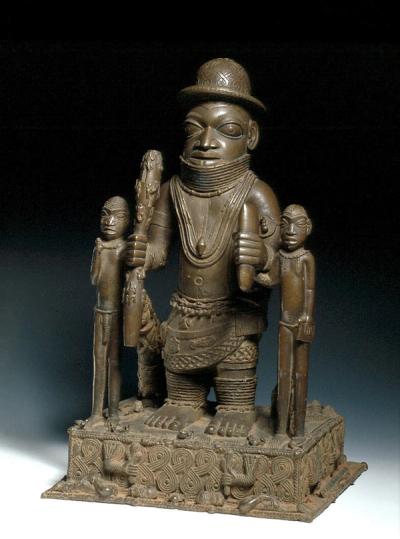
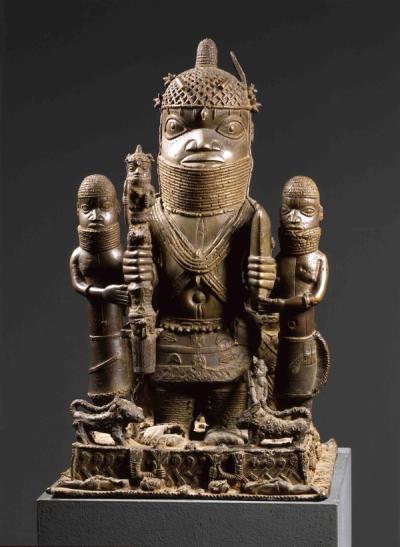
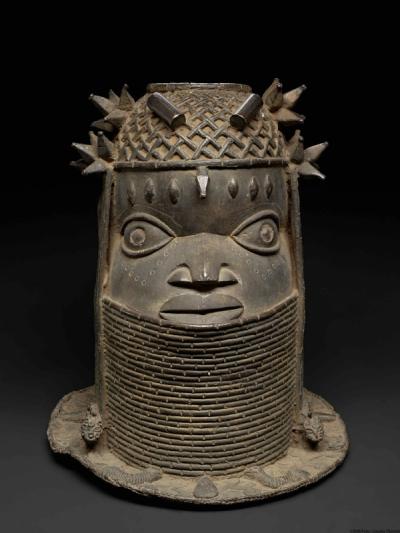
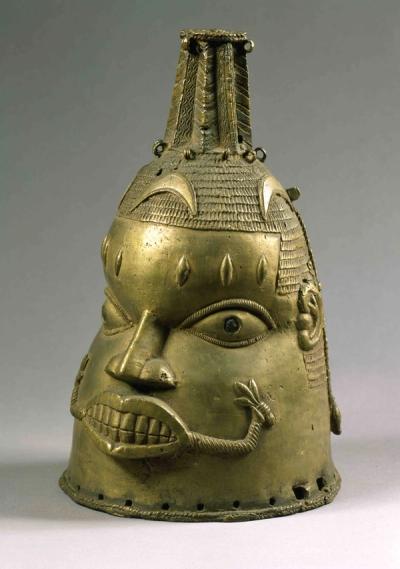
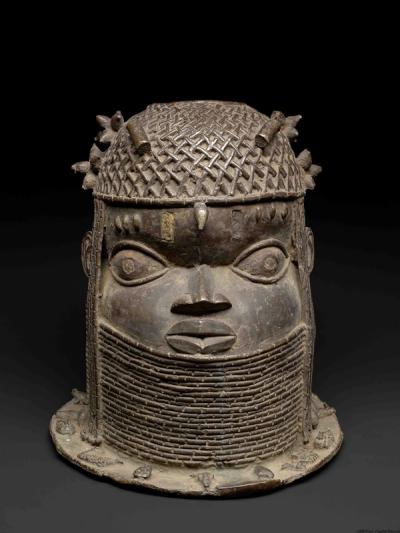
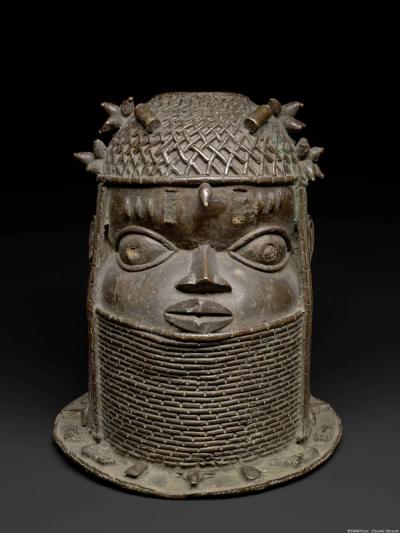
The trunk hand motif, comprising an elephant’s trunk ending in a fist, is believed to have complex and varied symbolic meanings. During the 15th and 16th centuries, the era of the warrior kings, the motif appeared only occasionally. During the 18th century, it was revived to honour the richest of all Ọbas, Ọba Akenzua I. This was particularly the case on the Aken'ni Elao (carved tusks), and the trunk hand motif commonly appears on these ivories from the 18th century and throughout the 19th and into the 20th centuries ( ). In her PhD thesis, Barbara Blackmun ( ) identified eight different kinds of motifs of this type on the Aken’ni Elao alone, indicating that the form itself is variable. In addition to the ivory Aken’ni Elao, the motif also commonly appears on the flanges of Uhunmwu-Elao (commemorative heads), the bases of Urhotọ (altar tableaux), and some ornately decorated bronze Ukhurhẹ (ancestral staffs).
The elephant trunk hand has been interpreted as a symbol of physical power ( ) and strength ( ), and as the “ultimate Hand of Hands” ( ). A past Ihama n’Igun-Ẹrọnmwọn ( ) interpreted the motif as a symbol of “taking life”. On some Emwin Arhe (royal treasures) where the trunk hand motif is present, depictions of human sacrifices are also present, representing the ultimate power held by the divine Ọbas. The potent nature of the trunk hand motif is further emphasised by Barbara Blackmun through the combination of “the head of one of the most powerful animals with a hand that grasps with enormous strength”; together, these signify “the acquisition of great wealth for the kingdom” ( ).
Digital Benin collates digital material from institutions, and some of this material is inherently colonial and contains words, terms and phrases that are inaccurate, derogatory and harmful towards African and African diasporic communities. Catalogue transcriptions, book titles, exhibition titles and museum titles may contain harmful terms. We recognise the potential for the material to cause physical and mental distress as well as evoke strong emotions. Owing to the scale of the collection’s data, a process to implement sensitive-content warnings in the displayed data is still incomplete. The material within the catalogue does not represent Digital Benin’s views. Digital Benin maintains a strong anti-colonial, anti-racist position and affirms its support for centring the humanity of historically marginalised and disenfranchised communities. Read more about the background of this statement here