
OBJEKTE_ID
1707511
English designations
Pendant Plaque
Categories
Ceremonial Regalia
Location
Johannispl. 5-11, 04103 Leipzig, Germany
Loading...

Iconographies

15 annotations
Uhunmwu-Ẹkuẹ
Pendant Mask

Uhunmwu-Ẹkuẹ (pendant masks) formed part of the ceremonial regalia worn by court dignitaries to indicate their rank or function and are frequently represented among the Emwin Arhe (royal treasures), particularly those made of brass, bronze, or ivory.

Different animals were depicted on Uhunmwu-Ẹkuẹ, particularly the heads of leopards and crocodiles. The most common type features the face or head of an Ọba. Other examples take the form of an elephant head incorporating the trunk-hand motif, a ram’s head, or, in a very small number of cases, the face of a Portuguese man. Different figures appear to have worn Uhunmwu-Ẹkuẹ with different imagery. For example, warrior chiefs are often depicted wearing leopard-head pendant masks, whereas crocodile-head Uhunmwu-Ẹkuẹ are generally shown being worn only by the Ọba and his Enọbare (Blackmun 2007, cat. no. 137, p. 365).

1 annotation
Uhunmwu-Ẹkuẹ
Colar Bead
Odigba
Coral beaded collar

Odigba (coral-beaded collar) is a rigid neck collar made of coral beads, worn as part of ceremonial attire only by senior princes who have been made Enigie (Inneh 2007, p. 107). Although Ibafe (2007, p. 43) argued that the Odigba was introduced during the Ogiso period (c. 900–c. 1170 AD) by Ogiso Ere, along with other symbolically important Emwin Arhe, such as the Ada (ceremonial sword) and the Ẹbẹn (ceremonial sword), this seems unlikely, as coral was only introduced in the late 15th century through trade with Portuguese merchants.

3 annotations
Odigba
Odigba
Odigba
king with mudfish legs
TBC_Ọba Ohẹn
King with Mudfish Legs

This motif of an Ọba with legs represented as two mudfish is often interpreted as Ọba Ohẹn, who reigned c. 1334–1370. According to oral traditions, Ohẹn suffered from paralysis of the legs and unsuccessfully attempted to conceal his condition from the chiefs and members of the royal court. The Iyasẹ Emuze eventually hid in the Ọba’s chambers to discover his secret ( ). When Ohẹn discovered this, he ordered the Iyasẹ to be executed. However, the people learned of the order and turned against the Ọba. According to the tradition, they plotted to kill him ritually by digging a hole beneath his throne and stoning him with Orhue (white kaolin chalk) when he fell into it ( ; ).

Not all representations of an Ọba with mudfish legs, however, are understood to refer to Ohẹn. Variations in the objects and animals carried by the figure are thought to indicate different meanings ( ; ). Members of the Igbesamwan and Igun-Ẹrọnmwọn have emphasised the significance of these accompanying motifs (Blackmun 1984, pp.249–255). When the mudfish-legged Ọba is shown holding aquatic creatures such as crocodiles, for example, the image has been interpreted as a “cosmological image” representing the correspondence between the two monarchs: the Ọba of Benin, ruler of the land, and Olokun, ruler of the waters ( ). By contrast, representations in which the Ọba holds swords or staffs have been interpreted specifically as depictions of Ọba Ohẹn.

1 annotation
TBC_Ọba Ohẹn
Ẹkirẹ
Frog

Ẹkirẹ is the Edo term for frog ( ; Ọbazee 2025, p. 135). The Ẹkirẹ carries significant and often ambiguous symbolic importance, primarily linked to its liminal nature and association with spiritual and magical powers. As an amphibian that lives on the threshold between water and land, the Ẹkirẹ is seen as a messenger of Olokun. This connection reinforces the Ọba’s (king’s) ability to bridge the human and spiritual realms, a concept consistently present in Benin art.

While not as common as the mudfish, frogs appear on various Benin artworks, including Aken'ni Elao (carved tusks), pendant plaques, and Ẹrhẹ (royal stools). Their presence often relates to medicinal and occult practices. Frogs can be used in powerful curses, with a jumping frog signifying failure, and a frog, along with a coiled fish, used in rituals to release such curses. They are also associated with Osun, the deity of medicine, and scenes of snakes swallowing frogs can represent supernatural attacks or strong spiritual powers. For warriors, the Ẹkirẹ could even symbolise an aspect of their protective equipment and was used in palace rituals to encourage success in battle ( ).

1 annotation
Ẹkirẹ
Oro
Headdress/crown with single projection

Figures wearing a headdress with a single protrusion from the crown of the head, known as the Oro, are found only among the Ọba and a select category of palace dignitaries whose ancestors originated in ancient Ile Ife ( ; Ọbazee 2025, p. 407). Only the Osa and Osuan, custodians of the Uwen and Ora deities, as well as members of the Emuru, who are responsible for the care of Iru vessels, may wear a headdress with the Oro. The identification of different figures is therefore interpreted based on the combination of the Oro with other items of regalia. Artists in the Igun-Ẹrọnmwọn and Igbesamwan depicted figures with the Oro on Ama-Ẹrọnmwọn (bronze relief plaques) and Aken'ni Elao (carved tusks), respectively. The Oro would either be made of coral beads as part of the crown or headdress, or be woven from itoto fibre ( ).

3 annotations
Oro
Oro
Oro
TBC_Royal Triad
Royal Triad

The Royal Triad is a motif composed of three figures, with a central figure supported on either side by two others. The motif has multiple meanings and interpretations. When understood on the human level, the central seated or standing figure is identified as the Ọba, flanked by two Enobare who each support one of his arms. This pose “encapsulates Edo ideals of kingship,” in which “even the most powerful of Benin's divinely ordained rulers cannot stand alone. He must maintain a careful balance between his authority over the Edo people and their acquiescence in his leadership” ( ). The identities of the supporting Enobare are interpreted variously. They have been identified as the Osa and Osuan, who support the Ọba in this manner during the Ugie Oro and Ododua festivals, although it is possible that the Edaiken (crown prince) and Ezọmọ performed these roles during the 18th century ( ).

In some examples, the central figure has mudfish in place of legs. These figures have sometimes been interpreted as representations of the deity Olokun ( ). Barbara Blackmun (1984, pp. 274–275) alternatively suggested that the triad may represent the high god Osanobua, his son and deity Olokun, and Olokun’s child, Ohen, who in turn represents the Ọba.

The number three is considered an “uncanny” number in Edo thought and “is never used lightly” ( ), being associated with the “threat of occult sanctions or forces” ( ).

The Royal Triad appears on almost all Aken'ni Elao (carved tusks), as well as on some Ẹgogo (gongs) and pendant plaques, and less frequently on Ama-Ẹrọnmwọn (bronze relief plaques). The motif is also referred to as the “supporting triad motif” or “linked supporting triad motif” ( ).

1 annotation
TBC_Royal Triad
TBC ov-ene obo
Trunk hand

The trunk hand motif, comprising an elephant’s trunk ending in a fist, is believed to have complex and varied symbolic meanings. During the 15th and 16th centuries, the era of the warrior kings, the motif appeared only occasionally. During the 18th century, it was revived to honour the richest of all Ọbas, Ọba Akenzua I. This was particularly the case on the Aken'ni Elao (carved tusks), and the trunk hand motif commonly appears on these ivories from the 18th century and throughout the 19th and into the 20th centuries ( ). In her PhD thesis, Barbara Blackmun ( ) identified eight different kinds of motifs of this type on the Aken’ni Elao alone, indicating that the form itself is variable. In addition to the ivory Aken’ni Elao, the motif also commonly appears on the flanges of Uhunmwu-Elao (commemorative heads), the bases of Urhotọ (altar tableaux), and some ornately decorated bronze Ukhurhẹ (ancestral staffs).

The elephant trunk hand has been interpreted as a symbol of physical power ( ) and strength ( ), and as the “ultimate Hand of Hands” ( ). A past Ihama n’Igun-Ẹrọnmwọn ( ) interpreted the motif as a symbol of “taking life”. On some Emwin Arhe (royal treasures) where the trunk hand motif is present, depictions of human sacrifices are also present, representing the ultimate power held by the divine Ọbas. The potent nature of the trunk hand motif is further emphasised by Barbara Blackmun through the combination of “the head of one of the most powerful animals with a hand that grasps with enormous strength”; together, these signify “the acquisition of great wealth for the kingdom” ( ).

1 annotation
TBC ov-ene obo
Ivie okpagbaru/Ivie Ewuare
Royal/Ewuare Bead

This oval-shaped bead with faceted sides is known as the Ivie okpagbaru or Ivie Ewuare (the ‘royal bead’ or ‘Ewuare bead’). The association of Ọba Ewuare with this bead is based on a story in which Ewuare took beads from the deity Olokun, sanctifying his royal position and, in turn, receiving the title ‘Lord of the Land’, in contrast to Olokun’s title ‘Lord of the Sea’ (Omomo of Enisen in Blackmun 1990, p. 65). The Ivie okpagbaru/Ivie Ewuare is a distinctive motif that can be used to identify representations of the Ọba.

Due to the association of beads with Olokun, it is unsurprising that this bead has come to symbolise wealth when used to decorate Emwin Arhe (royal treasures) (Blackmun 1984, p. 59). Paula Ben-Amos (1999, p. 64) associated the bead with a different narrative and the name ‘One Bead Does Not Go around the Neck’. Ben-Amos suggests that the bead is in fact the one that was fought over by Ọba Ẹsigie and his brother Aruanran when they struggled for the right to the throne in the early 16th century.

1 annotation
Ivie okpagbaru/Ivie Ewuare
Ẹrhu
Headwear

Many different kinds of Ẹrhu (headwear) are worn by the various figures depicted in the imagery of Benin royal artefacts. Through comparisons with ceremonial regalia still worn by chiefs and members of the royal court, including the Ọba himself, some Ẹrhu have been used to identify the different figures depicted. For example, the conical hat worn by high-ranking town chiefs as part of the pangolin regalia, still worn at ceremonies, is also visible on figures on some Ama-Ẹrọnmwọn (bronze relief plaques) ( ). Other examples include the distinctive bell-shaped helmet associated with the Iyasẹ ( ). Figures who wear a shallow-brimmed hat and a cross have been identified as Ewua or Ohensa priests ( ).

Different kinds of helmets and headwear were worn by warriors, reflecting the many different ranks and roles in the army at any given time, as well as developing trends that were in turn represented on Emwin Arhe created at different points in time. Warrior figures wearing helmets covered in cowrie shells were carved on the Aken'ni Elao (carved tusks) (Blackmun 1984, p. 330), yet on the brass Ama, warriors are sometimes depicted wearing helmets made from crocodile hide or horsehair with a front plate (Osadolor in Plankensteiner 2007, cat. no. 238, p. 457). Helmets made from horsehair with a front plate are one of the more common types represented on the Ama-Ẹrọnmwọn, and the demand for black horse tails was noted by both Portuguese and British traders during the late 17th and 18th centuries (Osadolor in Plankensteiner 2007, cat. no. 238, p. 457). Other warriors depicted on Ama-Ẹrọnmwọn wear helmets with a rounded top, chinstrap, and sometimes also a feather tucked into the left side. These types of headwear are known as Ẹrhu Iyokuo.

Attire worn for battle also differed from that worn for ceremonial occasions, such as the pointed headwear worn in combination with an ornate leopard-head tunic by war chiefs. Depictions of figures wearing this attire on brass Ama-Ẹrọnmwọn (bronze relief plaques) have been interpreted as representing the war chiefs’ participation in the war-ritual Isiokuo festival (Osadolor in Plankensteiner 2007, cat. no. 238, p. 457).

Another distinctive form of headwear is that worn by figures identified as leopard hunters on the brass Ama-Ẹrọnmwọn (relief plaques). These large helmets cover almost all of the leopard hunters’ faces except for their noses, eyes, and upper lips, and are made of an unusual material that remains unidentifiable (Plankensteiner 2007, cat. nos. 68–69, p. 322).

European figures are also portrayed with distinctive hats, such as Portuguese three-cornered hats. These depictions reflect the artists’ keen observation and highlight the impact of European trade and military assistance (Ezra 1992).

2 annotations
Ẹrhu
Ẹrhu
Beaded Crown
Ẹde
Beaded Crown

Although many other members of the Benin royal court wore a variety of hats and forms of headwear, only the Ọba may wear the Ẹde (beaded crown). The Ọba must never be seen bare-headed, and successive Ọbas introduced different styles and types of crowns ( ).

Across different media and objects, Ọbas are depicted wearing various types of crowns, all elaborately crafted from coral beads. Some feature tall projections rising from the crown, known as Oro, while others have curved projections extending from either side of the head, known as the winged cap. The latter was introduced only in the 19th century, most likely by Ọba Osẹmwẹndẹ ( ). Depictions of Ọba Esigie on Ama-Ẹrọnmwọn (bronze relief plaques) show him wearing an elaborate crown decorated with large jasper or coral beads ( ).

1 annotation
Ẹde

Provenance

5 events
Production
unknown to February 22, 1897 (day approximate)
The object was produced by Unknown member(s) of the Igun-Ẹrọnmwọn guild in Benin City.
Looted
February 22, 1897 (day approximate) to June 1899 (year approximate)
The object was looted by Unknown member of the British colonial military campaign on Benin - February 1897 from Benin Kingdom.
Unknown
February 22, 1897 (day approximate) to 1900
The object is known to have come into contact with William Downing Webster, later in Bicester.
Purchase
1900
The object was purchased by Arthur Baessler from William Downing Webster from Bicester to Berlin.
Donation
1900
The object was donated by Arthur Baessler to the Staatliche Ethnographische Sammlungen Sachsen und Staatliche Kunstsammlungen Dresden from Berlin to Dresden.

Related archival documents

2 documents
See all
Museum Catalogue
Staatsbibliothek zu Berlin
Die Altertümer von Benin
Date
January 1, 1919 at 12:00:00 AM
An archival document representing a Photograph Album of 2 page(s)
Photograph Album
British Museum
W. D. Webster photograph album
Date
January 1, 1898 to December 31, 1899

Institution data

Staatliche Ethnographische Sammlungen Sachsen und Staatliche Kunstsammlungen Dresden
The data was transferred directly by the institution.
Last updated: 2021-09-28
Language: german
Institution fieldValue
INV_NR
object id
16158
OBJEKTE_ID
object id
1707511
KURZTITEL
designation
Plakette mit Triadendarstellung
Object-name-and-materials
designation
material
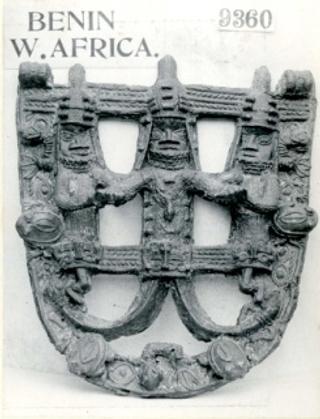
Große Plakette mit Oba und Begleitern, Triadendarstellung Gelbguss
TITEL
designation
Große Plakette mit Oba und Begleitern, Triadendarstellung;Hängeplatte mit 3 Figuren
INTERNETKOMMENTAR
description
notes
Das hohe Gewicht dieser Plakette schließt ein Tragen am Körper aus. Bei den dargestellten Personen handelt es sich um den Oba, der vermutlich von den Hohepriestern Osa und Osuan im Verlauf der Igue-Zeremonie unterstützt wird. Die Beine des Oba auf der großen Plakette wurden als „Welsbeine“ dargestellt. Dieses Bild und die abgebildeten Frösche, die auch mit dem Gott der Magie Osun in Zusammenhang gebracht werden, stellen deutliche Hinweise auf das Igue-Ritual dar, bei der die mystische Kraft des Königs erneuert wird. (MVD, S. D.)
KATALOGTEXT
description
MATERIAL
material
Metall
MASSEBEMERKUNG
dimensions
34 x 29 cm|(lt. Karteikarte) -->prüfen
MASSETABANGABE
dimensions
MASSETABBEMERKUNG
dimensions
MASSETABBREITE
dimensions
MASSETABDURCHMESSER
dimensions
MASSETABEINHEITLAENGE
dimensions
MASSETABEINHEITLAENGE_IDS
dimensions
MASSETABHOEHE
dimensions
MASSETABTIEFE
dimensions
Dimensions_weight
weight
H: 34 cm W: 29 cm
MASSETABEINHEITGEWICHT
weight
MASSETABEINHEITGEWICHT_ID
weight
MASSETABGEWICHT
weight
OBJEKTBEZ
object type
Plastik
KONVOLUT
provenance
object count
Sammlung Arthur Baessler; SES Benin-Objekte; SES Dossier Benin-Objekte, Überlieferung an die Kontaktstelle für Sammlungsgut aus kolonialen Kontexten
ORT_DATUM_BIS
date made
1897;1900
ORT_DATUM_KONKRET
date made
';'
ORT_DATUM_VON
date made
;
MATTECHBEMERKUNG
production technique
Gelbguss
TECHNIK
production technique
gegossen
ORTE
production place
Federal Republic of Nigeria;Benin City
ORTZEITBEMERKUNG
production place
Königreich Benin, vor 1897
Ort_Zeit-Bemerkung
production place
Königreich Benin, vor 1897
REGIONEN
production place
Benin
Collector/Previous-owner
prior source
Arthur Baessler, Berlin, purchased from William D. Webster, London, in 1900
ERWERBUNG
prior source
Schenkung 1900 von Arthur Baessler|
PERSON
prior source
unbekannt;Webster, William Downing;Baessler, Arthur
Acquisition-Details
provenance
Donated by Arthur Baessler, Berlin
EIGENTUEMER
provenance
SES/Freistaat Sachsen
PROVENIENZ
provenance
Arthur Baessler 1900 von William Webster gekauft|
PROVENIENZSTATUS
provenance
SKD-Eigentum
EREIGNISSE
event
Herstellung;Provenienz;Provenienz
ETHNIEN
ethnic attribution
Institution
department and institution
Staatliche Ethnographische Sammlungen Sachsen - Museum für Völkerkunde Dresden
MUSEUM
department and institution
MVD
Institutional-acquisition-date
accession date
1900
Comments
notes
Arthur Baessler, 1857-1907, German Ethnologist and Athropologist; William Downing Webster, 1868-1913, English Dealer and Collector of Ethnographica
PRAESENZ
display status
nicht ausgestellt
BIBLIOGRAPHIE
bibliography
Silvia Dolz: Schätze aus Afrika: Benin. Die Schenkung Baessler [Ausst.Kat.]. Dresden, 2006
ERWAEHNTIN
bibliography
MVD, 2006, S. 25 u. Abb. 61
LITERATUR
bibliography
LIT_LITERATUR
bibliography
Deimel 2006 [Schätze aus Afrika, ...]
BILDUNTERSCHRIFT
images
Übernahme Altdaten|Region original: Großregion => Westafrika; Land => Nigeria; Gebiet => Benin|Ethnie original: kein Eintrag|Region bei Datenübergabe: Afrika>Westafrika>Nigeria>Benin
ALTINVENTARE
AUTHENTIZITAETSZUSATZ
;;
AUTHZUSAETZE_IDS
;;
Additional-IDs
9360 (original number)
Dokumentname
16158_1
EREIGNISSE_IDS
12;15;15
ETHNIEN_IDS
ETH_AUTHZUSAETZE
ETH_AUTHZUSAETZE_IDS
ETH_EREIGNISSE
ETH_EREIGNIS_IDS
FERTIG
1
FLAG
EXP
FOTOFELD
ja
FUNKTION
Hersteller;Händler;Schenker
GEAENDERT_AM
14.06.2021
GLEICHRANGIG
GND_ID_OBEZ
22955
GND_ID_SCHLAGWORT
116012;18315;87169;22955;24148
GRUNDDATEN
1
INTERNETFREIGABE
1
INVENTURDATUM
INVNR_MERKMALE_IDS
581
KONVOLUTE_IDS
582;959;1409
KOORDINATEN
(10 8);(6,33504 5,62749)
LEIHVERKEHR
LIT_ABBILDUNG
61
LIT_BAND_SEITE
Seite 51
LIT_BEMERKUNG
farbig
LIT_LITERATUR_IDS
821
LIT_NUMMERE
LIT_STA_INETFREIGABE
1
MAND_ID
1
MATERIALIEN_IDS
1233
MERKMAL
Originalnummer
MUSEEN_ID
35
ORTE_IDS
2328926;2347283
ORT_AUTHZUSAETZE
;
ORT_AUTHZUSAETZE_IDS
;
ORT_BEZUG
;
ORT_EREIGNISSE
Herstellung;Erwerbung
ORT_EREIGNISSE_IDS
12;9
PND_BEZUG
;;
PND_FUNKTIONEN_IDS
-2;645;133
PND_INETFREIGABE
1;1;0
PND_PERSONEN_IDS
12797488;12821279;12106249
PRAESENZEN_WERT_ID
-67
PROVSTATUS_WERT_ID
-43
REGIONEN_IDS
612
REG_EREIGNISSE
Erwerbung
REG_EREIGNIS_IDS
9
SAMMLUNG
Afrika
SAMMLUNGEN_ID
535
SCHLAGWORT
Hofstaat;König;Plakette;Plastik;Relief
TECHNIKEN_IDS
75
UNTERGEORDNET
VORLAGEN
WEITERE_NUMMERN
9360
WISSENSCHAFT
1
XRAY
###
Sensitive Content

Digital Benin collates digital material from institutions, and some of this material is inherently colonial and contains words, terms and phrases that are inaccurate, derogatory and harmful towards African and African diasporic communities. Catalogue transcriptions, book titles, exhibition titles and museum titles may contain harmful terms. We recognise the potential for the material to cause physical and mental distress as well as evoke strong emotions. Owing to the scale of the collection’s data, a process to implement sensitive-content warnings in the displayed data is still incomplete. The material within the catalogue does not represent Digital Benin’s views. Digital Benin maintains a strong anti-colonial, anti-racist position and affirms its support for centring the humanity of historically marginalised and disenfranchised communities. Read more about the background of this statement here