
Catalog Number
79B:R:133
Edo designations
English designations
Altar Tableau
Categories
Altar & Shrine Objects
Location
1 Adesogbe (Plymouth) Road, P.M.B. 1115, Benin City , Edo State
Loading...
Altar Tableau
Altar Tableau
Altar Tableau
Altar Tableau
Altar Tableau
Altar Tableau

Iconographies

20 annotations
Beaded Crown
Ẹde
Beaded Crown

Although many other members of the Benin royal court wore a variety of hats and forms of headwear, only the Ọba may wear the Ẹde (beaded crown). The Ọba must never be seen bare-headed, and successive Ọbas introduced different styles and types of crowns ( ).

Across different media and objects, Ọbas are depicted wearing various types of crowns, all elaborately crafted from coral beads. Some feature tall projections rising from the crown, known as Oro, while others have curved projections extending from either side of the head, known as the winged cap. The latter was introduced only in the 19th century, most likely by Ọba Osẹmwẹndẹ ( ). Depictions of Ọba Esigie on Ama-Ẹrọnmwọn (bronze relief plaques) show him wearing an elaborate crown decorated with large jasper or coral beads ( ).

1 annotation
Ẹde
Ise vbe eigho
Proclamation Staff

The Isẹ vbe ẹigho is a type of proclamation staff held by the Ọba during the two main annual ceremonies in the Edo calendar: Igue and Ugie Erha Ọba. Its form resembles that of the Ẹgogo (gong), but it has a longer handle and a distinctive horizontal cross at the base of the V-shaped upper section. In depictions on Emwin Arre (royal treasures), the Ọba alone carries the Isẹ vbe ẹigho, usually in his left hand, while holding the Ebẹn (ceremonial sword) in his right. Such representations appear on carved wooden Agba (ceremonial stools), Aken'ni Elao (carved ivory tusks), and cast-brass representations of the Ọba.

The staff is emblematic of the Ọba’s power and authority (Ben-Amos Girschick 2007, p. 158; ). Together with the coral-beaded regalia worn during these ceremonies, the Isẹ vbe ẹigho is understood to confer upon the Ọba the power to swear oaths and pronounce curses.

3 annotations
Ise vbe eigho
Ise vbe eigho
Ise vbe eigho
Colar Bead
Odigba
Coral beaded collar

Odigba (coral-beaded collar) is a rigid neck collar made of coral beads, worn as part of ceremonial attire only by senior princes who have been made Enigie (Inneh 2007, p. 107). Although Ibafe (2007, p. 43) argued that the Odigba was introduced during the Ogiso period (c. 900–c. 1170 AD) by Ogiso Ere, along with other symbolically important Emwin Arhe, such as the Ada (ceremonial sword) and the Ẹbẹn (ceremonial sword), this seems unlikely, as coral was only introduced in the late 15th century through trade with Portuguese merchants.

1 annotation
Odigba
Ukpan obọ eva
Crossed Beaded Baldrics

The Ukpan obọ eva (coral-bead crossed baldrics) were worn as part of the ehaingbehia, the full ceremonial regalia, by only high-ranking members of the palace, including the Ọba himself, the Iy’Ọba, the Edaiken, and the Ezọmọ (Ben-Amos 1999, pp. 68, 141; Osadolor in Plankensteiner 2007, cat. no. 70, pp. 322–323).

2 annotations
Ukpan obọ eva
Ukpan obọ eva
Ughavan
Celts

Ughavan (celts) are often seen as part of the decoration along the flanges of the Uhunmwu-Elao (commemorative heads), alongside trunk hand, leopard, or cow’s head motifs, or held in the left hand of the Ọba on the Ikẹgobọ (altar to the hand). This imagery has a particular meaning: when the Ọba holds the Ughavan in his left hand, it is said to be known instead as isauan (faeces of thunder) and is believed to “increase the potency of a curse or a blessing” ( ).

1 annotation
Ughavan
Ẹrhu
Headwear

Many different kinds of Ẹrhu (headwear) are worn by the various figures depicted in the imagery of Benin royal artefacts. Through comparisons with ceremonial regalia still worn by chiefs and members of the royal court, including the Ọba himself, some Ẹrhu have been used to identify the different figures depicted. For example, the conical hat worn by high-ranking town chiefs as part of the pangolin regalia, still worn at ceremonies, is also visible on figures on some Ama-Ẹrọnmwọn (bronze relief plaques) ( ). Other examples include the distinctive bell-shaped helmet associated with the Iyasẹ ( ). Figures who wear a shallow-brimmed hat and a cross have been identified as Ewua or Ohensa priests ( ).

Different kinds of helmets and headwear were worn by warriors, reflecting the many different ranks and roles in the army at any given time, as well as developing trends that were in turn represented on Emwin Arhe created at different points in time. Warrior figures wearing helmets covered in cowrie shells were carved on the Aken'ni Elao (carved tusks) (Blackmun 1984, p. 330), yet on the brass Ama, warriors are sometimes depicted wearing helmets made from crocodile hide or horsehair with a front plate (Osadolor in Plankensteiner 2007, cat. no. 238, p. 457). Helmets made from horsehair with a front plate are one of the more common types represented on the Ama-Ẹrọnmwọn, and the demand for black horse tails was noted by both Portuguese and British traders during the late 17th and 18th centuries (Osadolor in Plankensteiner 2007, cat. no. 238, p. 457). Other warriors depicted on Ama-Ẹrọnmwọn wear helmets with a rounded top, chinstrap, and sometimes also a feather tucked into the left side. These types of headwear are known as Ẹrhu Iyokuo.

Attire worn for battle also differed from that worn for ceremonial occasions, such as the pointed headwear worn in combination with an ornate leopard-head tunic by war chiefs. Depictions of figures wearing this attire on brass Ama-Ẹrọnmwọn (bronze relief plaques) have been interpreted as representing the war chiefs’ participation in the war-ritual Isiokuo festival (Osadolor in Plankensteiner 2007, cat. no. 238, p. 457).

Another distinctive form of headwear is that worn by figures identified as leopard hunters on the brass Ama-Ẹrọnmwọn (relief plaques). These large helmets cover almost all of the leopard hunters’ faces except for their noses, eyes, and upper lips, and are made of an unusual material that remains unidentifiable (Plankensteiner 2007, cat. nos. 68–69, p. 322).

European figures are also portrayed with distinctive hats, such as Portuguese three-cornered hats. These depictions reflect the artists’ keen observation and highlight the impact of European trade and military assistance (Ezra 1992).

2 annotations
Ẹrhu
Ẹrhu
Oro
Headdress/crown with single projection

Figures wearing a headdress with a single protrusion from the crown of the head, known as the Oro, are found only among the Ọba and a select category of palace dignitaries whose ancestors originated in ancient Ile Ife ( ; Ọbazee 2025, p. 407). Only the Osa and Osuan, custodians of the Uwen and Ora deities, as well as members of the Emuru, who are responsible for the care of Iru vessels, may wear a headdress with the Oro. The identification of different figures is therefore interpreted based on the combination of the Oro with other items of regalia. Artists in the Igun-Ẹrọnmwọn and Igbesamwan depicted figures with the Oro on Ama-Ẹrọnmwọn (bronze relief plaques) and Aken'ni Elao (carved tusks), respectively. The Oro would either be made of coral beads as part of the crown or headdress, or be woven from itoto fibre ( ).

1 annotation
Oro
Ibierugha and TBC
Attendant

Figures of young men and women, often depicted nude except for waist beads, occur frequently throughout the visual language of Emwin Arhe (royal artefacts), particularly on Ama-Ẹrọnmwọn (bronze relief plaques), Urhotọ (altar tableaux), and Aken'ni Elao (carved tusks). These figures are typically shown attending or supporting high-status individuals such as the Ọba, Iy’Ọba, or warrior chiefs. Their smaller scale visually reinforces their subordinate status.

Attendants may carry symbols of state, such as the Ada and Ẹbẹn (ceremonial swords), on behalf of the Ọba; Ẹzuzu (fans), used to cool the Ọba and Iy’Ọba and to waft away evil spirits; or Asa (shields), held over the heads of higher-status figures to protect them from malevolent forces (Kaplan 2007, p. 149). Other attendants are shown carrying offerings, sometimes contained in specialised vessels such as Ẹkpoki (cylindrical boxes) or Orhiẹvbẹ (kola-nut bowls).

Ibierugha (male attendant figures) are distinguished by a characteristic crest-like hairstyle with a braided lock of hair falling over the left ear (Völger 2007, cat. no. 9, p. 279). The Ọba was typically attended by young men, while the Iy’Ọba was attended by young women. Attendants of both genders were usually provided with clothing by the Ọba or Iy’Ọba once they reached maturity, at which point the royal household would also arrange suitable marriage partners for them (Ezra 1992, p. 81).

2 annotations
Ibierugha and TBC
Ibierugha and TBC
Ẹkpẹn
Leopard

The Ẹkpẹn (leopard) is an animal that appears most often among the motifs decorating the Emwin Arhe (royal treasures). The Ẹkpẹn symbolises the valour and strength of the Ọba, as well as his political authority. The Benin people eulogise the Ọba as the ‘ẹkpẹn n'owa’ (leopard of the home).

When a hunter kills a leopard, he must say “ẹkpẹn n'oha” (I killed a bush leopard), as it is taboo to say that a hunter killed a leopard without specifying that it is a bush leopard, as otherwise this would “be tantamount to symbolically killing the king” (Nevadomsky 1988, p. 81). For this reason, leopards of the bush are called Atalakpa to distinguish them from those that represent the Ọba.

2 annotations
Ẹkpẹn
Ẹkpẹn
Unwẹnrhiẹnọtan
Switch

The Unwẹnrhiẹnọtan (switch) is made from branches of a tall shrub and is held by the Ọba and certain chiefs, such as the Osuan and Ooton, during sacrificial rituals and ceremonies, particularly Ugie Erha Ọba (B ). Figures carrying Unwẹnrhiẹnọtan are depicted in brass on the Ama-Ẹrọnmwọn (bronze relief plaques) and also carved in ivory on the Aken'ni Elao (altar tusk).

According to Barbara Blackmun ( ), the Unwẹnrhiẹnọtan “is required whenever the sacrifice of a living creature takes place within the Ọba’s palace complex, to drive away intrusive spiritual forces. The upright position of this essential implement suggests that the person who holds it is about to preside over a sacrificial ceremony.”

2 annotations
Unwẹnrhiẹnọtan
Unwẹnrhiẹnọtan
Udahae
Beaded forehead band

The Udahae is a forehead band made from coral beads and worn by chiefs. Sometimes a white Igan (feather) from the Oɛɣohɔ (vulturine fish eagle) is tucked into the left side of the Udahae. According to Benin oral tradition, the Udahae was introduced by Ọba Ezoti, the first son of Ọba Ewuare I. During his coronation, Ezoti was shot in the forehead with a poisoned arrow. To stop the bleeding, a band of red beads was wrapped around his forehead while he made public appearances. Fourteen days later, he died from his wound. Since then, Benin chiefs have worn the red-beaded Udahae around their foreheads to commemorate the cap used by Ezoti to stop the bleeding (Egharevba 1968, p. 21).

1 annotation
Udahae
Ivie okpagbaru/Ivie Ewuare
Royal/Ewuare Bead

This oval-shaped bead with faceted sides is known as the Ivie okpagbaru or Ivie Ewuare (the ‘royal bead’ or ‘Ewuare bead’). The association of Ọba Ewuare with this bead is based on a story in which Ewuare took beads from the deity Olokun, sanctifying his royal position and, in turn, receiving the title ‘Lord of the Land’, in contrast to Olokun’s title ‘Lord of the Sea’ (Omomo of Enisen in Blackmun 1990, p. 65). The Ivie okpagbaru/Ivie Ewuare is a distinctive motif that can be used to identify representations of the Ọba.

Due to the association of beads with Olokun, it is unsurprising that this bead has come to symbolise wealth when used to decorate Emwin Arhe (royal treasures) (Blackmun 1984, p. 59). Paula Ben-Amos (1999, p. 64) associated the bead with a different narrative and the name ‘One Bead Does Not Go around the Neck’. Ben-Amos suggests that the bead is in fact the one that was fought over by Ọba Ẹsigie and his brother Aruanran when they struggled for the right to the throne in the early 16th century.

1 annotation
Ivie okpagbaru/Ivie Ewuare
Ọba
King

The Ọba is the monarch of the Edo people and Kingdom. The current reigning monarch, Ọba Ẹwuare II, is the fortieth Ọba of the current dynasty, which is traditionally understood to have begun around 1170 AD ( ). Over the centuries, the role and conception of the monarch have shifted, and the Emwin Arre (royal treasures) and the visual language they carry provide important evidence for understanding these developments. Although Emwin Arhe served a variety of functions within court life and ritual, “their primary purpose was to glorify the godlike king and the history of the powerful empire” (Plankensteiner 2007, p. 25). Representations of the Ọba are therefore ubiquitous across Benin court arts and frequently occupy a central position within their visual language.

Representations of the Ọba can be recognised through a combination of characteristics, including his size, as he is usually depicted larger than other figures, and his position within compositions, where he may appear in front of or be supported by other figures, as in the Royal Triad motif. The Ọba is also distinguished by particular items of regalia, including the Oro projection from his crown, the distinctive beaded swag extending from his right hip, the Ewu ivie (coral-beaded shirt), and Ukpan obọ eva (crossed coral-beaded baldrics).

Since the early 20th century, scholars have sought to identify individual Ọbas represented on Emwin Arhe by analysing the regalia and other attributes of figures identified as monarchs, as well as the combinations of motifs and figures appearing on particular objects. Oral traditions and historical accounts, alongside European archival sources, have also played an important role in determining the identities of specific Ọbas (e.g., , ; ). Just as the institution of the monarchy developed and changed over time, so too did the ways in which Ọbas were represented by artists working within the royal guilds, including the Igun-Ẹrọnmwọn and Igbesamwan.

1 annotation
Ọba

Provenance

2 events
Production
unknown to February 22, 1897 (day approximate)
The object was produced by Unknown member(s) of the Igun-Ẹrọnmwọn guild in Benin City.
Unknown
1946 (approximate) to 1979
The object is known to have come into contact with the Omo n'Oba n'Edo Uku Akpolokpolo, Ọba of Benin & National Commission for Museums and Monuments, Nigeria, in Benin City.

Related archival documents

2 documents
See all
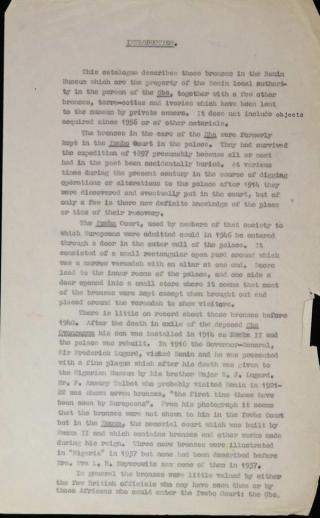
An archival document representing a Manuscript for publication of 59 page(s)
Manuscript for publication
Cadbury Research Library, University of Birmingham
Papers of Robert Elwyn Bradbury
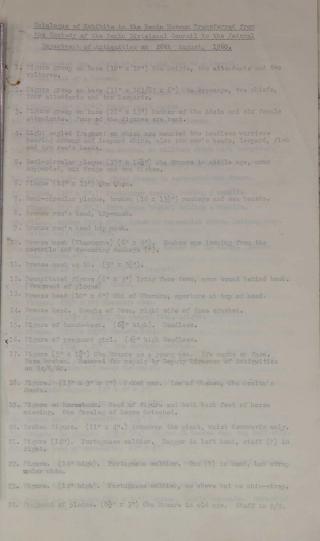
An archival document representing a Research notes of 49 page(s)
Research notesSketch
Cadbury Research Library, University of Birmingham
Papers of Robert Elwyn Bradbury
Date
August 26, 1960

Institution data

Omo n'Oba n'Edo Uku Akpolokpolo, Ọba of Benin & National Commission for Museums and Monuments, Nigeria
The data was transferred directly by the institution and digitized by Digital Benin in collaboration with the NCMM
Last updated: 2023-11-30
Languages: english, bini; edo
Institution fieldValue
Catalog Number
object id
79B:R:133
Dimension H (cm)
dimensions
28
Dimension W (cm)
dimensions
17
Dimension L (cm)
dimensions
26
Description
description
Urhotọ (altar tableau) are displayed on an ancestral altar dedicated to the Iy’Ọba, who was usually entitled to an Urhotọ in her ancestral shrine. Just like the Ọba, after her death, an altar was erected in her memory within Uselu Palace and Ọba Palace. These altars would be decorated with a collection of objects related to achievements in life. Urhotọ are usually placed on ancestral altars amid other typical altar objects, such as commemorative heads, bells and carved altar tusks. They are usually made up of a square or rectangular cast base with a square opening at the centre. The commemorated Ọba or Iy’Ọba is placed centrally, and attendants, courtiers and chiefs flank them on either side. The bases are usually decorated with a guilloche motif seen throughout the arts of the Benin royal court, and iconographic motifs such as elephant trunks ending in fists, mudfish and ram heads. Queen mother altar tableaux began being cast in the eighteenth century, a time when court arts flourished once again, after a period of turmoil in the seventeenth century (Ezra, 1992).
Object count
object count
1
Associated Guild
producer
Igun Ẹrọnmwọn
Production Place
production place
Benin City
URL
weblink
https://digitalbenin.org/catalogue/36_79BR133
Production Technique
production technique
Casting
P.N.
object id
Diameter
dimensions
Material
material
Title
designation
Date Made
date made
Inscription
inscriptions
fileNames
79BR133_2.jpg, 79BR133_3.jpg, 79BR133_1.jpg, 79BR133_4.jpg, 79BR133_5.jpg, 79BR133_6.jpg
Sensitive Content

Digital Benin collates digital material from institutions, and some of this material is inherently colonial and contains words, terms and phrases that are inaccurate, derogatory and harmful towards African and African diasporic communities. Catalogue transcriptions, book titles, exhibition titles and museum titles may contain harmful terms. We recognise the potential for the material to cause physical and mental distress as well as evoke strong emotions. Owing to the scale of the collection’s data, a process to implement sensitive-content warnings in the displayed data is still incomplete. The material within the catalogue does not represent Digital Benin’s views. Digital Benin maintains a strong anti-colonial, anti-racist position and affirms its support for centring the humanity of historically marginalised and disenfranchised communities. Read more about the background of this statement here