

Inventarnr
11-2
Edo designations
English designations
Altar Tableau
Categories
Altar & Shrine Objects
Location
Maximilianstraße 42, 80538 München, Germany
Loading...
Altar Tableau
Altar Tableau
Altar Tableau
Altar Tableau

Iconographies

8 annotations
Ẹkpẹn
Leopard

The Ẹkpẹn (leopard) is an animal that appears most often among the motifs decorating the Emwin Arhe (royal treasures). The Ẹkpẹn symbolises the valour and strength of the Ọba, as well as his political authority. The Benin people eulogise the Ọba as the ‘ẹkpẹn n'owa’ (leopard of the home).

When a hunter kills a leopard, he must say “ẹkpẹn n'oha” (I killed a bush leopard), as it is taboo to say that a hunter killed a leopard without specifying that it is a bush leopard, as otherwise this would “be tantamount to symbolically killing the king” (Nevadomsky 1988, p. 81). For this reason, leopards of the bush are called Atalakpa to distinguish them from those that represent the Ọba.

1 annotation
Ẹkpẹn
Colar Bead
Odigba
Coral beaded collar

Odigba (coral-beaded collar) is a rigid neck collar made of coral beads, worn as part of ceremonial attire only by senior princes who have been made Enigie (Inneh 2007, p. 107). Although Ibafe (2007, p. 43) argued that the Odigba was introduced during the Ogiso period (c. 900–c. 1170 AD) by Ogiso Ere, along with other symbolically important Emwin Arhe, such as the Ada (ceremonial sword) and the Ẹbẹn (ceremonial sword), this seems unlikely, as coral was only introduced in the late 15th century through trade with Portuguese merchants.

2 annotations
Odigba
Odigba
Ukpẹ ọkhọkhọ
Curved conical hairstyle worn by Iy'Ọba

The Ukpẹ ọkhọkhọ is a distinctive hairstyle and coral-beaded headdress worn by the Iy’Ọba. The headdress includes a projection called the ‘ede Iy’Ọba’, which indicates that “her spiritual potentialities are closer in quality to those of her ruling son than they are to the powers of the nobles” (Aigbe Eson and Ihama Iguneronmwon in Blackmun 1991, p. 60). The Iy’Ọba’s hairstyle and headdress are meant to resemble ukpe-okhue, or the curved parrot’s beak (Kaplan 1993).

Barbara Blackmun (1991, p. 60) argued that “Benin art is multivocal, and any depiction of the Iye Ọba [sic] is a reference to Idia. Every woman who holds the office of lye Ọba plays the part of Idia, the ideal model of an Ọba’s mother.” Wearing the Ukpẹ ọkhọkhọ is one of the ways the Iy’Ọba plays the role of Idia.

1 annotation
Ukpẹ ọkhọkhọ
Asa
Shield

Asa (shields) are a crucial attribute of warriors and warrior chiefs, forming part of their ceremonial and battle attire as represented on the Emwin Arhe (royal treasures). Asa were usually made from elephant or crocodile skin and used by warriors for protection during hand-to-hand combat (Osadolor 2001, p. 102). Interestingly, the form of Asa depicted on historic royal artefacts differs from those found in museum collections today, reflecting changes in shield shapes and designs over time.

1 annotation
Asa
Iy'Ọba
Queen Mother

In the 16th century, Ọba Ẹsigie established the title of Iy'Ọba (Queen Mother) in honour of his mother, Iy'Ọba Idia, for the crucial role she played in the Benin–Idah War (1515–16). She is often described as “the only woman who went to war” ( ).

The Iy'Ọba can usually be identified by her distinctive curved, conical hairstyle, known as Ukpẹ ọkhọkhọ, which is said to have been introduced by Iy'Ọba Idia (Kaplan 1993, p. 58). In addition, the Iy'Ọba was permitted to wear certain items of attire otherwise reserved for the Ọba, such as the Ewu ivie (coral-beaded shirt) and Ukpan obọ eva (crossed coral-beaded baldrics), as well as regalia associated with senior chiefs, including the Odigba (coral-beaded collar) and Udahae (coral-beaded forehead band) ( ).

Representations of the Iy'Ọba appear on ivory Emwin Arhe (royal treasures), including the five famous Uhunmwu-Ẹkuẹ (pendant masks) believed to depict Iy'Ọba Idia, as well as on a number of Aken'ni Elao (carved altar tusks). She is also represented in brass and bronze, including on Ikẹgobọ (altars to the hand) and Urhotọ (altar tableaux) made for Iy'Ọba shrines and altars ( ). In these representations, the Iy'Ọba is often accompanied by female attendants who form part of her retinue.

1 annotation
Iy'Ọba
Ubanu'hi / Obanu'hi
Ubanu'hi / Obanu'hi
Inifinity Symbol

The Ubanu'hi (infinity symbol) is a kind of guilloche or interlaced strapwork motif that can be angular or rounded. It was used by Edo artists in the decoration of many Emwin Arhe (royal treasures) and is ubiquitous in Benin royal arts. Ubanu'hi is a shortened form of “uba no Ọba ya de agbon ke ehimwin yi”, which means “the rope with which the Ọba ties the heaven and earth together” (pers. comm. Chief John Igbineweka Inneh n’Igbesawman, 2022). Similarly, Paula Ben-Amos Girshick (in Plankensteiner 2007, pp. 339, 341) described this as “Ọba n’iri agbon”, or the “rope of the world” pattern.

According to Ọbabanmu Ineh (in Blackmun 1984, p. 51), the use of this motif indicates that objects were carved by members of the Igbesanmwan. However, the motif is found on all types of Emwin Arhe (royal treasures), not only those made of ivory or wood. On the flanges of the Ama (relief plaques) alone, Kathryn Gunsch (2018, pp. 75–77) identified three different versions of the Ubanu'hi and, through her analysis of over 850 plaques, found that these different Ubanu'hi forms align with other characteristics, such as dimensions, the prevalence of ornamental motifs, and stylistic qualities. Together, these provide evidence, she argues, of different production groups among the plaque makers .

Kate Ezra (1992, pp. 209, 264) went on to argue that the use of these motifs indicates that certain objects were used in a “royal context” and were associated with “royal patronage”.

1 annotation
Ubanu'hi / Obanu'hi
Ẹrhu
Headwear

Many different kinds of Ẹrhu (headwear) are worn by the various figures depicted in the imagery of Benin royal artefacts. Through comparisons with ceremonial regalia still worn by chiefs and members of the royal court, including the Ọba himself, some Ẹrhu have been used to identify the different figures depicted. For example, the conical hat worn by high-ranking town chiefs as part of the pangolin regalia, still worn at ceremonies, is also visible on figures on some Ama-Ẹrọnmwọn (bronze relief plaques) ( ). Other examples include the distinctive bell-shaped helmet associated with the Iyasẹ ( ). Figures who wear a shallow-brimmed hat and a cross have been identified as Ewua or Ohensa priests ( ).

Different kinds of helmets and headwear were worn by warriors, reflecting the many different ranks and roles in the army at any given time, as well as developing trends that were in turn represented on Emwin Arhe created at different points in time. Warrior figures wearing helmets covered in cowrie shells were carved on the Aken'ni Elao (carved tusks) (Blackmun 1984, p. 330), yet on the brass Ama, warriors are sometimes depicted wearing helmets made from crocodile hide or horsehair with a front plate (Osadolor in Plankensteiner 2007, cat. no. 238, p. 457). Helmets made from horsehair with a front plate are one of the more common types represented on the Ama-Ẹrọnmwọn, and the demand for black horse tails was noted by both Portuguese and British traders during the late 17th and 18th centuries (Osadolor in Plankensteiner 2007, cat. no. 238, p. 457). Other warriors depicted on Ama-Ẹrọnmwọn wear helmets with a rounded top, chinstrap, and sometimes also a feather tucked into the left side. These types of headwear are known as Ẹrhu Iyokuo.

Attire worn for battle also differed from that worn for ceremonial occasions, such as the pointed headwear worn in combination with an ornate leopard-head tunic by war chiefs. Depictions of figures wearing this attire on brass Ama-Ẹrọnmwọn (bronze relief plaques) have been interpreted as representing the war chiefs’ participation in the war-ritual Isiokuo festival (Osadolor in Plankensteiner 2007, cat. no. 238, p. 457).

Another distinctive form of headwear is that worn by figures identified as leopard hunters on the brass Ama-Ẹrọnmwọn (relief plaques). These large helmets cover almost all of the leopard hunters’ faces except for their noses, eyes, and upper lips, and are made of an unusual material that remains unidentifiable (Plankensteiner 2007, cat. nos. 68–69, p. 322).

European figures are also portrayed with distinctive hats, such as Portuguese three-cornered hats. These depictions reflect the artists’ keen observation and highlight the impact of European trade and military assistance (Ezra 1992).

1 annotation
Ẹrhu

Provenance

6 events
Production
unknown to February 22, 1897 (day approximate)
The object was produced by Unknown member(s) of the Igun-Ẹrọnmwọn guild in Benin City.
Looted
February 22, 1897 (day approximate) to June 1899 (year approximate)
The object was looted by Unknown member of the British colonial military campaign on Benin - February 1897 from Benin Kingdom.
Unknown
February 22, 1897 (day approximate) to 1899
The object is known to have come into contact with Wilhelm Albert Maschmann, in Benin City and later Lagos.
Transfer
February 22, 1897 (day approximate) to 1898
The object was transferred from Wilhelm Albert Maschmann from Lagos to Hamburg.
Transfer
1899 to 1911
The object was transferred from Wilhelm Albert Maschmann to the Museum Fünf Kontinente, Staatliche Museen in Bayern in Hamburg.
Purchase
1911
The object was purchased by the Museum Fünf Kontinente, Staatliche Museen in Bayern from Maria Maschmann from Hamburg to Munich.

Related archival documents

2 documents
See all
Museum Catalogue
Staatsbibliothek zu Berlin
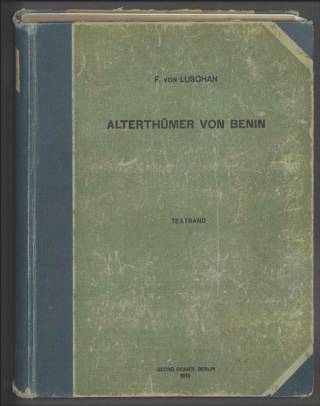
Die Altertümer von Benin
Date
January 1, 1919 at 12:00:00 AM
An archival document representing a Accession Records of 202 page(s)
Accession RecordInventory
Museum Fünf Kontinente, Staatliche Museen in Bayern
SMV-31 [1911 Inv.Nr. 11.1-11.1548]
Date
January 1, 1911

Institution data

Museum Fünf Kontinente, Staatliche Museen in Bayern
The data was transferred directly by the institution.
Last updated: 2022-05-22
Language: german
Institution fieldValue
Inventarnr
object id
11-2
Objektbezeichnung, Titel
designation
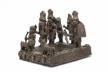
Figurengruppe mit Königinmutter (Iyoba)
Material
material
Kupferlegierung
Maße/Breite
dimensions
Maße/Durchmesser
dimensions
Maße/Höhe
dimensions
Maße/Länge
dimensions
Maße/Objektmaß
dimensions
27 x 28 x 34 cm
Maße/Tiefe
dimensions
Gewicht
weight
Datierung
date made
16. – 19. Jh.
Herkunft
production place
Benin Reich (Historische Region) (Afrika/Nigeria)
Beteiligte Personen/SammlerIn
prior source
Maschmann, Maria; Hamburg
Beteiligte Personen/VorbesitzerIn
prior source
Maschmann, Albert; Hamburg
Provenance
provenance
Eingangsdatum
accession date
1911
Erwerbungsart / Verbleib
accession method
Kauf
Copyright
license
Museum Fünf Kontinente, Nicolai Kästner (CC BY-NC-ND 4.0)
Beteiligte Personen/UrheberIn
Unbekannt
Sensitive Content

Digital Benin collates digital material from institutions, and some of this material is inherently colonial and contains words, terms and phrases that are inaccurate, derogatory and harmful towards African and African diasporic communities. Catalogue transcriptions, book titles, exhibition titles and museum titles may contain harmful terms. We recognise the potential for the material to cause physical and mental distress as well as evoke strong emotions. Owing to the scale of the collection’s data, a process to implement sensitive-content warnings in the displayed data is still incomplete. The material within the catalogue does not represent Digital Benin’s views. Digital Benin maintains a strong anti-colonial, anti-racist position and affirms its support for centring the humanity of historically marginalised and disenfranchised communities. Read more about the background of this statement here