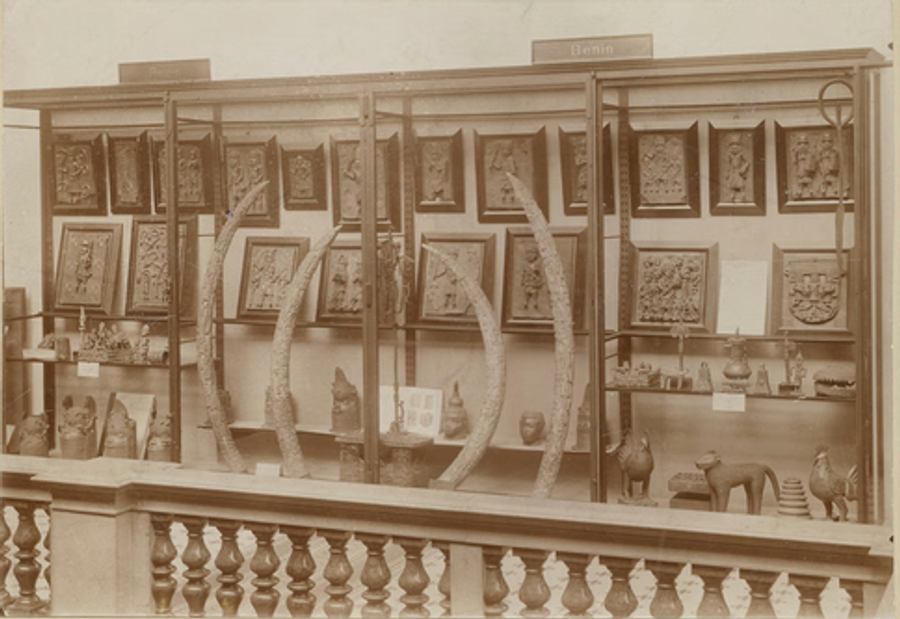
This is custom caption for the cover image with a link
Accounting for the Emwin arre before and after 1897: mapping locations and understanding the extent of the looting in Benin
follows that the historiography dedicated
o 1897 is overwhelming and has in the past been marked by some very different interpretations and points of view on the justifications for and the exact nature of the military activities led by British naval and Protectorate forces .
The looting itself has more often than not been described as a fairly monolithic event, principally associated with the space of the Oba's palace in the centre of Benin and the presence of
British naval forces who left the city in the following weeks (Igbafe, 1970; Hicks, 2020; Phillips, 2021; Docherty, 2022). Equally it remains associated with only a handful of colonial actors and well known transactions concerning specific groups of artefacts such as the brass ama (plaques) over a short time span.
a super caption with link
this is a caption
a good caption
Trends, timelines and the development of a market for Benin pieces
Although there was a close relationship between Colonial authorities and the staff who worked at museums during the late nineteenth and early twentieth centuries, no photolink participated directly in the British Military Campaign on Benin, unlike in other colonial military expansions such as the Abyssinian Campaign between 1867-8 (cf. Cormack 2025). Despite not being physically present in West Africa nor Benin City specifically, workers in museums in the UK and Germany undoubtedly played a clear and undeniable role in encouraging looting by others on the ground in order to fill the collections of the museums where they worked. They also played a crucial role in the further dispersals and (re)selling of ‘official’ spoils, such as the Foreign Office Ama-Ẹrọnmwọn, on the market and to others in their professional networks, as described in brief earlier (Coulson & Hudson, in preparation; Philips 2021, pp.89, 121-127).
Digital Benin collates digital material from institutions, and some of this material is inherently colonial and contains words, terms and phrases that are inaccurate, derogatory and harmful towards African and African diasporic communities. Catalogue transcriptions, book titles, exhibition titles and museum titles may contain harmful terms. We recognise the potential for the material to cause physical and mental distress as well as evoke strong emotions. Owing to the scale of the collection’s data, a process to implement sensitive-content warnings in the displayed data is still incomplete. The material within the catalogue does not represent Digital Benin’s views. Digital Benin maintains a strong anti-colonial, anti-racist position and affirms its support for centring the humanity of historically marginalised and disenfranchised communities. Read more about the background of this statement here