Emuru
The Emuru are a guild established during the reign of Ọba Ẹwuare I, who appointed its members to care for the sacred Uru (brass vessels). The Emuru are responsible for ensuring that the Uru are brought to the palace for the festivals and ceremonies in which they are required, including Ugie.
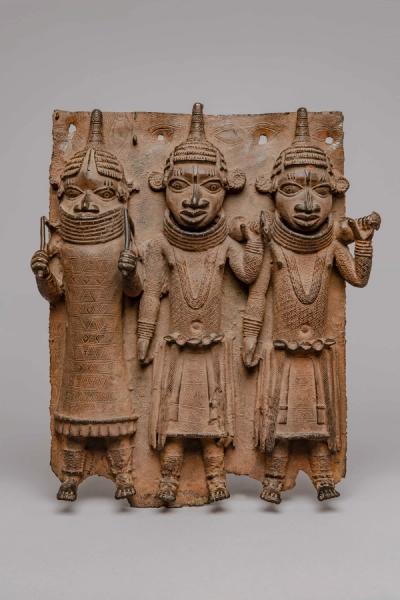
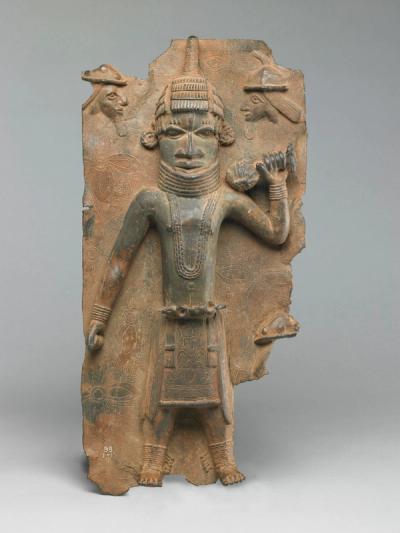
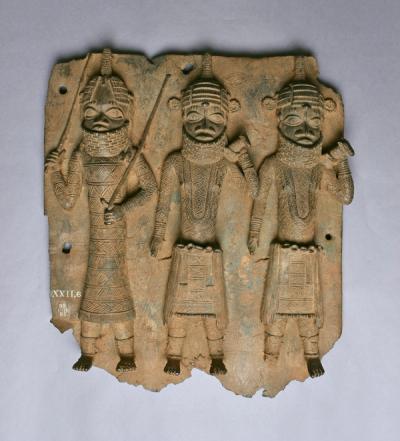
Members of the Emuru are represented on both Ama-Ẹrọnmwọn (bronze relief plaques) and Aken'ni Elao (carved tusks), although their appearance differs between the two media. On the Ama-Ẹrọnmwọn, artists from the Igun-Ẹrọnmwọn depict Emuru carrying sacred Uru topped with a ram’s-head finial and flanked by coiled braids. Like the Osa and Osuan, members of the guild were permitted to wear the tall Oro projection woven from itoto fibre extending from the crown. They also wear a chain around the hips and skirts with patterned sashes hanging down on either side ( ).
On Aken'ni Elao produced from the 18th century onward, however, the Emuru are generally depicted in a more simplified form. In all but one known example, they carry a simplified Uru without the ram’s-head finial, holding it directly in front of the torso rather than on the left shoulder. Their skirt-like garments are also replaced by what Blackmun describes as a “diaper-like” wrapper ( ). The single exception is an Aken'ni Elao dated to approximately 1730–1750. Here, the Emuru remain simplified, but the figures retain the Oro projection on their crowns; the characteristic coiled braids are absent and their clothing is likewise simplified.
Digital Benin collates digital material from institutions, and some of this material is inherently colonial and contains words, terms and phrases that are inaccurate, derogatory and harmful towards African and African diasporic communities. Catalogue transcriptions, book titles, exhibition titles and museum titles may contain harmful terms. We recognise the potential for the material to cause physical and mental distress as well as evoke strong emotions. Owing to the scale of the collection’s data, a process to implement sensitive-content warnings in the displayed data is still incomplete. The material within the catalogue does not represent Digital Benin’s views. Digital Benin maintains a strong anti-colonial, anti-racist position and affirms its support for centring the humanity of historically marginalised and disenfranchised communities. Read more about the background of this statement here