
Registration Number
Af1944,04.12
Institution
British Museum
Edo designations
English designations
Odudua Mask
Categories
Ceremonial Objects
Location
Great Russell St, Bloomsbury, London WC1B 3DG, United Kingdom
Loading...
Odudua Mask
Odudua Mask
Odudua Mask
Odudua Mask

Iconographies

6 annotations
snake
Ẹyẹn
Snake

Ẹyẹn (snakes) are among the most common animals depicted by Edo artists on the Emwin Arhe (royal treasures). The varied depictions of these reptiles suggest different snake species, including the Ikpin (python), Arhunmoto (puff adder), and Olose (red-black striped snake); therefore, here we use the generic term for snake: Ẹyẹn.

The identification of snake motifs and depictions as Ikpin, as well as the importance accorded to this species, is a subject of scholarly debate. Paula Ben-Amos (1976, p. 247) argued that the Edo admired the “stature, colouration and crushing power” of the python, which was in turn associated with Olokun. She went on to identify the brass figures of snakes that formerly adorned the roof of the palace, as well as several other snakes, as pythons. Joseph Nevadomsky (1988, p. 77) argued instead that the importance of the Ikpin had been overstated.

Some of these snake representations may in fact be the Arhunmwoto (puff adder). The first to suggest this was the German curator Felix von Luschan (1919) in his early research into the Benin royal treasures. Nevadomsky (1988, pp. 79–80) suggested that the large head, narrow neck, and rough scales are indicative of either the puff adder, a symbol of “material wealth, tribute, and gifts,” or the Gaboon viper.

Another kind of snake that may be depicted is the Olose (red-black striped snake). It has the praise name “king of the snakes” in Edo. Olose is also closely connected to the deity Olokun, both because of its attractiveness and because it inhabits wet environments such as forest streams, which in turn flow into rivers and the sea, where Olokun lives (Nevadomsky 1988, pp. 76–77). Although the exact meanings of these different snakes vary, they share the characteristic of being spiritually powerful creatures.

1 annotation
Ẹyẹn
alligator
Ẹghughu
Crocodile

In the riverine area surrounding Benin City, there are two types of crocodile. The Ẹghughu, known in English as the dwarf or bush crocodile, is believed to be more docile ( ; Ọbazee 2025, p. 133). The second type is the Àgbákà, the aggressive Nile crocodile ( ; Ọbazee 2025, p. 11).

Crocodiles are one of the important animals represented in the historical Emwin Arhe, and they are known as Olokun’s guards or the “policemen” of the waters. The powerful and ferocious qualities of these animals might explain why warrior figures are often depicted wearing Uhunmwu-Ẹkuẹ (pendant masks) in the shape of crocodile heads on Ama-Ẹrọnmwọn (bronze relief plaques) ( ). Olokun devotees use crocodiles as sacrificial animals in offerings during the worship of Olokun.

2 annotations
Ẹghughu
Ẹghughu
Ikharo
Forehead markings

Ikharo are linear keloid markings depicted on the forehead of Uhunmwu-Elao (commemorative heads) in groups of three or four above each eye. The exact meaning of Ikharo is debated; some have argued that they relate to the gender or tribal identification of the person on whom they are depicted. For example, has argued that they were worn only by men; however, their use in depictions is not consistent with this, and the Iy’Ọba are also shown wearing them. argued that they are instead a stylistic feature employed by artists that varied over time.

The naming of these markings differs between publications. For example, describe these markings as “agbaguda n'ehae”, which they write translates literally as “blades of the forehead”. However, later went on to call these “ikharo”, as used here. referred to these forehead markings as ikharo, meaning “tribal mark [of eye]”.

1 annotation
Ikharo
Uman-ague
Equal-armed cross

Uman-ague is a badge in the form of an equal-armed cross. The cross with straight-sided arms is known as the “Greek cross,” while the type with V-shaped arms, narrowing toward the centre, is known as the “Maltese cross.”

Uman-ague is usually worn around the neck by members of the Ewua or by the Ohensa ( ). The equal-armed cross has various meanings: as a symbol of cosmic order, it represents the number four and references the “four cardinal points established by the High God Osanobua when he created the world” (Girshick Ben-Amos 1999, p. 64), as well as the “crossroads or junction that serves as the point of connection between the natural and spiritual worlds” ( ). Paula Girshick Ben-Amos ( ) also argues that when used on the Aken'ni Elao (altar tusk), the cross, together with the Ivie okpagbaru (royal bead), constitutes an “emblematic reference” to Ọba Ẹsigie.

The cross also references the Portuguese missionaries who brought Christianity to the Kingdom during the reign of Ọba Ẹsigie, although the symbol was already in use before the arrival of Europeans ( ). The Maltese cross is thought to have been introduced by Ọba Eresonyẹn as part of his efforts to encourage the worship of the High God Osanobua during his reign ( ; ). Regardless, Uman-ague is often associated with Ọba Ẹsigie.

1 annotation
Uman-ague
Ikan Aro
Incised forehead markings

Ikan Aro are two linear markings in the centre of the forehead, located in between the eyes. These are usually inset with iron on depictions otherwise made of brass, bronze, ivory or wood.The use of iron was significant due the association of this metal with Ogun, who is god of iron and metal. These markings appear on both men and women, however are a common feature of representations of Iy'Oba Idia. Flora Kaplan (1993, 59) argued these are not tattoos, unlike the Ikharo. According to Nevadomsky (1986, 42), these incisions "signify determination, firmness, resolve, or even maturity". Kaplan (1993, 59) has also made a link between these markings and oral history told to her by Oba Erediauwa describing the events leading up to Idia (before she was Iy’Ọba) becoming the wife of Ọba Ozolua, whereby her parents tried to disfigure her to “repel” the Ọba. According to this history, the Ọba “sensing something was wrong”, called his doctors to intervene and treat her quickly, and as so she still became his wife.

1 annotation
Ikan Aro

Provenance

6 events
Production
unknown to February 22, 1897 (day approximate)
The object was produced by Unknown member(s) of the Igun-Ẹrọnmwọn guild in Benin City.
Looted
February 22, 1897 (day approximate) to June 1899 (year approximate)
The object was looted by Unknown member of the British colonial military campaign on Benin - February 1897 from Benin Kingdom.
Auction
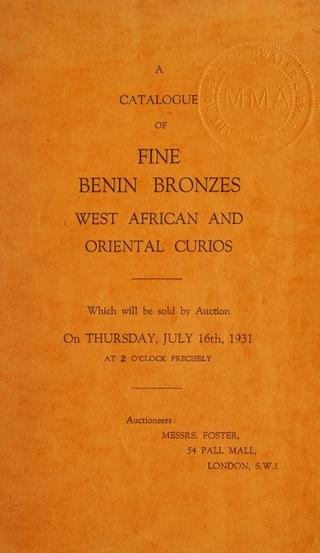
July 16, 1931
The object was auctioned to Irene Marguerite Beasley and Harry Geoffrey Beasley through Foster's in London.
Donation
some day in April 1944
The object was donated by Irene Marguerite Beasley to the British Museum from Chislehurst to British Museum.
Exhibition
1970 to 1973
The object was exhibited at London.
Exhibition
February 1, 1991 to April 30, 1991
The object was exhibited at Norwich.

Related archival documents

1 documents
See all
An archival document representing a Auction Catalog of 24 page(s)
Auction Catalogue
Metropolitan Museum of Art
Thomas J. Watson Library sales and auction catalogues
Date
July 16, 1931

Institution data

British Museum
The data was transferred directly by the institution.
Last updated: 2022-08-04
Language: english
Institution fieldValue
Registration Number
object id
Af1944,04.12
Object Name - Comment
designation
Object Name - Object Name
designation
helmet mask
Title
designation
Title translation
designation
Title type
designation
Object History Note / Acquisition Note
description
provenance
notes
Sold at auction on 16 July 1931 through Messrs Foster, The Galleries, Pall Mall, London, lot 160, to Harry Beasley. This object was previously in the collection of the Cranmore Ethnographical Museum established in 1928 by Harry Geoffrey Beasley and his wife Irene Marguerite Beasley. The Beasley collection was distributed following Harry Beasley’s death in 1939. This piece was part of the donation made by Irene Beasley to the British Museum in 1944.
Physical description
description
Odudua helmet mask; lost-wax cast in brass. In form of human head with tapering projection from top of head. Three vertical scarification marks above each eyebrow. Serpents and long-nosed crocodiles crawling down the projection and on cap. Serpents and crocodiles on chin. Under chin and on right and left sides of neck are crosses. Bottom of mask pierced with holes.
Material
material
brass
Material - Comment
material
Dimension
dimensions
H~W~X~M
Dimension comment
dimensions
~~~
Dimension measurement unit
dimensions
cm~cm~cm~kg
Dimension note
dimensions
Dimension value
dimensions
69.00~21.00~23.00~5.30
Dimension value end
dimensions
~~~
Inscription - Note
inscriptions
Inscription - Quoted
inscriptions
Inscription language
inscriptions
Inscription position
inscriptions
Inscription translation
inscriptions
Inscription type
inscriptions
Production date
date made
18thC
Production date - Comment
date made
Producer/Artist - Association
producer
Producer/Artist - Name
producer
Technique
production technique
lost-wax cast~pierced
Technique - Comment
production technique
~
Production place
production place
Benin City
Production place - Association
production place
M
Production place - Comment
production place
Production place - Site details
production place
Previous owner - Association
prior source
PO
Previous owner - Comment
prior source
Previous owner - Name
prior source
Beasley, Harry Geoffrey
Acquisition Funding Source Name
provenance
Acquisition Funding Source Name Association
provenance
Acquisition Funding Source Name Comment
provenance
Acquisition Name
provenance
Beasley, Irene Marguerite
Acquisition Name Association
provenance
D
Acquisition Name Comment
provenance
Excavation/Field Collection Note
provenance
Looted during the British to Benin City in 1897 where Dr Allman served as Principal Medical Officer.
Excavator/Field collector - Association
provenance
FC
Excavator/Field collector - Name
provenance
Allman, Robert
Associated event - Association
event
IU
Associated event - Event
event
Ododua masquerade at the Ague Osa ritual during New Yam festival (Ague)
Associated place
place collected
Associated place - Association
place collected
Findspot - Association
place collected
F
Findspot - Comment
place collected
Findspot - Place
place collected
Benin City
Findspot - Site details
place collected
Associated name - Association
reign associated name
Associated name - Comment
reign associated name
Associated name - Name
reign associated name
Associated ethnic name - Association
ethnic attribution
Associated ethnic name - Ethnic Name
ethnic attribution
Production ethnic name - Association
ethnic attribution
M
Production ethnic name - Comment
ethnic attribution
Production ethnic name - Ethnic Name
ethnic attribution
Edo
Responsible department
department and institution
E
Comment
notes
This male Ododua helmet mask cast in brass possibly dates to the eighteenth century and used to be one of the characters of the Ododua masquerade at the Ague Osa ritual, as part of the New Yam festival (Ague), an agricultural rite marking the end of the year. According to tradition, the Ododua royal masquerades were introduced under Oba Oresonyen's reign (c.1735), as a subsidiary performance to the New Yam festival. The Ododua masquerade is said to honour Ododua, the progenitor of the Benin royal dynasty, and the royal ancestors. The Ododua masks have important political significance which is suggested by their predominant royal symbolism. This mask represents a mythic healer. The iconography of the mask, including the serpents and crocodiles, as well as the grimace of the face, refers to the close relationship between the cosmological order or disorder, the natural world and kingship. It reflects also the symbolic relation between identified animal species and the powers of the king. The mask integrates also important Yoruba references including the name 'Odudua' which refers to the earth deity of the Yoruba people and founder of the ancient Ife.
Exhibitions Loans and Displays - Current and Past
exhibition history
Exhibited: 1970-1973, London, Museum of Mankind, Divine Kingship in Africa 1991 Feb-Apr, Norwich, Sainsbury Centre for Visual Arts, Man and Metal in Ancient Nigeria
Bibliographic reference - Citation
bibliography
Ben-Amos 1995~Blier 1998~Craddock & Picton 1986
Bibliographic reference - Comment
bibliography
~~
Bibliographic reference - Reference
bibliography
~~
Condition
condition
Good.
BM/Big No - Number
BM/Big No - Prefix
BM/Big No - item
Collection
DAMS Asset - Number
249943001;250017001;498405001;603708001
Other number
Other number - Comment
Other number type
PRN
School/Style
Subject - Comment
~~
Subject - Subject
reptile~crocodile~masquerade/party
calc acquisition link.spec acquisition date text
1944
Sensitive Content

Digital Benin collates digital material from institutions, and some of this material is inherently colonial and contains words, terms and phrases that are inaccurate, derogatory and harmful towards African and African diasporic communities. Catalogue transcriptions, book titles, exhibition titles and museum titles may contain harmful terms. We recognise the potential for the material to cause physical and mental distress as well as evoke strong emotions. Owing to the scale of the collection’s data, a process to implement sensitive-content warnings in the displayed data is still incomplete. The material within the catalogue does not represent Digital Benin’s views. Digital Benin maintains a strong anti-colonial, anti-racist position and affirms its support for centring the humanity of historically marginalised and disenfranchised communities. Read more about the background of this statement here