

Registration number
Af1909,0626.13
Institution
British Museum
Edo designations
English designations
Osun Staff
Categories
Staffs
Altar & Shrine Objects
Location
Great Russell St, Bloomsbury, London WC1B 3DG, United Kingdom
Loading...
Staff of Office
Staff of Office
Staff of Office
Staff of Office
Staff of Office
Staff of Office

Iconographies

9 annotations
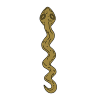
snake
Ẹyẹn
Snake

Ẹyẹn (snakes) are among the most common animals depicted by Edo artists on the Emwin Arhe (royal treasures). The varied depictions of these reptiles suggest different snake species, including the Ikpin (python), Arhunmoto (puff adder), and Olose (red-black striped snake); therefore, here we use the generic term for snake: Ẹyẹn.

The identification of snake motifs and depictions as Ikpin, as well as the importance accorded to this species, is a subject of scholarly debate. Paula Ben-Amos (1976, p. 247) argued that the Edo admired the “stature, colouration and crushing power” of the python, which was in turn associated with Olokun. She went on to identify the brass figures of snakes that formerly adorned the roof of the palace, as well as several other snakes, as pythons. Joseph Nevadomsky (1988, p. 77) argued instead that the importance of the Ikpin had been overstated.

Some of these snake representations may in fact be the Arhunmwoto (puff adder). The first to suggest this was the German curator Felix von Luschan (1919) in his early research into the Benin royal treasures. Nevadomsky (1988, pp. 79–80) suggested that the large head, narrow neck, and rough scales are indicative of either the puff adder, a symbol of “material wealth, tribute, and gifts,” or the Gaboon viper.

Another kind of snake that may be depicted is the Olose (red-black striped snake). It has the praise name “king of the snakes” in Edo. Olose is also closely connected to the deity Olokun, both because of its attractiveness and because it inhabits wet environments such as forest streams, which in turn flow into rivers and the sea, where Olokun lives (Nevadomsky 1988, pp. 76–77). Although the exact meanings of these different snakes vary, they share the characteristic of being spiritually powerful creatures.

2 annotations
Ẹyẹn
Ẹyẹn
Ikharo
Forehead markings

Ikharo are linear keloid markings depicted on the forehead of Uhunmwu-Elao (commemorative heads) in groups of three or four above each eye. The exact meaning of Ikharo is debated; some have argued that they relate to the gender or tribal identification of the person on whom they are depicted. For example, has argued that they were worn only by men; however, their use in depictions is not consistent with this, and the Iy’Ọba are also shown wearing them. argued that they are instead a stylistic feature employed by artists that varied over time.

The naming of these markings differs between publications. For example, describe these markings as “agbaguda n'ehae”, which they write translates literally as “blades of the forehead”. However, later went on to call these “ikharo”, as used here. referred to these forehead markings as ikharo, meaning “tribal mark [of eye]”.

1 annotation
Ikharo
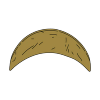
moon
Uki
Moon

The Uki (moon) is said to be associated with coolness, peace, and joy and to be more important than even Owẹn (the sun) ( ; ). The behaviour and nature of the moon were and are studied by the Iwoki, the guild of astrologists and meteorologists established by Ọba Esigie (c. 1504–50).

The Uki is usually depicted in crescent or half-moon form and appears on some of the Ama-Ẹrọnmwọn (bronze relief plaques), sometimes on its own as a corner motif and at other times as part of compositions with figures identified as being part of the Iwoki. Crescent forms of the moon are also used as part of the motifs decorating textiles and clothing worn by figures.

1 annotation
Uki
sun
Owẹn
Sun

This circular-shaped motif represents Owẹn (the sun). As with Uki (the moon) in its crescent or half-moon form—which this motif often appears alongside—the sun is associated with the Iwoki, the guild of astrologists and meteorologists established by Ọba Esigie (c. 1504–50). When depicted together, Owẹn and Uki are understood to be protective; just as the sun and the moon reach their destinations through the day and the night, so will those who use these symbols. Given these protective associations, artists often incorporated depictions of these dual motifs into the clothing of warriors ( ), for example, on the Ama-Ẹrọnmwọn (bronze relief plaques).

Additionally, a single Ama-Ẹrọnmwọn shows Owẹn and Uki as its central subjects, a unique occurrence that further indicates the importance of these motifs when depicted together.

The Owẹn motif is much less common than the sun in its rosette form, the latter being associated with the proverb Owẹn iba ẹdẹ ku (‘The Sun Never Misses a Day’ – Rosette).

1 annotation
Owẹn
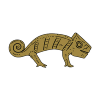
chameleon
Ẹrokhi
Chameleon

The Ẹrokhi (chameleon) carries several distinct and often potent meanings. The reptile is primarily associated with supernatural power, transformation, and long life, and is often depicted on objects associated with Osun, the deity of medicine. It is also considered one of the symbols of this deity ( ).

The supernatural power and transformative associations with the Ẹrokhi relate to the way the animal is seen as a symbol of the bush, due to its ability to camouflage itself. This capacity for camouflage has led to parallels being drawn between the Ẹrokhi and the Edo army, suggesting their ability to appear and disappear, as well as to adapt strategically. The skin of the Ẹrokhi is also believed to be poisonous, and the animal is associated with long life, as well as with the belief that anyone who depends on Osun will not die in battle.

Osogan (Osun staffs) decorated with Ẹrokhi walking up the length of the staff were carried into battle by Osun specialists, who walked ahead of the army, conveying their spiritual power and potency against the enemy. The praise name for these staffs is ‘osun-nigiogio’ (medicine hot-hot), indicating the dangerous and potent beliefs surrounding these staffs, to which chameleon motifs contribute ( ). Overall, the chameleon is a complex symbol that reinforces themes of mystical potency, endurance, and the transformative power wielded by the Ọba and those associated with Osun.

1 annotation
Ẹrokhi
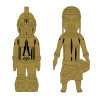
Ẹrhu
Headwear

Many different kinds of Ẹrhu (headwear) are worn by the various figures depicted in the imagery of Benin royal artefacts. Through comparisons with ceremonial regalia still worn by chiefs and members of the royal court, including the Ọba himself, some Ẹrhu have been used to identify the different figures depicted. For example, the conical hat worn by high-ranking town chiefs as part of the pangolin regalia, still worn at ceremonies, is also visible on figures on some Ama-Ẹrọnmwọn (bronze relief plaques) ( ). Other examples include the distinctive bell-shaped helmet associated with the Iyasẹ ( ). Figures who wear a shallow-brimmed hat and a cross have been identified as Ewua or Ohensa priests ( ).

Different kinds of helmets and headwear were worn by warriors, reflecting the many different ranks and roles in the army at any given time, as well as developing trends that were in turn represented on Emwin Arhe created at different points in time. Warrior figures wearing helmets covered in cowrie shells were carved on the Aken'ni Elao (carved tusks) (Blackmun 1984, p. 330), yet on the brass Ama, warriors are sometimes depicted wearing helmets made from crocodile hide or horsehair with a front plate (Osadolor in Plankensteiner 2007, cat. no. 238, p. 457). Helmets made from horsehair with a front plate are one of the more common types represented on the Ama-Ẹrọnmwọn, and the demand for black horse tails was noted by both Portuguese and British traders during the late 17th and 18th centuries (Osadolor in Plankensteiner 2007, cat. no. 238, p. 457). Other warriors depicted on Ama-Ẹrọnmwọn wear helmets with a rounded top, chinstrap, and sometimes also a feather tucked into the left side. These types of headwear are known as Ẹrhu Iyokuo.

Attire worn for battle also differed from that worn for ceremonial occasions, such as the pointed headwear worn in combination with an ornate leopard-head tunic by war chiefs. Depictions of figures wearing this attire on brass Ama-Ẹrọnmwọn (bronze relief plaques) have been interpreted as representing the war chiefs’ participation in the war-ritual Isiokuo festival (Osadolor in Plankensteiner 2007, cat. no. 238, p. 457).

Another distinctive form of headwear is that worn by figures identified as leopard hunters on the brass Ama-Ẹrọnmwọn (relief plaques). These large helmets cover almost all of the leopard hunters’ faces except for their noses, eyes, and upper lips, and are made of an unusual material that remains unidentifiable (Plankensteiner 2007, cat. nos. 68–69, p. 322).

European figures are also portrayed with distinctive hats, such as Portuguese three-cornered hats. These depictions reflect the artists’ keen observation and highlight the impact of European trade and military assistance (Ezra 1992).

1 annotation
Ẹrhu
Ubanu'hi / Obanu'hi
Ubanu'hi / Obanu'hi
Inifinity Symbol

The Ubanu'hi (infinity symbol) is a kind of guilloche or interlaced strapwork motif that can be angular or rounded. It was used by Edo artists in the decoration of many Emwin Arhe (royal treasures) and is ubiquitous in Benin royal arts. Ubanu'hi is a shortened form of “uba no Ọba ya de agbon ke ehimwin yi”, which means “the rope with which the Ọba ties the heaven and earth together” (pers. comm. Chief John Igbineweka Inneh n’Igbesawman, 2022). Similarly, Paula Ben-Amos Girshick (in Plankensteiner 2007, pp. 339, 341) described this as “Ọba n’iri agbon”, or the “rope of the world” pattern.

According to Ọbabanmu Ineh (in Blackmun 1984, p. 51), the use of this motif indicates that objects were carved by members of the Igbesanmwan. However, the motif is found on all types of Emwin Arhe (royal treasures), not only those made of ivory or wood. On the flanges of the Ama (relief plaques) alone, Kathryn Gunsch (2018, pp. 75–77) identified three different versions of the Ubanu'hi and, through her analysis of over 850 plaques, found that these different Ubanu'hi forms align with other characteristics, such as dimensions, the prevalence of ornamental motifs, and stylistic qualities. Together, these provide evidence, she argues, of different production groups among the plaque makers .

Kate Ezra (1992, pp. 209, 264) went on to argue that the use of these motifs indicates that certain objects were used in a “royal context” and were associated with “royal patronage”.

1 annotation
Ubanu'hi / Obanu'hi
tribal marks
Iwu
Facial and Body Markings

Iwu are facial and body markings (scarifications) that were historically worn by Edo men and women. However, since the 1960s, the practice has been nearly extinct (Aisien 2011). In the past, Iwu were used as a way of proving that one was an Edo citizen, and the ceremony of having Iwu completed was an important rite of passage for men and women. The Osiwu, who also practised circumcision and other surgical procedures, would carry out the procedure of adding Iwu. There are different types of Iwu: ‘blades’ worn on the torso (Iwu-eko), and those worn on the face, such as Ikharo (three or four markings above the eyebrows), Irho (two narrow ‘blades’ worn on each cheek), Ovbihue (nasal ‘blades’), Ovbi-agbanmwen (chin ‘blade’), and Igho-okpa/Ukpgho (three forehead ‘blades’) (Aisien 2011, p. 22).

The number of Iwu also varied depending on the identity of the person wearing them. For example, royal men would wear six ‘blades’ on their torso, whilst men who were not royal would wear seven ‘blades’. Meanwhile, the Ọba’s female children would wear fifteen ‘blades’, and all other women would wear sixteen (Aisien 2011).

1 annotation
Iwu

Provenance

6 events
Production
unknown to February 22, 1897 (day approximate)
The object was produced by Unknown member(s) of the Igun-Ẹrọnmwọn guild in Benin City.
Looted
February 22, 1897 (day approximate) to June 1899 (year approximate)
The object was looted by Unknown member of the British colonial military campaign on Benin - February 1897 from Benin Kingdom.
Unknown
1900s to June 26, 1909
The object is known to have come into contact with Alfred Walter Francis Fuller, later in London.
Purchase
June 26, 1909
The object was purchased by the British Museum from Alfred Walter Francis Fuller in London.
Exhibition
1970 to 1973
The object was exhibited at London.
Exhibition
sometime in 1993 to sometime in 1997
The object was exhibited at London.

Institution data

British Museum
The data was transferred directly by the institution.
Last updated: 2025-06-10
Language: english
Institution fieldValue
Registration number
object id
Af1909,0626.13
PRN
object id
EAF15149
Object Type
designation
staff
Description
description
Staff; lost-wax cast in brass.
Ethnic name (made by)
ethnic attribution
Edo
Date
16thC - 19thC
Production place
production place
Made in: Nigeria
Findspot
place collected
Found/Acquired: Benin City
Materials
material
brass
Technique
production technique
lost-wax cast
Dimensions
dimensions
Height: 148.50 cm~Width: 8.80 cm~Depth: 8.80 cm~Depth: 23.30 cm (max)~Weight: 9.30 kg
Exhibition history
exhibition history
Exhibited: 1970-1973, London, Museum of Mankind, Divine Kingship in Africa 1993-1997, London, Museum of Mankind, Great Benin: a West African Kingdom
Associated events
event
Associated Event: British to Benin City - Feb 1897
Acquisition name (acquisition)
provenance
Capt. A W F Fuller
Acquisition date
accession date
1909.0
Sensitive Content

Digital Benin collates digital material from institutions, and some of this material is inherently colonial and contains words, terms and phrases that are inaccurate, derogatory and harmful towards African and African diasporic communities. Catalogue transcriptions, book titles, exhibition titles and museum titles may contain harmful terms. We recognise the potential for the material to cause physical and mental distress as well as evoke strong emotions. Owing to the scale of the collection’s data, a process to implement sensitive-content warnings in the displayed data is still incomplete. The material within the catalogue does not represent Digital Benin’s views. Digital Benin maintains a strong anti-colonial, anti-racist position and affirms its support for centring the humanity of historically marginalised and disenfranchised communities. Read more about the background of this statement here