
Registration number
Af1903,1022.1
Institution
British Museum
Edo designations
English designations
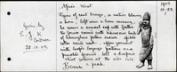
Hornblower or Fluteplayer Figure
Categories
Figures
Location
Great Russell St, Bloomsbury, London WC1B 3DG, United Kingdom
Loading...
Hornblower or Fluteplayer Figure

Iconographies

6 annotations
Ukpọn
Wrapper

Ukpọn is the Edo term for cloth (Aigbe 1985, p. 55; Ọbazee 2025, p. 542) and is used here to refer to the wrappers or kilts worn by many of the figures depicted on the Emwin Arre (royal treasures). The cloth worn around the waist may be plain, but it is more commonly richly decorated with motifs associated with the monarchy, power, and wealth, such as the Ọba'nui (infinity symbol) and Uhunme Ikpotoki (Portuguese heads).

The Benin Kingdom was renowned for its textile production, both for local use and for trade ( ). Within the royal court, members of the Owina n’Ido produced ukhuen cloth for the Ọba and other members of the court, who wore it as wrappers during festivals and ceremonies ( ).

Alongside locally produced textiles, imported cloth was also an important commodity in the Benin Kingdom’s trade networks. Textiles were exchanged with neighbouring production centres, particularly Ijebu ( ), while European traders brought silks, woollens, linens, and cotton from Europe and Asia from the 15th century onwards ( ).

1 annotation
Ukpọn
Ikpakohẹn
Fluteplayer or Hornblower

Hornblower and flute-player figures recur frequently in the visual language of Emwin Arhe (royal treasures), particularly on Ama-Ẹrọnmwọn (bronze relief plaques) and Aken’ni Elao (carved tusks). Horns and flutes made from ivory and brass have long been used in the Benin Kingdom, with ivory instruments continuing to be used today ( ).

Akohẹn are the largest type of horn and were used exclusively by the Ọba’s retainers before sacrifices in the palace. The Ikpakohẹn is a specialist hornblower responsible for playing the ivory Akohẹn, a role introduced during the reign of Ọba Eresonyẹn. According to Ọba Akẹnzua II, a group of six hornblowers from Use played these horns during Ugie (in Bradbury 1957, B.S. 85; ). Another type of horn, the Oko, was used by Ebo “to call witches and wizards to come to the crossroads” ( ).

Ọba Akẹnzua II (in Bradbury 1957, B.S. 85) also described the Eziken, a thin, side-blown fife or flute made from calabash or ivory. These instruments were played by members of the Ikpeziken, the guild of royal flute players, who performed as part of musical ensembles during ceremonies such as Ugie.

1 annotation
Ikpakohẹn
leopard teeth
Akọn Ẹkpen
Leopard Teeth Neck Ornament

Akọn Ẹkpẹn are necklaces or neck ornaments made of strung leopard’s teeth. They are worn by figures to signify their high rank and military prowess, as well as by their leaders, the Ezọmọ or Iyasẹ. They are often worn alongside quadrangular Ẹroro (bells) and Ohian Ẹkpẹn (leopard tunics).

The Akọn Ẹkpẹn is clearly and profoundly related to the symbolism of the Ẹkpẹn (leopard) and its association with the Ọba (king), who is metaphorically referred to as ‘ẹkpẹn ne owa’, the ‘leopard of the home’. On the other hand, the Ẹkpẹn is often referred to as the ‘king of the bush’, embodying ferocity, aggression, strength, and leadership—qualities attributed to the Ọba (Nevadomsky 1988). This intricate link between the leopard, the monarch, and his military leaders reinforces the complex hierarchy and spiritual authority central to Benin’s courtly art.

1 annotation
Akọn Ẹkpen
Abuwa
Hand of Wealth

Abuwa ornaments are made from red ododo cloth and are a symbol of wealth (Inneh 2007, pp. 110–111). ‘Abuwa’ is understood to translate directly as “hand of wealth” (Ezra 1992, p. 313). The Abuwa is worn at the waist by high-ranking chiefs as part of their ‘pangolin skin’ ceremonial regalia (Inneh 2007, p. 110) and continues to be worn today.

1 annotation
Abuwa
Oko/Akohẹn
Horn/Flute

Akohẹn, or ivory horns, are played by members of the Ikpakoen (guild of ivory hornblowers), while Oko, or flutes, are played by members of the Ikpeziken (guild of royal flute players). Among the Emwin Arhe (royal treasures), Oko and Akohẹn are usually depicted being played by brass-cast figures representing members of these guilds, and also appear on Ama-Ẹrọnmwọn (bronze relief plaques), Aken'ni Elao (carved altar tusks), and Urhotọ (altar tableau).

Today in Benin City, when a public procession leaves the palace, a court official may sound side-blown horns made from ivory. Historically, these instruments were also used during warfare, where they were played alongside Ema (drums) and Ẹroro (bells), producing a “cacophony of sound” whose “[t]he psychological effect of the barrage of noise magnified the size of Benin’s forces” ( ).

Some Oko/Akohẹn were also cast in brass by members of the Igun-Ẹrọnmwọn. However, these brass examples are understood not to have been functional instruments and could not have been blown like their ivory counterparts ( ).

1 annotation
Oko/Akohẹn
Ẹrhu
Headwear

Many different kinds of Ẹrhu (headwear) are worn by the various figures depicted in the imagery of Benin royal artefacts. Through comparisons with ceremonial regalia still worn by chiefs and members of the royal court, including the Ọba himself, some Ẹrhu have been used to identify the different figures depicted. For example, the conical hat worn by high-ranking town chiefs as part of the pangolin regalia, still worn at ceremonies, is also visible on figures on some Ama-Ẹrọnmwọn (bronze relief plaques) ( ). Other examples include the distinctive bell-shaped helmet associated with the Iyasẹ ( ). Figures who wear a shallow-brimmed hat and a cross have been identified as Ewua or Ohensa priests ( ).

Different kinds of helmets and headwear were worn by warriors, reflecting the many different ranks and roles in the army at any given time, as well as developing trends that were in turn represented on Emwin Arhe created at different points in time. Warrior figures wearing helmets covered in cowrie shells were carved on the Aken'ni Elao (carved tusks) (Blackmun 1984, p. 330), yet on the brass Ama, warriors are sometimes depicted wearing helmets made from crocodile hide or horsehair with a front plate (Osadolor in Plankensteiner 2007, cat. no. 238, p. 457). Helmets made from horsehair with a front plate are one of the more common types represented on the Ama-Ẹrọnmwọn, and the demand for black horse tails was noted by both Portuguese and British traders during the late 17th and 18th centuries (Osadolor in Plankensteiner 2007, cat. no. 238, p. 457). Other warriors depicted on Ama-Ẹrọnmwọn wear helmets with a rounded top, chinstrap, and sometimes also a feather tucked into the left side. These types of headwear are known as Ẹrhu Iyokuo.

Attire worn for battle also differed from that worn for ceremonial occasions, such as the pointed headwear worn in combination with an ornate leopard-head tunic by war chiefs. Depictions of figures wearing this attire on brass Ama-Ẹrọnmwọn (bronze relief plaques) have been interpreted as representing the war chiefs’ participation in the war-ritual Isiokuo festival (Osadolor in Plankensteiner 2007, cat. no. 238, p. 457).

Another distinctive form of headwear is that worn by figures identified as leopard hunters on the brass Ama-Ẹrọnmwọn (relief plaques). These large helmets cover almost all of the leopard hunters’ faces except for their noses, eyes, and upper lips, and are made of an unusual material that remains unidentifiable (Plankensteiner 2007, cat. nos. 68–69, p. 322).

European figures are also portrayed with distinctive hats, such as Portuguese three-cornered hats. These depictions reflect the artists’ keen observation and highlight the impact of European trade and military assistance (Ezra 1992).

1 annotation
Ẹrhu

Provenance

6 events
Production
unknown to February 22, 1897 (day approximate)
The object was produced by Unknown member(s) of the Igun-Ẹrọnmwọn guild in Benin City.
Looted
February 22, 1897 (day approximate) to June 1899 (year approximate)
The object was looted by Edward James Kennedy Cordner from Benin Kingdom.
Donation
October 22, 1903
The object was donated by Edward James Kennedy Cordner to the British Museum with its destination in London.
Exhibition
1970 to 1973
The object was exhibited at London.
Exhibition
sometime in 1993 to sometime in 1997
The object was exhibited at London.
Exhibition
1997 to 1998
The object was exhibited at Osaka, later moved to Tokyo.

Institution data

British Museum
The data was transferred directly by the institution.
Last updated: 2025-06-10
Language: english
Institution fieldValue
Registration number
object id
Af1903,1022.1
PRN
object id
EAF14759
Object Type
designation
figure
Description
description
Sculpture of standing male figure blowing horn; lost-wax cast in brass.
Ethnic name (made by)
ethnic attribution
Edo
Date
16thC
Production place
production place
Made in: Benin City
Findspot
place collected
Found/Acquired: Benin City
Materials
material
brass
Technique
production technique
lost-wax cast
Dimensions
dimensions
Height: 62.50 cm~Width: 36.00 cm~Depth: 19.00 cm~Weight: 27.20 kg
Curator’s comments
provenance
Published on acquisition by T A Joyce in 'Man' 1903 no.105 (p.185).
Exhibition history
exhibition history
Exhibited: 1970-1973, London, Museum of Mankind, Divine Kingship in Africa 1993-1997, London, Museum of Mankind, Great Benin: a West African Kingdom 1997-1998 Sep-Jan, Osaka, National Museum of Ethnology, Images of Other Cultures 1998, Feb-Apr, Tokyo, Setagaya Art Museum, Images of Other Cultures
Subjects
iconography
musical instrument
Associated events
event
Associated Event: British to Benin City - Feb 1897
Acquisition name (acquisition)
provenance
E J K Cordner
Acquisition date
accession date
1903.0
Sensitive Content

Digital Benin collates digital material from institutions, and some of this material is inherently colonial and contains words, terms and phrases that are inaccurate, derogatory and harmful towards African and African diasporic communities. Catalogue transcriptions, book titles, exhibition titles and museum titles may contain harmful terms. We recognise the potential for the material to cause physical and mental distress as well as evoke strong emotions. Owing to the scale of the collection’s data, a process to implement sensitive-content warnings in the displayed data is still incomplete. The material within the catalogue does not represent Digital Benin’s views. Digital Benin maintains a strong anti-colonial, anti-racist position and affirms its support for centring the humanity of historically marginalised and disenfranchised communities. Read more about the background of this statement here