


Iconographies


Provenance
Institution data
| Institution field | Value |
|---|---|
ObjectNumber_Original object id | VO_98167 |
NativeTitle edo designation | |
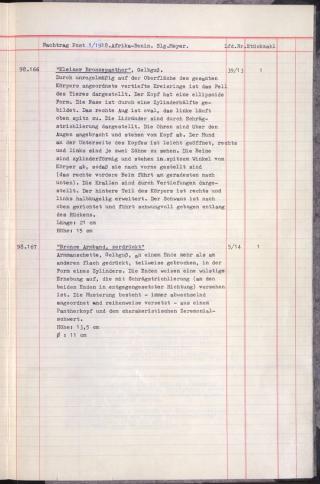
TextEntry description | Diese Armmanschette ist Teil der historischen Sammlungen aus dem Königreich Benin im heutigen Nigeria. 1897 wurde das Königreich erobert und dessen Oba (König) Ovonramwen ins Exil verbannt. Die aus dem Königspalast geraubten Kunstschätze wurden anschließe |
Medium material | Gelbguss |
Medium_en material | Brass |
ObjectName object type | Armmanschette |
ObjectName_en object type | Armcuff |
DateBegin date made | 1700 |
DateEnd date made | 1800 |
Dated date made | 18. Jahrhundert |
Dated_en date made | 18th century |
Period date made | |
Term production place | Afrika südlich der Sahara |
Term2 production place | West-Afrika |
Term3 production place | Nigeria |
Term4 production place | Benin |
Thesaurus production place | Afrika südlich der Sahara/West-Afrika/Nigeria/Benin |
Provenance provenance | |
Role_person provenance | Sammlung-Collection-Hans Meyer| |
Culture ethnic attribution | Edo, Benin Königreich |
Culture_en ethnic attribution | Edo, Benin Kingdom |
CreditLine department and institution | Weltmuseum Wien |
Department department and institution | MVK Objekte - Afrika südlich der Sahara |
Zugangsdatum accession date | 1918 |
LocationString display status | Raum Me.40 |
FileName images | VO_98167_x.jpg| |
PrimaryImage images | VO_98167_x.jpg |
Classification | || |
DepartmentID | 35 |
Department_cut | Afrika südlich der Sahara |
DisplayOrder | | |
Last_Modified | 2021-12-06 08:15:34 |
LocationID | 75091 |
ObjectID | 579502 |
ObjectNumber | 98167 |
PublicAccess | 1 |
SortNumber | VO 98167 |
TextDate_en | | |
TextEntryHTML | Diese Armmanschette ist Teil der historischen Sammlungen aus dem Königreich Benin im heutigen Nigeria. 1897 wurde das Königreich erobert und dessen Oba (König) Ovonramwen ins Exil verbannt. Die aus dem Königspalast geraubten Kunstschätze wurden anschließe |
TextEntryHTML_en | This Armcuff is part of the historical collections from the Benin Kingdom, in present-day Nigeria. In 1897, the kingdom was conquered and Oba (king) Ovonramwen banned into exile. The loot from the royal palace was then sold through the art market to finan |
TextEntry_en | This Armcuff is part of the historical collections from the Benin Kingdom, in present-day Nigeria. In 1897, the kingdom was conquered and Oba (king) Ovonramwen banned into exile. The loot from the royal palace was then sold through the art market to finan |
cxrDisplayOrder | 1| |
Digital Benin collates digital material from institutions, and some of this material is inherently colonial and contains words, terms and phrases that are inaccurate, derogatory and harmful towards African and African diasporic communities. Catalogue transcriptions, book titles, exhibition titles and museum titles may contain harmful terms. We recognise the potential for the material to cause physical and mental distress as well as evoke strong emotions. Owing to the scale of the collection’s data, a process to implement sensitive-content warnings in the displayed data is still incomplete. The material within the catalogue does not represent Digital Benin’s views. Digital Benin maintains a strong anti-colonial, anti-racist position and affirms its support for centring the humanity of historically marginalised and disenfranchised communities. Read more about the background of this statement here