Reg No.
43017
Edo designations
English designations
Armcuff
Categories
Ceremonial Regalia
Location
1 Adesogbe (Plymouth) Road, P.M.B. 1115, Benin City , Edo State
Loading...
Armcuff

Iconographies

2 annotations
Ugianranran
Manilla

Ugianranran (manillas) are highly important objects in the visual language of the Emwin Arhe (royal treasures). Although Ugianranran were made in a variety of sizes, forms, and weights, they share the characteristics of being made from copper or copper alloys, namely brass or bronze, and having a curved, ring- or horseshoe-shaped form.

In the early years of trade between the Portuguese and Edo, during the late 15th and early 16th centuries, manillas were made primarily of copper. During the early 16th century, Edo traders increasingly sought manillas made of brass. This changing preference is believed to have corresponded with the growing demand for brass among artists of the Igun-Ẹrọnmwọn ( ). During the 17th and early 18th centuries, the Dutch also traded manillas with the Edo, although to a lesser extent than the Portuguese. Recent scientific analysis has shown similarities between the composition of metals in manillas from the southern Rhineland region of Germany and the copper alloys used in some Emwin Arhe, supporting earlier scholarship suggesting that manillas were used by casters to produce Emwin Arhe (Skowronek et al. 2023).

When depicted on objects, Ugianranran are often shown alongside or being held by figures identified as Portuguese. In one case, figures identified as Benin traders or royal emissaries are shown holding manillas in their hands ( ). This is particularly the case on the Ama-Ẹrọnmwọn (bronze relief plaques), which are believed to have been commissioned by Ọba Esigie. Esigie is understood to have encouraged the production of artworks, made possible in part by the increased supply of manillas and other copper-alloy objects resulting from trade ( ). Ugianranran are therefore associated with overseas trade, wealth, and Olokun, the deity of the seas ( ). In addition to being held by figures or appearing alongside them on artworks, Ugianranran sometimes serve as focal decorative motifs, further indicating their symbolic and economic potency.

1 annotation
Ugianranran
Ẹkpẹn
Leopard

The Ẹkpẹn (leopard) is an animal that appears most often among the motifs decorating the Emwin Arhe (royal treasures). The Ẹkpẹn symbolises the valour and strength of the Ọba, as well as his political authority. The Benin people eulogise the Ọba as the ‘ẹkpẹn n'owa’ (leopard of the home).

When a hunter kills a leopard, he must say “ẹkpẹn n'oha” (I killed a bush leopard), as it is taboo to say that a hunter killed a leopard without specifying that it is a bush leopard, as otherwise this would “be tantamount to symbolically killing the king” (Nevadomsky 1988, p. 81). For this reason, leopards of the bush are called Atalakpa to distinguish them from those that represent the Ọba.

1 annotation
Ẹkpẹn

Provenance

5 events
Production
unknown to February 22, 1897 (day approximate)
The object was produced by Unknown member(s) of the Igbesamwan guild in Benin City.
Looted
February 22, 1897 (day approximate) to June 1899 (year approximate)
The object was looted by Unknown member of the British colonial military campaign on Benin - February 1897 from Benin Kingdom.
Purchase
1930 (approximate) to 1934
The object was purchased by Louis Carré and Charles Alfred Marius Ratton with its destination in Paris.
Purchase
March 23, 1944
The object was purchased by the Rautenstrauch-Joest-Museum from Louis Carré through Hildebrand Gurlitt from Paris to Cologne.
Restitution
December 8, 2022
The object was restituted by the Rautenstrauch-Joest-Museum to the Omo n'Oba n'Edo Uku Akpolokpolo, Ọba of Benin & National Commission for Museums and Monuments, Nigeria from Cologne to Nigeria.

Related archival documents

1 documents
See all
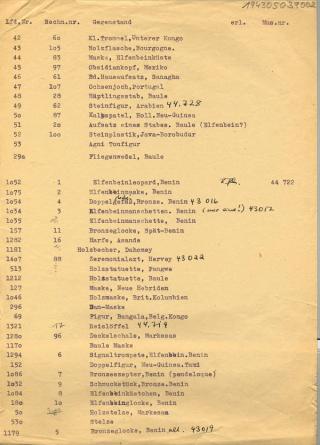
An archival document representing a Inventories of 1 page(s)
Inventory
Rautenstrauch-Joest-Museum
194305

Institution data

Rautenstrauch-Joest-Museum
The data was transferred directly by the institution.
Last updated: 2022-07-27
Language: english
Institution fieldValue
Additional Ids
object id
194305
Additional Ids / bundle
object id
RJM 1943/05
Other numbers
object id
Reg No.
object id
43017
Reg. No / Inventory number
object id
RJM 43017
Object name
designation
object type
arm cuff depicting Europeans
Object name / Title
designation
Arm Cuff
materials
material
ivory
Dimension/s
dimensions
H.12.80cm W.9cm X. 8.20cm
previous owner/collector
prior source
Hildebrand Gurlitt
provenance
provenance
from 23.03.1944, Rautenstrauch-Joest Museum (purchase); until 23.03.1944, Hildebrand Gurlitt (1895-1956) (consignment); probably 1934 - 1944, Louis Carré (17.12.1897 - 11.09.1977), Paris (place) (purchase)
Institution
department and institution
Rautenstrauch-Joest Museum - Cultures of the World, Cologne
Institution acquisition date
accession date
3/23/44
Acquisition details
accession method
purchase
comments
notes
The Konvolut 1943/05 runs under Dr. med. Hildebrand Gurlitt, although Gurlitt was probably not a previous owner in the true sense, but middleman, the transport of the objects selected in the occupied Paris by museum director Martin Heydrich. Acquired in Paris in 1944; through Art Cabinet Hildebrand Gurlitt, Hamburg / Dresden
Copyright
license
© Museumsgesellschaft RJM Köln, Foto Uli Grohs
notes concerning "other numbers"
Sensitive Content

Digital Benin collates digital material from institutions, and some of this material is inherently colonial and contains words, terms and phrases that are inaccurate, derogatory and harmful towards African and African diasporic communities. Catalogue transcriptions, book titles, exhibition titles and museum titles may contain harmful terms. We recognise the potential for the material to cause physical and mental distress as well as evoke strong emotions. Owing to the scale of the collection’s data, a process to implement sensitive-content warnings in the displayed data is still incomplete. The material within the catalogue does not represent Digital Benin’s views. Digital Benin maintains a strong anti-colonial, anti-racist position and affirms its support for centring the humanity of historically marginalised and disenfranchised communities. Read more about the background of this statement here