





Information from catalogue/Number
ABDUA:64906
Edo designations
English designations
Commemorative Head
Categories
Altar & Shrine Objects
Heads
Location
1 Adesogbe (Plymouth) Road, P.M.B. 1115, Benin City , Edo State
Loading...
Commemorative Head
Commemorative Head
Commemorative Head
Commemorative Head
Commemorative Head
Commemorative Head
Commemorative Head
Commemorative Head
Commemorative Head
Commemorative Head
Commemorative Head
Commemorative Head
Commemorative Head
Commemorative Head
Commemorative Head
Commemorative Head

Iconographies

6 annotations
Ititi ako
Star beads

The Ititi ako is a cluster of coral beads, usually three or four, attached to a pin and used to embellish the royal crowns on Uhunmwu-Elao (commemorative heads) and Uhunmwu-Ẹkuẹ (pendant masks). These bead clusters are also known as star beads, which indicate the prosperous destiny of an individual or wearer. Apart from enhancing the appearance of the wearer, they also represent the individual’s high social status. Judging from their presence on a variety of head sculptures, both men and women wore Ititi ako.

1 annotation
Ititi ako
Ikharo
Forehead markings

Ikharo are linear keloid markings depicted on the forehead of Uhunmwu-Elao (commemorative heads) in groups of three or four above each eye. The exact meaning of Ikharo is debated; some have argued that they relate to the gender or tribal identification of the person on whom they are depicted. For example, has argued that they were worn only by men; however, their use in depictions is not consistent with this, and the Iy’Ọba are also shown wearing them. argued that they are instead a stylistic feature employed by artists that varied over time.

The naming of these markings differs between publications. For example, describe these markings as “agbaguda n'ehae”, which they write translates literally as “blades of the forehead”. However, later went on to call these “ikharo”, as used here. referred to these forehead markings as ikharo, meaning “tribal mark [of eye]”.

1 annotation
Ikharo
Colar Bead
Odigba
Coral beaded collar

Odigba (coral-beaded collar) is a rigid neck collar made of coral beads, worn as part of ceremonial attire only by senior princes who have been made Enigie (Inneh 2007, p. 107). Although Ibafe (2007, p. 43) argued that the Odigba was introduced during the Ogiso period (c. 900–c. 1170 AD) by Ogiso Ere, along with other symbolically important Emwin Arhe, such as the Ada (ceremonial sword) and the Ẹbẹn (ceremonial sword), this seems unlikely, as coral was only introduced in the late 15th century through trade with Portuguese merchants.

1 annotation
Odigba
Beaded Crown
Ẹde
Beaded Crown

Although many other members of the Benin royal court wore a variety of hats and forms of headwear, only the Ọba may wear the Ẹde (beaded crown). The Ọba must never be seen bare-headed, and successive Ọbas introduced different styles and types of crowns ( ).

Across different media and objects, Ọbas are depicted wearing various types of crowns, all elaborately crafted from coral beads. Some feature tall projections rising from the crown, known as Oro, while others have curved projections extending from either side of the head, known as the winged cap. The latter was introduced only in the 19th century, most likely by Ọba Osẹmwẹndẹ ( ). Depictions of Ọba Esigie on Ama-Ẹrọnmwọn (bronze relief plaques) show him wearing an elaborate crown decorated with large jasper or coral beads ( ).

1 annotation
Ẹde
Ughavan
Celts

Ughavan (celts) are often seen as part of the decoration along the flanges of the Uhunmwu-Elao (commemorative heads), alongside trunk hand, leopard, or cow’s head motifs, or held in the left hand of the Ọba on the Ikẹgobọ (altar to the hand). This imagery has a particular meaning: when the Ọba holds the Ughavan in his left hand, it is said to be known instead as isauan (faeces of thunder) and is believed to “increase the potency of a curse or a blessing” ( ).

1 annotation
Ughavan
cattle (dwarf mutu cow)
Ẹmila
Cattle (dwarf mutu cow)

Ẹmila are used mainly for social functions. Although, they maybe used by some affluent chiefs and the royal palace for ceremonial purposes

1 annotation
Ẹmila

Provenance

6 events
Production
unknown to February 22, 1897 (day approximate)
The object was produced by Unknown member(s) of the Igun-Ẹrọnmwọn guild in Benin City.
Looted
February 22, 1897 (day approximate) to June 1899 (year approximate)
The object was looted by Unknown member of the British colonial military campaign on Benin - February 1897 from Benin Kingdom.
Unknown
1928 (approximate) to 1951
The object is known to have come into contact with Sydney Bernard Burney, in London.
Unknown
1928 (approximate) to March 18, 1957
The object is known to have come into contact with H. B. Bell-Syer.
Auction
March 18, 1957
The object was auctioned to Aberdeen University by H. B. Bell-Syer through Sotheby's in London.
Restitution
October 28, 2021
The object was restituted by the Museums and Special Collections, University of Aberdeen to the Omo n'Oba n'Edo Uku Akpolokpolo, Ọba of Benin & National Commission for Museums and Monuments, Nigeria from Aberdeen to Nigeria.

Institution data

Omo n'Oba n'Edo Uku Akpolokpolo, Ọba of Benin & National Commission for Museums and Monuments, Nigeria
The data was transferred directly from Museums and Special Collections, University of Aberdeen and given to the NCMM without restrictions. The NCMM gave permission to Digital Benin to display this data.
Last updated: 2022-02-07
Language: english
Institution fieldValue
Archival documentation ID
object id
ABDUA:64906
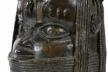
Exceptional commemorative head of a king
description
Edo, Kingdom of Benin, Nigeria, late 18th century Cast bronze, the base with interlaced ornament and a series of animal figures in high relief, a high cylinder of bead necklaces enveloping the neck and chin, the face with full lips and angular nose, recessed pupils to the large eyes, three keloids in relief above each hatched brow, adorned with a pearl punctuating the middle of the forehead, the latticework beaded headdress with four attached clusters of five beads and two diagonal beads to the front, beaded tassels cast in relief before and behind the ears and joining the base, a large aperture at the top of the head for the insertion of ivory tusks, dark patina
Provenance:
provenance
British Benin Punitive 1897 Mr. Sidney Burney 1878 - 1951 Mr. H.B. Bell-Syer Sotheby’s, London, 18th March 1957, lot 196 Aberdeen University, acquired at the above
Note:
notes
The present piece is a superb example of Benin Late Period Art. The cylindrical shape, extended beaded collar covering the chin, addition of bead clusters to the crown and wide flange at the base all suggest a late eighteenth-century date. The form is that of uhunmwun-elao, representing an oba. He is identified by the royal crown (ede), the frontal band (udahae) adorned with a pearl punctuating the middle of the forehead and a multi-row necklace (odigba), all composed of coral beads. The beautiful tension of the face projected forward is accentuated by the large eyes staring intently onwards. There is exceptional quality of casting, with fine detailing and modelling throughout.
For a similar example please see:
Segy, L. African Sculpture Speaks. Fig. 103
fileNames
abdua-64906.jpg, abdua-64906_1.jpg, abdua-64906_2.jpg, abdua-64906_3.jpg, abdua-64906_4.jpg, abdua-64906_5.jpg, abdua-64906_6.jpg, abdua-64906_7.jpg, abdua-64906_8.jpg, abdua-64906_9.jpg, abdua-64906_10.jpg, abdua-64906_11.jpg, abdua-64906_12.jpg, abdua-64906_13.jpg, abdua-64906_14.jpg, abdua-64906_15.jpg
Sensitive Content

Digital Benin collates digital material from institutions, and some of this material is inherently colonial and contains words, terms and phrases that are inaccurate, derogatory and harmful towards African and African diasporic communities. Catalogue transcriptions, book titles, exhibition titles and museum titles may contain harmful terms. We recognise the potential for the material to cause physical and mental distress as well as evoke strong emotions. Owing to the scale of the collection’s data, a process to implement sensitive-content warnings in the displayed data is still incomplete. The material within the catalogue does not represent Digital Benin’s views. Digital Benin maintains a strong anti-colonial, anti-racist position and affirms its support for centring the humanity of historically marginalised and disenfranchised communities. Read more about the background of this statement here