


Iconographies


Provenance
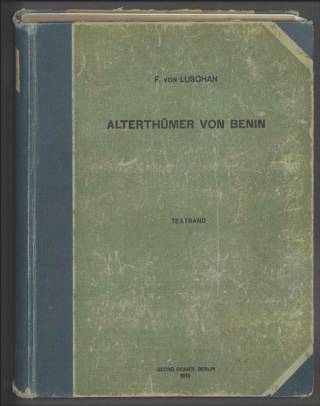
Institution data
| Institution field | Value |
|---|---|
Identifikationsnummer object id | C 3347 |
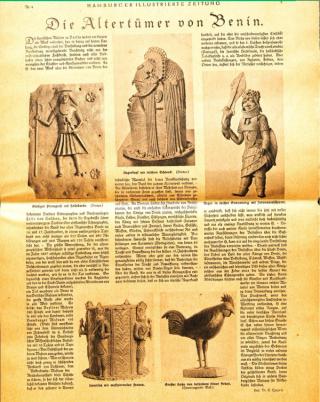
Titel designation | Altarfigur eines Hahns, Bronze |
Materialien material | ANORGANISCH/Metall/Gelbguß |
Heutiges Staatsgebiet des Herstellungsortes production place | Afrika/Westafrika/Nigeria/Benin-Reich |
Provenienz/Name prior source provenance | Riedemann |
Provenienz Objektitinerar Akteure Orte Daten provenance | Wilhelm Anton Riedemann |
Provenienz/Affiliation provenance | DAPG, today Esso |
Provenienz/Country provenance | Germany |
Provenienz/Date of Birth provenance | 08.12.1832 |
Provenienz/Date of Death provenance | 20.01.1920 |
Provenienz/First Name provenance | Wilhelm Anton (von) |
Provenienz/No provenance | 31 |
Provenienz/Place of Birth provenance | Meppen |
Provenienz/Place of Death provenance | Lugano |
Provenienz/Profession provenance | Merchant |
Provenienz/Role-Function/0 provenance | Consignor |
Provenienz/Role-Function/1 provenance | Collector |
Provenienz/Sex provenance | male |
Provenienz/Short Biography provenance | Wilhelm Anton (von) Riedemann was a North German merchant and pioneer in the field of tanker shipping. As a freight haulier, Riedemann was active in the oil business and operated a shipping company. Riedemann was one of the co-founders of the Hamburg-based German-American Petroleum Company (DAPG), which became known as “Esso” in 1950. In 1902, he donated an altar figure of a rooster from the Kingdom of Benin to the MARKK. |
Provenienz/Street provenance | Alsterufer 27 |
Provenienz/Town provenance | Hamburg |
Hersteller kulturhist. Herkunftsgesellschaft ethnic attribution | --/Edo |
Heutiger Aufbewahrungsort Sammlung department and institution | Museum am Rothenbaum. Kulturen und Künste der Welt (MARKK) |
Akquisitionsdatum accession date | 1902 |
Alte Inventarnummer | |
Inventurdatum | 23.07.2015 |
Label Text (deu) | Altarfigur eines Hahns Okpa Unbekannte Werkstatt der Bronzegießergilde Igun Eronmwon / Königreich Benin, Nigeria, 17./18. Jh. / Gelbguss / Schenkung Wilhelm Anton Riedemann, 1902, Inv. Nr. C 3347 In Benin wird die ranghöchste Frau des Oba als „der Hahn, der am lautesten kräht“ bezeichnet. Ihr Titel Eson n'Erie und ihre Funktion findet sich auch in den Mehrfrauen-Haushalten hochrangiger Würdenträger. Sie ist immer die älteste unter den Frauen eines Mannes. Der Vergleich mit dem Hahn unterstreicht ihre Führungsposition. Hahnenfiguren sollen auf den Ahnenaltären der Iyoba, der Königinmutter, gestanden haben. |
Label Text (eng) | Altar Figure: Rooster Okpa Unidentified workshop of the Bronze Casters Guild Igun Eronmwon / Benin Kingdom, Nigeria, 17th/18th century / Brass / Donated by Wilhelm Anton Riedemann, 1902, Inv. no. C 3347 In Benin, the highest-ranking wife of the Oba is called “the rooster that crows the loudest.” Her title, Eson n’Erie, and her function are also found in the multiple-wife households of high-ranking dignitaries. She is always the oldest among a man’s wives. The comparison with the rooster underlines her position of leadership. Figures of roosters are said to have stood on the ancestral altars of Iyoba, the queen mother. |
Maße | Höhe: 44,00 cm; Breite: 44,00 cm |
Digital Benin collates digital material from institutions, and some of this material is inherently colonial and contains words, terms and phrases that are inaccurate, derogatory and harmful towards African and African diasporic communities. Catalogue transcriptions, book titles, exhibition titles and museum titles may contain harmful terms. We recognise the potential for the material to cause physical and mental distress as well as evoke strong emotions. Owing to the scale of the collection’s data, a process to implement sensitive-content warnings in the displayed data is still incomplete. The material within the catalogue does not represent Digital Benin’s views. Digital Benin maintains a strong anti-colonial, anti-racist position and affirms its support for centring the humanity of historically marginalised and disenfranchised communities. Read more about the background of this statement here