

Identifikationsnummer
C 2391
English designations
Pendant Plaque
Categories
Ceremonial Regalia
Location
1 Adesogbe (Plymouth) Road, P.M.B. 1115, Benin City , Edo State
Loading...
Pendant Plaque
Pendant Plaque
Pendant Plaque

Iconographies

5 annotations
Bead
Ivie
Beads

The Benin people use beads as one of their most important ceremonial body ornaments. There are coral and stone beads, which came mostly from long distance trade. The bead workers of Benin kingdom are called Enisen and they specialise in the art of bead making, particularly the royal regalia. Different types of beads are also worn for various ceremonies. The greatest honour anyone can get in Benin kingdom and from the Oba is to be decorated with a bead, the Ikele - a symbol of nobility.

1 annotation
Ivie
TBC_Royal Triad
Royal Triad

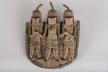
The Royal Triad is a motif composed of three figures, with a central figure supported on either side by two others. The motif has multiple meanings and interpretations. When understood on the human level, the central seated or standing figure is identified as the Ọba, flanked by two Enobare who each support one of his arms. This pose “encapsulates Edo ideals of kingship,” in which “even the most powerful of Benin's divinely ordained rulers cannot stand alone. He must maintain a careful balance between his authority over the Edo people and their acquiescence in his leadership” ( ). The identities of the supporting Enobare are interpreted variously. They have been identified as the Osa and Osuan, who support the Ọba in this manner during the Ugie Oro and Ododua festivals, although it is possible that the Edaiken (crown prince) and Ezọmọ performed these roles during the 18th century ( ).

In some examples, the central figure has mudfish in place of legs. These figures have sometimes been interpreted as representations of the deity Olokun ( ). Barbara Blackmun (1984, pp. 274–275) alternatively suggested that the triad may represent the high god Osanobua, his son and deity Olokun, and Olokun’s child, Ohen, who in turn represents the Ọba.

The number three is considered an “uncanny” number in Edo thought and “is never used lightly” ( ), being associated with the “threat of occult sanctions or forces” ( ).

The Royal Triad appears on almost all Aken'ni Elao (carved tusks), as well as on some Ẹgogo (gongs) and pendant plaques, and less frequently on Ama-Ẹrọnmwọn (bronze relief plaques). The motif is also referred to as the “supporting triad motif” or “linked supporting triad motif” ( ).

1 annotation
TBC_Royal Triad
Ọba
King

The Ọba is the monarch of the Edo people and Kingdom. The current reigning monarch, Ọba Ẹwuare II, is the fortieth Ọba of the current dynasty, which is traditionally understood to have begun around 1170 AD ( ). Over the centuries, the role and conception of the monarch have shifted, and the Emwin Arre (royal treasures) and the visual language they carry provide important evidence for understanding these developments. Although Emwin Arhe served a variety of functions within court life and ritual, “their primary purpose was to glorify the godlike king and the history of the powerful empire” (Plankensteiner 2007, p. 25). Representations of the Ọba are therefore ubiquitous across Benin court arts and frequently occupy a central position within their visual language.

Representations of the Ọba can be recognised through a combination of characteristics, including his size, as he is usually depicted larger than other figures, and his position within compositions, where he may appear in front of or be supported by other figures, as in the Royal Triad motif. The Ọba is also distinguished by particular items of regalia, including the Oro projection from his crown, the distinctive beaded swag extending from his right hip, the Ewu ivie (coral-beaded shirt), and Ukpan obọ eva (crossed coral-beaded baldrics).

Since the early 20th century, scholars have sought to identify individual Ọbas represented on Emwin Arhe by analysing the regalia and other attributes of figures identified as monarchs, as well as the combinations of motifs and figures appearing on particular objects. Oral traditions and historical accounts, alongside European archival sources, have also played an important role in determining the identities of specific Ọbas (e.g., , ; ). Just as the institution of the monarchy developed and changed over time, so too did the ways in which Ọbas were represented by artists working within the royal guilds, including the Igun-Ẹrọnmwọn and Igbesamwan.

1 annotation
Ọba
Colar Bead
Odigba
Coral beaded collar

Odigba (coral-beaded collar) is a rigid neck collar made of coral beads, worn as part of ceremonial attire only by senior princes who have been made Enigie (Inneh 2007, p. 107). Although Ibafe (2007, p. 43) argued that the Odigba was introduced during the Ogiso period (c. 900–c. 1170 AD) by Ogiso Ere, along with other symbolically important Emwin Arhe, such as the Ada (ceremonial sword) and the Ẹbẹn (ceremonial sword), this seems unlikely, as coral was only introduced in the late 15th century through trade with Portuguese merchants.

2 annotations
Odigba
Odigba

Provenance

6 events
Production
unknown to February 22, 1897 (day approximate)
The object was produced by Unknown member(s) of the Igun-Ẹrọnmwọn guild in Benin City.
Looted
February 22, 1897 (day approximate) to June 1899 (year approximate)
The object was looted by Unknown member of the British colonial military campaign on Benin - February 1897 from Benin Kingdom.
Unknown
1899 (approximate)
The object is known to have come into contact with John Lembcke, in Benin City.
Transfer
1899 (approximate)
The object was transferred from John Lembcke through L. Pagenstecher & Co. from Benin City to Hamburg.
Purchase
1899
The object was purchased by the MARKK Museum am Rothenbaum Kulturen und Künste der Welt from John Lembcke in Hamburg.
Restitution
December 16, 2022
The object was restituted by the MARKK Museum am Rothenbaum Kulturen und Künste der Welt to the Omo n'Oba n'Edo Uku Akpolokpolo, Ọba of Benin & National Commission for Museums and Monuments, Nigeria through Carsten Brosda, S.E. Yusuf Maitama Tuggar, Abba Isa Tijani and Barbara Plankensteiner from Hamburg to Nigeria.

Institution data

MARKK Museum am Rothenbaum Kulturen und Künste der Welt
The data was transferred directly by the institution.
Last updated: 2022-06-10
Languages: german, english
Institution fieldValue
Identifikationsnummer
object id
C 2391
Titel
designation
Anhänger, König mit zwei ihn stützenden Würdenträgern
Materialien
material
ANORGANISCH/Metall/Gelbguß
Heutiges Staatsgebiet des Herstellungsortes
production place
Afrika/Westafrika/Nigeria/Benin-Reich
Provenienz/Name
prior source
provenance
Lembcke
Provenienz Objektitinerar Akteure Orte Daten
provenance
John Lembcke
Provenienz/Affiliation
provenance
L. Pagenstecher & Co.
Provenienz/Country
provenance
Germany
Provenienz/Date of Birth
provenance
19.03.1873
Provenienz/Date of Death
provenance
unknown
Provenienz/First Name
provenance
John
Provenienz/No
provenance
25
Provenienz/Place of Birth
provenance
Provenienz/Place of Death
provenance
unknown
Provenienz/Profession
provenance
Merchant
Provenienz/Role-Function/0
provenance
Consignor
Provenienz/Role-Function/1
provenance
Provenienz/Sex
provenance
male
Provenienz/Short Biography
provenance
John Lembcke (1873-?) originally came from Mecklenburg and was a Hamburg merchant. He worked as an agent for the trading company L. Pagenstecher & Co. in southern Nigeria. The company maintained several branches in Cameroon and Nigeria and traded raw rubber, among other things.Lembcke was probably employed at a branch of the firm in Warri, from where he went to nearby Benin City. There, he found objects which he eventually brought to Hamburg. Between 1899 and 1905, he sold 40 objects from the Kingdom of Benin to the museum.
Provenienz/Street
provenance
Hammmerlandstr. 75 II (Address Mrs. C. Lembcke, widow)
Provenienz/Town
provenance
Hamburg
Hersteller kulturhist. Herkunftsgesellschaft
ethnic attribution
--/Edo
Heutiger Aufbewahrungsort Sammlung
department and institution
Museum am Rothenbaum. Kulturen und Künste der Welt (MARKK)
Akquisitionsdatum
accession date
1899
Alte Inventarnummer
Inventurdatum
23.07.2015
Label Text (deu)
Anhänger mit königlicher Triade Unbekannte Werkstatt der Bronzegießergilde Igun Eronmwon / Königreich Benin, Nigeria, 16./17. Jh. / Gelbguss / Ankauf von John Lembcke, 1899, Inv. Nr. C 2391 Anhänger mit Triadendarstellung wurden früher zu je drei Stück vom Oba und von bestimmten Würdenträgern um die Körpermitte getragen. Die kleinen Ösen entlang der Ränder hielten Kettchen mit Schellen. Auf der Brust des Oba in der Mitte der Dreiheit ist die große Königsperle sichtbar, ein Symbol seiner Herrschaft.
Label Text (eng)
Pendant with Royal Triad Unidentified workshop of the Bronze Casters Guild Igun Eronmwon / Benin Kingdom, Nigeria, 16th/17th century / Brass / Acquired from John Lembcke, 1899, Inv. no. C 2391 Pendants with a royal triad were once worn in groups of three around the waist by the Oba and certain dignitaries. The small loops along the edges held chains of crotals. The Oba in the middle of the trinity is distinguished by the large king’s bead, a signifier of his supremacy.
Maße
Höhe: 19,00 cm; Breite: 15,30 cm
Sensitive Content

Digital Benin collates digital material from institutions, and some of this material is inherently colonial and contains words, terms and phrases that are inaccurate, derogatory and harmful towards African and African diasporic communities. Catalogue transcriptions, book titles, exhibition titles and museum titles may contain harmful terms. We recognise the potential for the material to cause physical and mental distress as well as evoke strong emotions. Owing to the scale of the collection’s data, a process to implement sensitive-content warnings in the displayed data is still incomplete. The material within the catalogue does not represent Digital Benin’s views. Digital Benin maintains a strong anti-colonial, anti-racist position and affirms its support for centring the humanity of historically marginalised and disenfranchised communities. Read more about the background of this statement here