

Object Number
1991.17.106
Edo designations
English designations
Altar Tusk
Categories
Altar & Shrine Objects
Location
1000 5th Ave, New York, NY 10028, United States
Loading...

Iconographies

23 annotations
Ubanu'hi / Obanu'hi
Ubanu'hi / Obanu'hi
Inifinity Symbol

The Ubanu'hi (infinity symbol) is a kind of guilloche or interlaced strapwork motif that can be angular or rounded. It was used by Edo artists in the decoration of many Emwin Arhe (royal treasures) and is ubiquitous in Benin royal arts. Ubanu'hi is a shortened form of “uba no Ọba ya de agbon ke ehimwin yi”, which means “the rope with which the Ọba ties the heaven and earth together” (pers. comm. Chief John Igbineweka Inneh n’Igbesawman, 2022). Similarly, Paula Ben-Amos Girshick (in Plankensteiner 2007, pp. 339, 341) described this as “Ọba n’iri agbon”, or the “rope of the world” pattern.

According to Ọbabanmu Ineh (in Blackmun 1984, p. 51), the use of this motif indicates that objects were carved by members of the Igbesanmwan. However, the motif is found on all types of Emwin Arhe (royal treasures), not only those made of ivory or wood. On the flanges of the Ama (relief plaques) alone, Kathryn Gunsch (2018, pp. 75–77) identified three different versions of the Ubanu'hi and, through her analysis of over 850 plaques, found that these different Ubanu'hi forms align with other characteristics, such as dimensions, the prevalence of ornamental motifs, and stylistic qualities. Together, these provide evidence, she argues, of different production groups among the plaque makers .

Kate Ezra (1992, pp. 209, 264) went on to argue that the use of these motifs indicates that certain objects were used in a “royal context” and were associated with “royal patronage”.

1 annotation
Ubanu'hi / Obanu'hi
Ehẹn
Fish

Ehẹn is a general term used to describe various types of fish (Ọbazee 2025, p. 90; ). Although mudfish are one of the most common motifs in Benin art, other kinds of fish are also represented. According to Blackmun ( ), a greater variety of fish are represented on the Aken'ni Elao (carved tusks) than on other types of royal artefacts. According to Kathy Curnow ( ), fish appear on 70 Ama-Ẹrọnmwọn (bronze relief plaques), making them the most commonly represented animal. Despite their prevalence, the precise species of fish are not easy to identify due to their “generic renderings”, possibly indicating that artists did not always distinguish between specific varieties ( ). Fish are represented on the Ama-Ẹrọnmwọn both in profile and from above.

1 annotation
Ehẹn
Ugianranran
Manilla

Ugianranran (manillas) are highly important objects in the visual language of the Emwin Arhe (royal treasures). Although Ugianranran were made in a variety of sizes, forms, and weights, they share the characteristics of being made from copper or copper alloys, namely brass or bronze, and having a curved, ring- or horseshoe-shaped form.

In the early years of trade between the Portuguese and Edo, during the late 15th and early 16th centuries, manillas were made primarily of copper. During the early 16th century, Edo traders increasingly sought manillas made of brass. This changing preference is believed to have corresponded with the growing demand for brass among artists of the Igun-Ẹrọnmwọn ( ). During the 17th and early 18th centuries, the Dutch also traded manillas with the Edo, although to a lesser extent than the Portuguese. Recent scientific analysis has shown similarities between the composition of metals in manillas from the southern Rhineland region of Germany and the copper alloys used in some Emwin Arhe, supporting earlier scholarship suggesting that manillas were used by casters to produce Emwin Arhe (Skowronek et al. 2023).

When depicted on objects, Ugianranran are often shown alongside or being held by figures identified as Portuguese. In one case, figures identified as Benin traders or royal emissaries are shown holding manillas in their hands ( ). This is particularly the case on the Ama-Ẹrọnmwọn (bronze relief plaques), which are believed to have been commissioned by Ọba Esigie. Esigie is understood to have encouraged the production of artworks, made possible in part by the increased supply of manillas and other copper-alloy objects resulting from trade ( ). Ugianranran are therefore associated with overseas trade, wealth, and Olokun, the deity of the seas ( ). In addition to being held by figures or appearing alongside them on artworks, Ugianranran sometimes serve as focal decorative motifs, further indicating their symbolic and economic potency.

1 annotation
Ugianranran
Ebo
European Figures

During the late 15th century, European visitors began arriving in Benin City and subsequently played important roles in trade, the military, religion, and belief. Edo artists incorporated a range of figures understood to represent Europeans into the visual language of Emwin Arre (royal treasures). These depictions served in part to communicate the power and reach of the Benin monarchy, making the “greatness of ruler and realm more palpable” and demonstrating that the Ọba’s authority extended beyond his own people to those who came from distant lands ( ).

European visitors came from a number of countries, including the Netherlands, Britain, France, and Italy. Portuguese visitors, however, had the most extensive and enduring influence, which is particularly evident in the visual language of Benin royal arts ( ).

European figures were incorporated into Ama-Ẹrọnmwọn (bronze relief plaques), dating primarily to the 16th and 17th centuries, and Aken'ni Elao (carved tusks), dating from the 17th to the 19th centuries. They are typically depicted with straight, shoulder-length hair and/or beards, rounded cap-like headwear, heavily pleated skirts, and jerkins ( ). These figures often appear alongside other motifs associated with European trade and contact, such as Ugianranran (manillas) and horses, or with warfare, such as firearms. In addition to full-length figures, the Uhunmwu Ikpotoki (Portuguese head) was incorporated into a wide range of objects, most likely as a symbol of power and wealth associated with overseas trade and, by extension, with Olokun, the deity of the sea.

European figures also became part of the visual language developed by the Emada, palace pages whose carving tradition differed from that of the royal guild of wood and ivory carvers, the Igbesamwan. Although the precise origins of the Emada carving tradition are uncertain, it is thought to have developed during the reign of Ọba Adolo, and many surviving examples are therefore dated to the 19th century. Their representations of Europeans differ from the conventions used in earlier depictions understood to represent Portuguese visitors. Rather than wearing pleated skirts and jerkins, these later figures are typically shown in suits, wide-brimmed hats, and smoking pipes, and may carry straighter, sabre-like swords, guns, or umbrellas.

1 annotation
Ebo
Ukhurhẹ
Ancestral Staff

Representations of figures, often the Ọba, with an Ukhurhẹ (Ancestral Staff) in their right hand recur in a number of Emwin Arre (royal treasures), particularly those carved in wood as Agba (royal stools), cast in brass as part of Osogan (Osun staffs) and Ikẹgobọ (altars to the hand), and carved in ivory as Aken'ni Elao (carved tusks).

Ukhurhẹ are rattle staffs, usually made from wood, although brass examples are believed to have been owned by the Ọba. Ukhurhẹ were, and continue to be, commissioned when the paternal head of a family passes away as a way of commemorating them ( ). Following a ceremony in which they are installed on the family’s ancestral altar, Ukhurhẹ are typically lined up against the back of the altar and are used to communicate with ancestors and the spirit world. When depicted on the Emwin Arhe, Ukhurhẹ are usually held in the right hand of the Ọba, while an Ughavan (celts) is carried in his left hand.

2 annotations
Ukhurhẹ
Ukhurhẹ
snake
Ẹyẹn
Snake

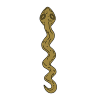
Ẹyẹn (snakes) are among the most common animals depicted by Edo artists on the Emwin Arhe (royal treasures). The varied depictions of these reptiles suggest different snake species, including the Ikpin (python), Arhunmoto (puff adder), and Olose (red-black striped snake); therefore, here we use the generic term for snake: Ẹyẹn.

The identification of snake motifs and depictions as Ikpin, as well as the importance accorded to this species, is a subject of scholarly debate. Paula Ben-Amos (1976, p. 247) argued that the Edo admired the “stature, colouration and crushing power” of the python, which was in turn associated with Olokun. She went on to identify the brass figures of snakes that formerly adorned the roof of the palace, as well as several other snakes, as pythons. Joseph Nevadomsky (1988, p. 77) argued instead that the importance of the Ikpin had been overstated.

Some of these snake representations may in fact be the Arhunmwoto (puff adder). The first to suggest this was the German curator Felix von Luschan (1919) in his early research into the Benin royal treasures. Nevadomsky (1988, pp. 79–80) suggested that the large head, narrow neck, and rough scales are indicative of either the puff adder, a symbol of “material wealth, tribute, and gifts,” or the Gaboon viper.

Another kind of snake that may be depicted is the Olose (red-black striped snake). It has the praise name “king of the snakes” in Edo. Olose is also closely connected to the deity Olokun, both because of its attractiveness and because it inhabits wet environments such as forest streams, which in turn flow into rivers and the sea, where Olokun lives (Nevadomsky 1988, pp. 76–77). Although the exact meanings of these different snakes vary, they share the characteristic of being spiritually powerful creatures.

1 annotation
Ẹyẹn
Ise vbe eigho
Proclamation Staff

The Isẹ vbe ẹigho is a type of proclamation staff held by the Ọba during the two main annual ceremonies in the Edo calendar: Igue and Ugie Erha Ọba. Its form resembles that of the Ẹgogo (gong), but it has a longer handle and a distinctive horizontal cross at the base of the V-shaped upper section. In depictions on Emwin Arre (royal treasures), the Ọba alone carries the Isẹ vbe ẹigho, usually in his left hand, while holding the Ebẹn (ceremonial sword) in his right. Such representations appear on carved wooden Agba (ceremonial stools), Aken'ni Elao (carved ivory tusks), and cast-brass representations of the Ọba.

The staff is emblematic of the Ọba’s power and authority (Ben-Amos Girschick 2007, p. 158; ). Together with the coral-beaded regalia worn during these ceremonies, the Isẹ vbe ẹigho is understood to confer upon the Ọba the power to swear oaths and pronounce curses.

1 annotation
Ise vbe eigho
king with mudfish legs
TBC_Ọba Ohẹn
King with Mudfish Legs

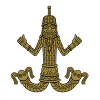
This motif of an Ọba with legs represented as two mudfish is often interpreted as Ọba Ohẹn, who reigned c. 1334–1370. According to oral traditions, Ohẹn suffered from paralysis of the legs and unsuccessfully attempted to conceal his condition from the chiefs and members of the royal court. The Iyasẹ Emuze eventually hid in the Ọba’s chambers to discover his secret ( ). When Ohẹn discovered this, he ordered the Iyasẹ to be executed. However, the people learned of the order and turned against the Ọba. According to the tradition, they plotted to kill him ritually by digging a hole beneath his throne and stoning him with Orhue (white kaolin chalk) when he fell into it ( ; ).

Not all representations of an Ọba with mudfish legs, however, are understood to refer to Ohẹn. Variations in the objects and animals carried by the figure are thought to indicate different meanings ( ; ). Members of the Igbesamwan and Igun-Ẹrọnmwọn have emphasised the significance of these accompanying motifs (Blackmun 1984, pp.249–255). When the mudfish-legged Ọba is shown holding aquatic creatures such as crocodiles, for example, the image has been interpreted as a “cosmological image” representing the correspondence between the two monarchs: the Ọba of Benin, ruler of the land, and Olokun, ruler of the waters ( ). By contrast, representations in which the Ọba holds swords or staffs have been interpreted specifically as depictions of Ọba Ohẹn.

2 annotations
TBC_Ọba Ohẹn
TBC_Ọba Ohẹn
Ukpan obọ eva
Crossed Beaded Baldrics

The Ukpan obọ eva (coral-bead crossed baldrics) were worn as part of the ehaingbehia, the full ceremonial regalia, by only high-ranking members of the palace, including the Ọba himself, the Iy’Ọba, the Edaiken, and the Ezọmọ (Ben-Amos 1999, pp. 68, 141; Osadolor in Plankensteiner 2007, cat. no. 70, pp. 322–323).

2 annotations
Ukpan obọ eva
Ukpan obọ eva
Ewi
Mudfish

Depictions of Ewi (mudfish) are among the most frequent motifs in the Emwin Arhe (royal treasures). Mudfish hold an important place in Edo belief, both as representations of the god Olokun and as symbols of royalty (Plankensteiner 2007, p. 410), as well as of “prosperity, peace, well-being and fertility” (Ben-Amos 1976, p. 245). Mudfish are also particularly common animals for sacrifice, and mudfish-shaped Orhiẹvbẹ (kola-nut boxes) were used to make offerings or store kola nuts.

Yet, the appearance of Ewi across the Emwin Arhe is not consistent, and it has been argued that different species of mudfish were depicted by Edo artists, each with different qualities and capabilities. For example, the electric shock of Malapterurus electricus resembles the fierceness of the Ọba, while the liminal qualities of the Synodontis clarias mudfish, which lives both on land and in water, similarly reflect the Ọba’s rule over land and sea (Gallagher 1983, p. 93). With these different qualities in mind, the mudfish is an important symbol of Benin kingship and royalty.

Sometimes the Ọba was depicted by artists with mudfish rather than legs (see Ọba with Mudfish Legs).

1 annotation
Ewi
Uzo
Antelope

These motifs are sometimes interpreted as Uzo (antelopes) but also as Emila (cows). Both animals share certain characteristics, being regarded as physically beautiful and peaceful creatures. Some Orhiẹvbẹ (kola-nut bowls) take the form of an antelope head with its horns grasped by a pair of hands, a gesture that symbolises the right of humans to sacrifice antelopes and cows with impunity (Ben-Amos Girschick 2007, cat. no. 88, pp. 339, 341).

Uzo primarily symbolise beauty, docility, and their status as permissible sacrificial animals, reinforcing themes of human control over nature and the rituals that underpin social and spiritual order.

1 annotation
Uzo
alligator
Ẹghughu
Crocodile

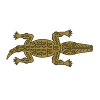
In the riverine area surrounding Benin City, there are two types of crocodile. The Ẹghughu, known in English as the dwarf or bush crocodile, is believed to be more docile ( ; Ọbazee 2025, p. 133). The second type is the Àgbákà, the aggressive Nile crocodile ( ; Ọbazee 2025, p. 11).

Crocodiles are one of the important animals represented in the historical Emwin Arhe, and they are known as Olokun’s guards or the “policemen” of the waters. The powerful and ferocious qualities of these animals might explain why warrior figures are often depicted wearing Uhunmwu-Ẹkuẹ (pendant masks) in the shape of crocodile heads on Ama-Ẹrọnmwọn (bronze relief plaques) ( ). Olokun devotees use crocodiles as sacrificial animals in offerings during the worship of Olokun.

1 annotation
Ẹghughu
Uhunmwu-Ẹkuẹ
Pendant Mask

Uhunmwu-Ẹkuẹ (pendant masks) formed part of the ceremonial regalia worn by court dignitaries to indicate their rank or function and are frequently represented among the Emwin Arhe (royal treasures), particularly those made of brass, bronze, or ivory.

Different animals were depicted on Uhunmwu-Ẹkuẹ, particularly the heads of leopards and crocodiles. The most common type features the face or head of an Ọba. Other examples take the form of an elephant head incorporating the trunk-hand motif, a ram’s head, or, in a very small number of cases, the face of a Portuguese man. Different figures appear to have worn Uhunmwu-Ẹkuẹ with different imagery. For example, warrior chiefs are often depicted wearing leopard-head pendant masks, whereas crocodile-head Uhunmwu-Ẹkuẹ are generally shown being worn only by the Ọba and his Enọbare (Blackmun 2007, cat. no. 137, p. 365).

1 annotation
Uhunmwu-Ẹkuẹ
Colar Bead
Odigba
Coral beaded collar

Odigba (coral-beaded collar) is a rigid neck collar made of coral beads, worn as part of ceremonial attire only by senior princes who have been made Enigie (Inneh 2007, p. 107). Although Ibafe (2007, p. 43) argued that the Odigba was introduced during the Ogiso period (c. 900–c. 1170 AD) by Ogiso Ere, along with other symbolically important Emwin Arhe, such as the Ada (ceremonial sword) and the Ẹbẹn (ceremonial sword), this seems unlikely, as coral was only introduced in the late 15th century through trade with Portuguese merchants.

2 annotations
Odigba
Odigba
Ẹroro
Bell

Ẹroro (bells) frequently appear as ornaments worn by figures depicted on the Emwin Arhe, particularly on Ama-Eronmwon (bronze relief plaques) and Aken’ni Elao (carved tusks). These Ẹroro are most commonly quadrangular in form or, less commonly, cylindrical with rounded tops. Quadrangular Ẹroro worn around the neck are often part of the attire that indicates that figures can be interpreted as warriors, alongside the Akọn Ẹkpẹn (leopard tooth neck ornament) and the Ohian Ẹkpẹn (leopard tunics).

1 annotation
Ẹroro
Asa
Shield

Asa (shields) are a crucial attribute of warriors and warrior chiefs, forming part of their ceremonial and battle attire as represented on the Emwin Arhe (royal treasures). Asa were usually made from elephant or crocodile skin and used by warriors for protection during hand-to-hand combat (Osadolor 2001, p. 102). Interestingly, the form of Asa depicted on historic royal artefacts differs from those found in museum collections today, reflecting changes in shield shapes and designs over time.

1 annotation
Asa
Ahianmwẹ
Birds

A variety of different kinds of Ahianmwẹ (birds) were depicted by artists from the palace guilds on royal artefacts over the centuries. The precise identification and interpretation of these birds, and the meanings attributed to them, vary. Some of the most commonly depicted are the Akala (white-backed vulture), Oɛɣohɔ (vulturine fish eagle), and Esughusughu (owl).

The Akala is usually depicted on top of Osogan, potent staffs kept by priests for the worship of Osun. Its ewawa (beak) is associated with the azen (witches), and the Akala is associated with “death, abandonment, morbidity, and spoils” ( ). The Oɛɣohɔ is known as the “king of the day birds,” and its feathers are often worn by chiefs in their headwear as symbols of respected old age and proper chieftaincy ( ).

1 annotation
Ahianmwẹ
Ughavan
Celts

Ughavan (celts) are often seen as part of the decoration along the flanges of the Uhunmwu-Elao (commemorative heads), alongside trunk hand, leopard, or cow’s head motifs, or held in the left hand of the Ọba on the Ikẹgobọ (altar to the hand). This imagery has a particular meaning: when the Ọba holds the Ughavan in his left hand, it is said to be known instead as isauan (faeces of thunder) and is believed to “increase the potency of a curse or a blessing” ( ).

1 annotation
Ughavan
Osuan
Osuan

“Only Osa and the Osuan know what is in the palm frond” ( )

The title of Osuan is paired with that of Osa, and both were created by Ọba Ewuare I to protect the Ọba and the Edo people as a whole ( ). According to Inneh ( ), the Osuan is responsible for Ora, the deity associated with fertility. The Osuan is therefore responsible for ensuring the fecundity of the land and people of the Kingdom ( ).

During ceremonies such as Ugie and Oduduwa, the Osa and Osuan support the Ọba on either side, a pose that is frequently reflected in the visual language of Emwin Arhe (royal treasures) ( ). Both are often depicted wearing basketry headwear with a pointed Oro projection, similar to the headwear still worn by holders of these titles today ( ). The Osuan, as well as other members of the Ooton guild to which the titleholder belongs, are often depicted holding an Unwẹnrhiẹnọtan (switch) in one or both hands. This pose reflects the historical role of the Osuan during sacrificial ceremonies, when the Unwẹnrhiẹnọtan was held aloft to “fend off intrusive spirits that crowded around as the victim died” ( ).

During the Igue festival, both the Osa and Osuan wrap raffia palm cloth around their waists, which “indicate[s] the deep secrecy of the inner details of the palace worship and Ugie ceremonies” ( ).

1 annotation
Osuan

Provenance

5 events
Production
1750 (year uncertain/approximate) to February 22, 1897 (day approximate)
The object was produced by Unknown member(s) of the Igbesamwan guild in Benin City.
Looted
February 22, 1897 (day approximate) to June 1899 (year approximate)
The object was looted by Unknown member(s) of the Igbesamwan guild from Benin Kingdom.
Auction
December 13, 1977
The object was auctioned through Sotheby's in London.
Purchase
December 16, 1978
The object was purchased by Klaus Gunther & Amelia 'Dolly' Perls through Hôtel Drouot in Paris.
Gift
1991
The object was given as a gift by Klaus Gunther & Amelia 'Dolly' Perls to the Metropolitan Museum of Art in New York City.

Institution data

Metropolitan Museum of Art
The data was transferred directly by the institution.
Last updated: 2021-07-30
Language: english
Institution fieldValue
Object Number
object id
1991.17.106
Object Sort Number
object id
1991 17 106
Primary Rendition No
object id
DT6589
Title
designation
object type
Altar Tusk
Medium
material
Ivory
Dimensions
dimensions
L. 73 3/4 in. × Circum. 16 1/4 in. (187.3 × 41.3 cm)
Classification
object type
Bone/Ivory-Sculpture
Date
date made
20th century
Geo: City
production place
Court of Benin
Geo: Country
production place
Nigeria
Credit Line
prior source
Gift of Mr. and Mrs. Klaus G. Perls, 1991
Provenance
provenance
Collected probably ca. 1958; (Sotheby Parke-Bernet and Co., London, December 13, 1977, no. 351); (Hôtel Drouot Rive Gauche, Paris, December 16, 1978, no. 47); Mr. and Mrs. Klaus G. Perls, New York, 1991.Court of Benin Objects in the Michael C. Rockefeller Wing, Metropolitan Museum of Art
Dynasty
reign associated name
Oranmiyan
Culture
ethnic attribution
Edo peoples
ExhibitionHistory
exhibition history
Royal Art of Benin from the Perls Collection The Metropolitan Museum of Art, January 16, 1992–September 13,1992 Elephant: The Animal and Its Ivory in AfricanArt The Metropolitan Museum of Art, October 13, 1993–March 27,1994
Bibliography
bibliography
Ezra, Kate. Royal Art of Benin: The Perls Collection in the Metropolitan Museum of Art. New York: The Metropolitan Museum of Art, 1992, pp. 64–65, no. 13. Ross, Doran H. Elephant: The Animal and Its Ivory in African Culture. Los Angeles: Fowler Museum of Cultural History, 1992.
Published References
bibliography
Sotheby Parke-Bernet and Co., London. 1977. Catalogue of Antiquities and Art. Sale catalogue of December 13, 1977: lot 351. Drouot Rive Gauche, Paris. 1978. Arts s. Sale catalogue of December 16, 1978: lot 47. Blackmun, B. 1984. "Iconography of Carved Altar Tusks from Benin, Nigeria." Ph.D. dissertation, University of California at Los Angeles. University Microfilms, Ann Arbor, Mich.: no. 137. "ROYAL ART OF BENIN. The Perls Collection in The Metropolitan Museum of Art." Kate Ezra. The Metropolitan Museum of Art and Harry N. Abrams Inc., New York 1992, no. 13
Sensitive Content

Digital Benin collates digital material from institutions, and some of this material is inherently colonial and contains words, terms and phrases that are inaccurate, derogatory and harmful towards African and African diasporic communities. Catalogue transcriptions, book titles, exhibition titles and museum titles may contain harmful terms. We recognise the potential for the material to cause physical and mental distress as well as evoke strong emotions. Owing to the scale of the collection’s data, a process to implement sensitive-content warnings in the displayed data is still incomplete. The material within the catalogue does not represent Digital Benin’s views. Digital Benin maintains a strong anti-colonial, anti-racist position and affirms its support for centring the humanity of historically marginalised and disenfranchised communities. Read more about the background of this statement here