


Iconographies











Provenance
Institution data
| Institution field | Value |
|---|---|
ID object id | A41812 |
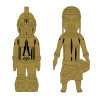
Notes description | Benin plaques exist in two formats, which probably relate to the way they were originally arranged and fitted to palace architecture. In one format, the vertical sides have been folded back to produce a thin (approximately 30mm deep) decorative edge. The other format is skinnier and appears to be a trimmed back version of the first; it lacks an edging and the figures are surrounded by less background. A41812 is of the first type, and frames three figures against a background of floral motifs. The figures with high beaded collars [odigba] are chiefs, while the third figure is a priest. They each holds vessels, which may indicate that they are collecting ritual substances. The quatrefoil motif in the background might represent a medicinal plant. Philip Dark (1973:73) identifies this as a ‘river-leaf’ [ebe-ame] plant. And Ben-Amos (1980:28) associates these leaves with healing rites performed by the mythical African priestess Olokun, god of the sea. |
Media material | Bronze, cast |
Dimensions dimensions | 507 mm H x 357 mm W x 112 mm D |
Weight weight | 21.30 kg |
Description object type | Plaque depicting three figures |
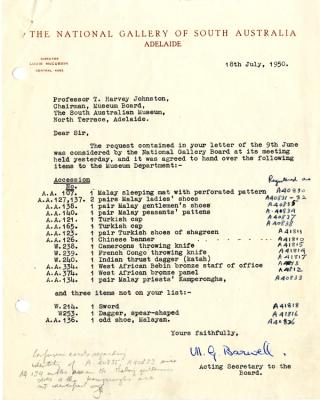
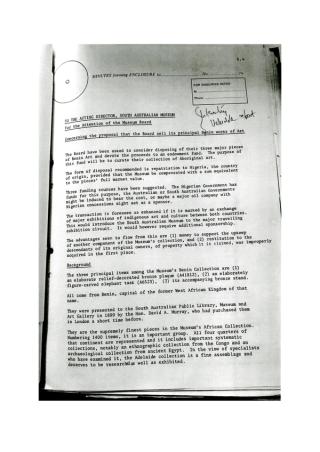
Timeline provenance | Benin cultural material at the South Australian Museum Timeline 09.02.1897 The British Admiralty invades Benin City 04.10.1898 Webster writes a price list of items sent to SAM on approval. Three items are from Benin, and are described by Webster as ‘taken in Benin City, W. Coast Africa by the British troops in Feb. 1897’. The three items are a carved elephant tusk (A73539), a bronze head (A6523) and a bronze ‘staff of office’ (A41813). The list also includes three non-Benin items: a battle axe from the Congo, and two New Caledonian clubs. AA309/1/192. 05.10.1898 Webster writes to Stirling letting him know that he has sent ‘six specimens on approval’. He explains that he has ‘purchased most of the Benin specimens, primarily from officers in the Expedition and a few from government’, and that ‘there is nothing left in Benin’. He mentions that a tusk and some bronzes are included in the six specimens. AA309/1/195. 08.10.1898 Webster writes a short note to Stirling, telling him that he has enclosed a bill of lading for the shipment (bill of lading not sighted). AA309/1/196. 21.11.1898 SAM receives notice from Port Adelaide of the shipment’s arrival: two cases of ethnographic specimens. AA309/1/199 front, AA309/1/199 back. 15.12.1898 Stirling’s letter to the editor is published seeking a purchaser/donor for the Benin items being sold by Webster. This is published in the South Australian Register newspaper on page 5 with the heading ‘Treasures From Benin’. South Australian Register (Adelaide, SA 1839 - 1900), Thursday 15 December 1898, page 5. 21.12.1898 Stirling writes to Webster, referring to Webster’s letter dated 5.10.1898 and confirming receipt of the specimens that Webster sent. In relation to the items from Benin he writes ‘I regret to say that our funds (this year very small) do not permit us to become purchaser nor is it -----[?] to suspect that the ----[?] will be much better ------[?] years. He also says that he has contacted the two daily papers in the hope that someone might help with purchase. A298 - Letter Book Museum Book 1 1895 Part 1 - page 117. 05.01.1899 Stirling writes to Webster, referring to his letter to Webster dated 21.12.1898. The letter states ‘I have received from a gentleman of standing here an offer of fifty pounds £50 for the lot, that is to say for those from Benin and West Africa’. A298 - Letter Book Museum Book 1 1895 Part 1 - page 120. 06.01.1899 Newspaper articles in Adelaide’s Evening Journal and the South Australian Register titled ‘The Adelaide Museum’. Both articles are identical. The bulk of the articles is about the items from Benin. They state that Webster’s selling price is £60 and that Stirling had received ‘a private offer from an Adelaide gentleman which he will forward to Mr. Webster’. The rest of the article describes these items in some detail. It also quotes an extract from a book by Captain Alan Boisragon, one of the two survivors of the English expedition to Benin. This extract details how these items were used. Evening Journal (Adelaide, SA 1869 - 1912), Friday 6 January 1899, page 4. South Australian Register (Adelaide, SA 1839 - 1900), Friday 6 January 1899, page 5. 15.01.1899 Stirling writes to Webster (not sighted) – NB: this is probably Stirling’s letter to Webster dated 05.01.1899; the date ‘15.01.1899’ is implied from the text of Webster’s letter to Stirling dated 13.02.1899 27.01.1899 Webster responds to a letter from Stirling (presumably the one dated 21.12.1898). The letter expresses thanks to Stirling for ‘writing to the papers’ to find a buyer/donor for the material sent by Webster. AA309-1-1-202. 13.02.1899 Webster writes to Stirling, referring to Stirling’s letter of 15.01.1899 [sic]. The letter he is referring to is probably the one dated 05.01.1899. He once again mentions Stirling’s attempt to secure a buyer for his material. He describes the shipment as containing ‘Benin and Congo specimens’ and that he will accept the offer of £50 for them but hoping for an additional £5 AA309-1-1-208. 20.03.1899 Stirling writes to Webster (not sighted). Based on Webster’s letter to Stirling dated 25.05.1899 it’s possible that Stirling’s letter is actually dated 20.04.1899 rather than 20.03.1899. Still couldn’t find it. 03.04.1899 Report of the Museum Committee notes an offer from Mr David Murray to donate ‘interesting and valuable ethnographic specimens from Benin City’. 25.05.1899 Webster refers to Stirling’s letter dated 20.04.1899. He acknowledges receipt of payment for the Benin material and a New Caledonian club. He also notes that there was a second New Caledonian jade axe that Stirling must have ‘overlooked’, and says that he is sending payment receipts and an invoice for the jade axe (both not sighted). AA309-1-1-215. June 1898-99 Record of David Murray’s donations of ‘1 Bronze Mask, 1 Carved Elephant tusk, 1 Iron axe with copper plated handle, 1 Bronze staff of Office’. Written under this in different hand-writing is ‘New Caledonian greenstone ax-head mounted in handle’. AA298-14-1-8 - Donations to SA Museum Book 3 - page 257. 30.06.1899 Annual Report, 1898-99 page 9, from the Assistant Museum Director A. Zietz. The report indicates that four items from Benin were acquired: A carved elephant tusk, a bronze bust, a bronze ‘staff of office’, and a battle axe. The items were presented to the museum as a donation by David A. Murray Esq. Annual Report 1898-99. 02.08.1899 Stirling writes to Webster enclosing payment for the New Caledonian jade axe. This is the item referred to in the Benin correspondence. A298 - Letter Book Museum Book 1 1895 Part 1 - page 130. 26.02.1902 Newspaper article in Adelaide’s Register page 8 with the heading ‘Professor Stirling’s Travels’ and the sub-heading ‘Notes on Museums’. The first paragraph details, amongst other thigs, donations made by various people to the museum, including the donations made by Sir William Ingram – ‘ethnological articles from New Guinea and the Polynesian Islands’ and ‘a valuable bronze house-panel from Benin, West Africa, of the same class of workmanship as the bronze mask now in the museum which, with some other Benin metalwork, was recently presented by Mr. David Murray’. The rest of the article is about visits to various American museums and the British Museum and improvements needed to Adelaide’s museum. Register (Adelaide, SA 1901 - 1929), Wednesday 26 February 1902, page 8. Feb 1901-02 Record of Sir William Ingram’s donation of ’30 Ethnological specimens from various localities’. AA298-14-1-9 - Donations to SA Museum Book 4 - page 78. 08.03.1902 Newspaper article in the Adelaide Observer, page 3 – the same article as that published on 26.02.1902 in Adelaide’s Register newspaper. This copy is, however, easier to read. It is in ‘The Traveller’ section with the heading ‘Professor Stirling’s Travels’ and the sub-heading ‘Notes on Museums’. Adelaide Observer (SA 1843 - 1904), Saturday 8 March 1902, page 3. 30.06.1902 Annual Report, 1901-02, pages 8 and 21. Records Ingram’s donations. On page 8 – ‘a fine bronze plaque from Benin City, West Africa as well as a number of New Guinea and Polynesian articles of interest’. On page 21 – ‘2 Humming Birds, 30 Ethnological specimens from various localities’. The ‘Ethnological specimens’ include those noted on page 8. Annual Report 1901-02. 06.11.1902 Newspaper articles in two Adelaide newspapers – the Advertiser, page 4 and the Express and Telegraph, page 2, titled ‘Gifts to the Museum’. Sir William Ingram’s donations of the bronze plaque from Benin and specimens from New Guinea and Polynesia are mentioned as donations received during the year ended June 1902. Advertiser (Adelaide, SA 1889 - 1931), Thursday 6 November 1902, page 4. Express and Telegraph (Adelaide, SA 1867 - 1922), Thursday 6 November 1902, page 2. Another article on the same date is in Adelaide’s Register on page 3. This is a longer article titled ‘Public Library Board’, sub-heading ‘Extracts from Annual Report – General’. Sir William Ingram’s donations are mentioned in Stirling’s part of the report. Register (Adelaide, SA 1901 - 1929), Thursday 6 November 1902, page 3. 1928—1950 Extended loan of Benin material to AGSA. See Correspondence file: 29 May, 18 July and September 1950. Petty (22.08.1983) notes that AGSA has frequently questioned the assignment of these pieces to the SA Museum. Letter dated 29.05.1950 not located. Letter dated 18.07.1950: AA298 - Correspondence June to August 1950. Letter in September1950 not located. 22.08.1983 Graeme Pretty presents paper to the SA Museum Board discussing the merits of a proposal to repatriate the Museum’s Benin material to Nigeria. Graeme Pretty 22081983. Biographical notes Edward Charles Stirling (1848—1919) was the Director of the South Australian Museum from 1884 to 1912. He was buying Aboriginal artefacts for SAM from Webster from as early as December 1897. David Murray (1829—1907) was an Adelaide-based merchant and politician. Murray’s import and export business took him on ten round trips between Australia and England, and he finally settled back in London in March 1900. He was also an art collector and critic who purchased on behalf of the Board of Governors of the Adelaide Public Library. (see Australian Dictionary of Biography). William James Ingram (1847—1924) was a British politician and the Managing Director of The Illustrated London News. He married Stirling’s sister in 1874. Stirling visited Ingram in England in 1899 and was given a collection of ethnographic material that included ‘a bronze’. |
Digital Benin collates digital material from institutions, and some of this material is inherently colonial and contains words, terms and phrases that are inaccurate, derogatory and harmful towards African and African diasporic communities. Catalogue transcriptions, book titles, exhibition titles and museum titles may contain harmful terms. We recognise the potential for the material to cause physical and mental distress as well as evoke strong emotions. Owing to the scale of the collection’s data, a process to implement sensitive-content warnings in the displayed data is still incomplete. The material within the catalogue does not represent Digital Benin’s views. Digital Benin maintains a strong anti-colonial, anti-racist position and affirms its support for centring the humanity of historically marginalised and disenfranchised communities. Read more about the background of this statement here