


Iconographies




Provenance
Institution data
| Institution field | Value |
|---|---|
IMDAS ID object id | 576F0BC6750842A38A7E5BE9293024CC |
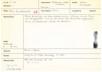
Inventarnummer object id | I/0068 |
Indigene Bezeichnung (Museumsobjekt) edo designation | |
Titel (Museumsobjekt) designation object type | Elfenbeinzahn |
Titel engl. designation object type | Ivory tooth |
Titel franz. designation object type | Dent ivoire |
Text kurz Online-Sammlung dt. description | Die beschnitzten Elefantenzähne wurden im alten Königreich Benin auf Gedenkköpfen befestigt. Die Schnitzereien auf den Zähnen zu „lesen“ war nur einem kleinen Kreis Eingeweihter möglich. Die vertikal aufgestellten Elefantenzähne galten als symbolische Verbindung zwischen Diesseits und Jenseits. Elefanten standen für Kraft und Langlebigkeit. Die Farbe Weiß symbolisierte Reinheit, Wohlstand und Frieden. |
Text kurz Online-Sammlung engl. description | In the ancient Kingdom of Benin, carved elephant tusks were attached to commemorative heads. Only a small circle of the initiated was able or permitted to "read" the carvings on the teeth. The carved tusks were regarded as a symbolic link between this world and the next. Elephants stood for power and longevity. The colour white symbolised purity, prosperity and peace. |
Text kurz Online-Sammlung franz. description | A l’époque de l’ancien royaume du Bénin, les défenses d’éléphants ciselées étaient posées sur des têtes commémoratives. Seul un cercle restreint d’initiés était capable de « lire » les motifs de ces ciselures. Par leur silhouette verticale, les défenses d’éléphants représentaient un lien symbolique entre la vie ici-bas et l’au-delà. En outre, les éléphants incarnaient la force et la longévité. La couleur blanc symbolisait la pureté, la prospérité et la paix. |
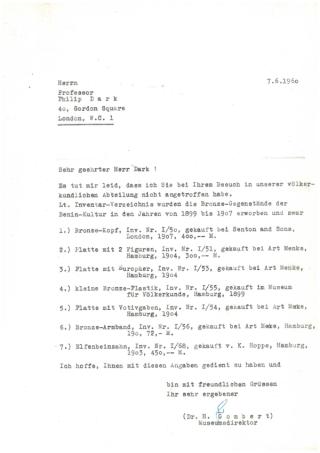
Text lang Online-Sammlung dt. description | Reich beschnitzte Elfenbeinzähne waren im Hof Benins wichtige Bestandteile der Ahnenaltäre. Ihre Motive erzählen von historischen Ereignissen oder sind kultischen Ursprungs. Das Flechtbandornament ist Zeichen der Gilde der Elfenbeinschnitzer. Zeremonialschwerter der Würdenträger sind zu erkennen sowie Darstellungen von Schlammfischen. Sie stehen für Wohlstand, Frieden und Fruchtbarkeit. Der Wels ist Symbol für die Beziehung des Königs zu Olokun, dem Gott des Wassers. Elfenbein war nicht nur ein wertvolles Handelsgut Westafrikas, es galt als Zeichen der Herrscher und stand für Weisheit, Kraft, Führung und Macht. Ab dem 19. Jahrhundert wurden die Stoßzähne auf Bronzeköpfe gesetzt. Als Einheit stehen sie für die Verbindung des Königs mit der Welt des Unsichtbaren, der Ahnen und Götter. Dieser Elfenbeinzahn wurde 1903 von einem Privathändler in Hamburg für das Museum in Freiburg erworben. |
Text lang Online-Sammlung engl. description | Richly carved ivory tusks were important components of the ancestral altars in the court of Benin. Their motifs tell of historical events or are of cultic origin. This interlace ornament is emblematic for the guild of ivory carvers. Ceremonial swords of dignitaries are frequent motifs, as well as representations of the hingemouth (Phractolaemus ansorgii). They stand for prosperity, peace and fertility. The wels catfish is a symbol of the king's relationship with Olokun, the god of water. Ivory was not only a valuable trading commodity of West Africa, it symbolised the ruler, standing for wisdom, strength, leadership and political power. From the 19th century onwards, tusks were inserted into the bronze heads. Unified in this way, they represent the king's connection with the realm of invisible, ancestors and gods. This ivory tusk was acquired privately in 1903 by a Hamburg dealer for the museum in Freiburg. Translation: Timothy Connell |
Text lang Online-Sammlung franz. description | Les défenses d’éléphants richement ciselées étaient des pièces importantes des autels dédiés aux ancêtres de la cour du Bénin. Leurs motifs relatent des événements historiques ou sont d’origine cultuelle. L’ornement figurant un bandeau tressé est l’enseigne de la guilde des sculpteurs d’ivoire. On reconnaît des épées cérémoniales de dignitaires ainsi que les représentations de poissons-castor. Les épées incarnent la prospérité, la paix et la fertilité. Le poisson-chat est le symbole de la relation du roi à Olokun, le dieu de l’eau. L’ivoire n’était pas seulement un bien commercial précieux en Afrique de l’Ouest, il était considéré comme un symbole du souverain et était synonyme de sagesse, force, direction et pouvoir. A partir du XIXe siècle, les défenses furent placées sur des têtes de bronze. Formant une unité avec elles, elles représentent le lien du roi avec le monde de l’invisible, des ancêtres et des dieux. Cette défense d’éléphant a été acquise en 1903 à Hambourg pour le musée de Fribourg, par un commerçant particulier. Traduction: Julia Walter |
Trägermaterial material | Elfenbein <Elefant> |
Maße zum Objekt dimensions | Höhe: 1.280,00 mm; Durchmesser: 115,00 mm |
Objektbezeichnung object type | Elefantenzahn |
Objektbezeichnung engl. object type | Elephant tooth |
Objektbezeichnung franz. object type | Dent d'éléphant |
Datierung date made | 19. Jahrhundert |
Datierung bis date made | 31.12.1899 |
Datierung von date made | 01.01.1801 |
Entstehungszeit date made | 19. Jahrhundert |
Technik production technique | Schnitzerei |
Fundort/Herkunft production place | Benin <Königreich>; Nigeria; Westafrika |
Sammler/in öffentlich prior source | Hoppe, Carl |
Voreigentümer prior source | Hoppe, Carl |
Objektgeschichte provenance | Ausgestellt in "Letzte Ölung Nigerdelta" 24.05.2014- 25.01.2015, Objekttext vorhanden. Ausstellungsbereich. Ausstellungstext zur Sonderausstellnug "Letzte Ölung Nigerdelta" verknüpft. |
Ethnie ethnic attribution | Edo |
Institution department and institution | Ethnologische Sammlung MNM |
Eingangsdatum accession date | 06.03.1903 |
Eingangsart accession method | Kauf |
Digitaler Katalog Standort display status | Nicht ausgestellt |
Nutzungsrechte (Medienobjekt) license | CC BY-NC-SA 4.0 |
URL-Digitalisat weblink | https://onlinesammlung.freiburg.de/de/object/576F0BC6750842A38A7E5BE9293024CC |
Fotograf (Medienobjekt) | Killian, Axel |
Sammlung | Afrika |
Schlagworte | Ethnologie (außereuropäische) |
Digital Benin collates digital material from institutions, and some of this material is inherently colonial and contains words, terms and phrases that are inaccurate, derogatory and harmful towards African and African diasporic communities. Catalogue transcriptions, book titles, exhibition titles and museum titles may contain harmful terms. We recognise the potential for the material to cause physical and mental distress as well as evoke strong emotions. Owing to the scale of the collection’s data, a process to implement sensitive-content warnings in the displayed data is still incomplete. The material within the catalogue does not represent Digital Benin’s views. Digital Benin maintains a strong anti-colonial, anti-racist position and affirms its support for centring the humanity of historically marginalised and disenfranchised communities. Read more about the background of this statement here