

Iconographies


Provenance

Institution data
| Institution field | Value |
|---|---|
Inventory no. [ObjInventarNrS] object id | 11043 |
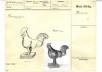
Object designation [ObjTitelOriginalS] designation object type | Figure. Cock |
Description [ObjReserve02M] description | 11043. Copper spots. Casting defects on the right wing and comb. Tail feather broken off during casting. Large opening in the back. Interior: Ventral part massively filled. 3 toes & spurs. Braided band motif around base edges. "Bronze cocks are used to decorate the shrines of queen-mothers. In some households particularly those of people of high rank, there is an altar to the mothers of the living and past household heads, decorated with uxurhe .. and wooden images of fowls. (Bradbury) "Two bronze female heads, a cock and an altar piece are for the cult of the king's mothers (i.e. his own mother and those of the preceding kings, from whom he descends in the direct male line.). These pieces are all of the Late Period, the finest and earliest being the cock, which may date from the reign of oba Eresonyen (about 1750)." Fagg, 20 PUBL Kat. 1975: Abb. 6 Rachewiltz 1960: Abb. 21 LIT Dark 1982: ill. 3 und 5 (Leiden) Gall 1962: Abb. 6, 59 Dark 1962: The Art of Benin Fagg 197=: Divine Kingship in Africa. London. pl. 13, p. 20 |
Mat./Technique [ObjTechMatM] material | Yellow cast iron, very lead-rich brass grade with significantly elevated trace element concentrations |
Dimensions [ObjMasse1S] dimensions | W 44; H c. 46.5, Kopf |
Dating [ObjDatierungS] date made | |
Year from [ObjJahrVonL] date made | |
Year until [ObjJahrBisL] date made | |
Geographical reference [ObjGeografieS] production place | Kingdom of Benin (Africa->West Africa->Nigeria) |
Name sorting [KueSortierungS_0] prior source | Oldman, William Ockelford |
Name sorting [KueSortierungS_1] prior source | |
First Name 2 [KueVorNameS_1] provenance | |
First name [KueVorNameS_0] provenance | William Ockelford |
Function collector 2 [OkuFunktionS_1] provenance | |
Function collector [OkuFunktionS_0] provenance | Merchant |
Inventory note [ObjFeld07M] provenance | |
Last Name 2 [KueNameS_1] provenance | |
Last name [KueNameS_0] provenance | Oldman |
Date of acquisition[ObjFeld04M] accession date | ca. 1910 |
Acquisition type [ObjFeld02M] accession method | |
Comemnts[ObjCreditlineM] notes | |
Exhibition exhibition history | Kunst? Handwerk in Afrika im Wandel (Art? Handicraft in Africa in Transition), Museum für Völkerkunde, Frankfurt am Main 1975 |
Literature bibliography | |
Type [ObjSystematikS] | Sculpture (Art) |
Type of ownership [ObjFeld01M] | |
Type of person 2 [KueTypS_1] | |
Type of person [KueTypS_0] | Person |
| Institution field | Value |
|---|---|
Inventarnr. [ObjInventarNrS] object id | 11043 |
Beschreibung [ObjReserve02M] description | 11043. Kupferflecken. Gußfehler am rechten Flügel und Kamm. Schwanzfeder beim Guß abgebrochen. Große Öffnung hinten. Innen: Bauchteil massiv ausgefüllt. 3 Zehen u. Sporne. Flechtbandmotiv um Sockelkanten. "Bronze cocks are used to decorate the shrines of queen-mothers. In some households particularly those of people of high rank, there is an altar to the mothers of the living and past household heads, decorated with uxurhe .. and wooden images of fowls. (Bradbury) "Two bronze female heads, a cock and an altar piece are for the cult of the king's mothers (i.e. his own mother and those of the preceding kings, from whom he descends in the direct male line.). These pieces are all of the Late Period, the finest and earliest being the cock, which may date from the reign of oba Eresonyen (about 1750)." Fagg, 20 PUBL Kat. 1975: Abb. 6 Rachewiltz 1960: Abb. 21 LIT Dark 1982: ill. 3 und 5 (Leiden) Gall 1962: Abb. 6, 59 Dark 1962: The Art of Benin Fagg 197=: Divine Kingship in Africa. London. pl. 13, p. 20 |
Mat./Technik [ObjTechMatM] material production technique | Gelbguß, Sehr bleireiche Messingsorte mit deutlich erhöhten Spurenelementkonzentrationen |
Maßangaben [ObjMasse1S] dimensions | B 44; H c. 46.5, Kopf |
Gattung [ObjSystematikS] object type | Skulptur (Kunst) |
Objektbezeichnung [ObjTitelOriginalS] object type | Figur. Hahn |
Datierung [ObjDatierungS] date made | |
Jahr bis [ObjJahrBisL] date made | |
Jahr von [ObjJahrVonL] date made | |
Geogr. Bezug [ObjGeografieS] production place | Königtum Benin (Afrika->Westafrika->Nigeria) |
Nachname 2 [KueNameS_1] prior source | |
Nachname [KueNameS_0] prior source | Oldman |
Namensortierung [KueSortierungS_0] prior source | Oldman, William Ockelford |
Namenssortierung [KueSortierungS_1] prior source | |
Vorname 2 [KueVorNameS_1] prior source | |
Vorname [KueVorNameS_0] prior source | William Ockelford |
Funktion Sammler 2 [OkuFunktionS_1] prior source role | |
Funktion Sammler [OkuFunktionS_0] prior source role | Händler |
Erwerbsdatum [ObjFeld04M] accession date | ca. 1910 |
Besitzart [ObjFeld01M] accession method | |
Erwerbungsart [ObjFeld02M] accession method | |
Bemerkungen [ObjCreditlineM] notes | |
Inventar Notiz [ObjFeld07M] notes | |
Ausstellung exhibition history | Kunst? Handwerk in Afrika im Wandel, Museum für Völkerkunde, Frankfurt am Main 1975 |
Literatur bibliography | |
Personentyp 2 [KueTypS_1] | |
Personentyp [KueTypS_0] | Person |
Digital Benin collates digital material from institutions, and some of this material is inherently colonial and contains words, terms and phrases that are inaccurate, derogatory and harmful towards African and African diasporic communities. Catalogue transcriptions, book titles, exhibition titles and museum titles may contain harmful terms. We recognise the potential for the material to cause physical and mental distress as well as evoke strong emotions. Owing to the scale of the collection’s data, a process to implement sensitive-content warnings in the displayed data is still incomplete. The material within the catalogue does not represent Digital Benin’s views. Digital Benin maintains a strong anti-colonial, anti-racist position and affirms its support for centring the humanity of historically marginalised and disenfranchised communities. Read more about the background of this statement here