

ID
212039
Edo designations
English designations
Relief Plaque
Categories
Palace Architecture & Ornamentation
Location
1 Adesogbe (Plymouth) Road, P.M.B. 1115, Benin City , Edo State
Loading...
Relief Plaque
Relief Plaque

Iconographies

15 annotations
Ẹroro
Bell

Ẹroro (bells) frequently appear as ornaments worn by figures depicted on the Emwin Arhe, particularly on Ama-Eronmwon (bronze relief plaques) and Aken’ni Elao (carved tusks). These Ẹroro are most commonly quadrangular in form or, less commonly, cylindrical with rounded tops. Quadrangular Ẹroro worn around the neck are often part of the attire that indicates that figures can be interpreted as warriors, alongside the Akọn Ẹkpẹn (leopard tooth neck ornament) and the Ohian Ẹkpẹn (leopard tunics).

2 annotations
Ẹroro
Ẹroro
Ẹguẹn
Anklet

Ẹguẹn are worn by the Ọba and chiefs as part of their Ehaengbehia, the full regalia worn during special ceremonies. Ẹguẹn are worn around the ankles or calves and can be made from beads, ivory, brass or even iron. A separate category, called Elubase, refers to those which have integrated rattles or crotal bell attachments, however both are described as anklets in English.

As early as 1899, Read and Dalton commented that the anklets worn by figures shown on plaques were a signifier of high rank. Today, anklets continue to signify social status, with the Ọba wearing many ivory and coral anklets stretching up his calves as part of his ceremonial regalia (Okpokunu, Agbontaen‐Eghafona & Ojo, 2005, p.162[106]). However, anklets were not the preserve of the Ọba alone, and different kinds and quantities were worn by other members of the royal court and Edo people. For example, Flora Kaplan (2006, p.85[107]) described a photograph of Iy’Ọba Aghahowa N’Errua, who took her title in 1981, in which she wears coral anklets as one of a number of insignia of her newly invested high rank. In contrast, brass anklets would be worn by young male attendants to the Ọba (see attendant figure), such as sword bearers or Emada pages (Kaplan, 2006, p.90[107]).

1 annotation
Ẹguẹn
Owẹn iba ẹdẹ ku
Rosette - 'The Sun Never Misses a Day'

This rosette design, usually found in the corners of Ama-Ẹrọnmwọn (bronze relief plaques), is one of two motifs representing the sun and one of a number of motifs in Edo art that are also connected with Olokun. The association between the sun and Olokun refers to the way in which the sun descends into the sea each day—hence the proverb ‘the sun never misses a day’—and the sea is where the deity Olokun lives ( ).

2 annotations
Owẹn iba ẹdẹ ku
Owẹn iba ẹdẹ ku
Ikpigho
Cowrie

Historically, Ikpigho (cowries) were used as a form of currency, and they continue to carry associations with wealth and prosperity. Further strengthening the association between Ikpigho and wealth is the fact that cowries were among the goods imported by European merchants to the kingdom from the 15th century until the 19th century, from as far afield as the Maldives in the Indian Ocean. Together with motifs such as Portuguese heads, cowries became associated with wealth brought from overseas and, therefore, are also associated with Olokun, god of the sea. The white colour of Ikpigho further associates them with Olokun, as well as with joy (Nevadomsky 2007, p. 498).

1 annotation
Ikpigho
Water fern
Ebe Amẹ
Water Fern

Ebe Amẹ refers to a wide variety of plants, particularly the leaves of the water fern or river leaf, found in riverine areas of southern Nigeria ( ). Artists from the Igun-Ẹrọnmwọn used these as a decorative motif in the background of most Ama-Ẹrọnmwọn (bronze relief plaques). The petals of the Ebe Amẹ, like the points of the ἀghàdàgháda (crossroads), represent the four cardinal directions: north, east, south, and west. The number four plays a foundational role in the Edo calendar, which is structured around four market days ( ).

1 annotation
Ebe Amẹ
Ẹbẹn
Ceremonial Sword

Ẹbẹn are a type of ceremonial sword of significant importance in the Benin Kingdom. During ceremonies, titled chiefs would hold them or toss them during dances, thereby paying homage to the Ọba at these public events, particularly when a chief receives a certain status. It is forbidden for Ẹbẹn to touch the ground, so the chief must take extra precautions to avoid dropping the Ẹbẹn during the dance. Therefore, the Okae-Odionmwan (head of executioners) dances with the Umozo (warfare or executioner’s sword) behind the dancing chief.

There are two central ceremonial swords used in the royal court of the Benin Kingdom, one of which is the Ẹbẹn, along with the Ada (ceremonial swords). They are distinguished by their blades: the Ẹbẹn blade reflects the shape of a leaf or an oar. Sometimes, it is decorated with openwork designs and/or brass inlays, most commonly shaped as small Ẹbẹn and Ẹkpẹn (leopards). The handle of the Ẹbẹn also has an unusual ring-shaped form, which further differentiates it from the Ada.

1 annotation
Ẹbẹn
Colar Bead
Odigba
Coral beaded collar

Odigba (coral-beaded collar) is a rigid neck collar made of coral beads, worn as part of ceremonial attire only by senior princes who have been made Enigie (Inneh 2007, p. 107). Although Ibafe (2007, p. 43) argued that the Odigba was introduced during the Ogiso period (c. 900–c. 1170 AD) by Ogiso Ere, along with other symbolically important Emwin Arhe, such as the Ada (ceremonial sword) and the Ẹbẹn (ceremonial sword), this seems unlikely, as coral was only introduced in the late 15th century through trade with Portuguese merchants.

1 annotation
Odigba
Uko ugbo-ohamwen
Fortified chest band

Uko ugbo-ohamwen is a chest band often worn around the chests of warriors depicted on the Ama-Ẹrọnmwọn (relief plaques) and is fortified with charms. The band was worn to increase the strength and endurance of warriors ( ). This fortified chest band has also been referred to as ukugba olila (Ine n’Igun in Bradbury 1959, B.S. 245; ; ).

1 annotation
Uko ugbo-ohamwen
leopard teeth
Akọn Ẹkpen
Leopard Teeth Neck Ornament

Akọn Ẹkpẹn are necklaces or neck ornaments made of strung leopard’s teeth. They are worn by figures to signify their high rank and military prowess, as well as by their leaders, the Ezọmọ or Iyasẹ. They are often worn alongside quadrangular Ẹroro (bells) and Ohian Ẹkpẹn (leopard tunics).

The Akọn Ẹkpẹn is clearly and profoundly related to the symbolism of the Ẹkpẹn (leopard) and its association with the Ọba (king), who is metaphorically referred to as ‘ẹkpẹn ne owa’, the ‘leopard of the home’. On the other hand, the Ẹkpẹn is often referred to as the ‘king of the bush’, embodying ferocity, aggression, strength, and leadership—qualities attributed to the Ọba (Nevadomsky 1988). This intricate link between the leopard, the monarch, and his military leaders reinforces the complex hierarchy and spiritual authority central to Benin’s courtly art.

1 annotation
Akọn Ẹkpen
Uko
Container

Uko are flask-shaped containers with globular bodies and narrow openings, which could be made from calabash or cast in brass. The Uko depicted on Emwin Arhe (royal treasures) are usually worn around the neck or waist of figures, particularly those identified as ritual specialists or warriors, suggesting that they may have contained protective or ritual substances. Figures on Ama-Ẹrọnmwọn (bronze relief plaques) are sometimes shown holding or pouring from larger Uko, likely referencing the presentation of offerings during ceremonies and festivals. Uko motifs also decorate the flanges of Ikẹgobọ (altars to the hand), where they may similarly reference vessels used to contain liquid offerings.

1 annotation
Uko
Ẹrhu
Headwear

Many different kinds of Ẹrhu (headwear) are worn by the various figures depicted in the imagery of Benin royal artefacts. Through comparisons with ceremonial regalia still worn by chiefs and members of the royal court, including the Ọba himself, some Ẹrhu have been used to identify the different figures depicted. For example, the conical hat worn by high-ranking town chiefs as part of the pangolin regalia, still worn at ceremonies, is also visible on figures on some Ama-Ẹrọnmwọn (bronze relief plaques) ( ). Other examples include the distinctive bell-shaped helmet associated with the Iyasẹ ( ). Figures who wear a shallow-brimmed hat and a cross have been identified as Ewua or Ohensa priests ( ).

Different kinds of helmets and headwear were worn by warriors, reflecting the many different ranks and roles in the army at any given time, as well as developing trends that were in turn represented on Emwin Arhe created at different points in time. Warrior figures wearing helmets covered in cowrie shells were carved on the Aken'ni Elao (carved tusks) (Blackmun 1984, p. 330), yet on the brass Ama, warriors are sometimes depicted wearing helmets made from crocodile hide or horsehair with a front plate (Osadolor in Plankensteiner 2007, cat. no. 238, p. 457). Helmets made from horsehair with a front plate are one of the more common types represented on the Ama-Ẹrọnmwọn, and the demand for black horse tails was noted by both Portuguese and British traders during the late 17th and 18th centuries (Osadolor in Plankensteiner 2007, cat. no. 238, p. 457). Other warriors depicted on Ama-Ẹrọnmwọn wear helmets with a rounded top, chinstrap, and sometimes also a feather tucked into the left side. These types of headwear are known as Ẹrhu Iyokuo.

Attire worn for battle also differed from that worn for ceremonial occasions, such as the pointed headwear worn in combination with an ornate leopard-head tunic by war chiefs. Depictions of figures wearing this attire on brass Ama-Ẹrọnmwọn (bronze relief plaques) have been interpreted as representing the war chiefs’ participation in the war-ritual Isiokuo festival (Osadolor in Plankensteiner 2007, cat. no. 238, p. 457).

Another distinctive form of headwear is that worn by figures identified as leopard hunters on the brass Ama-Ẹrọnmwọn (relief plaques). These large helmets cover almost all of the leopard hunters’ faces except for their noses, eyes, and upper lips, and are made of an unusual material that remains unidentifiable (Plankensteiner 2007, cat. nos. 68–69, p. 322).

European figures are also portrayed with distinctive hats, such as Portuguese three-cornered hats. These depictions reflect the artists’ keen observation and highlight the impact of European trade and military assistance (Ezra 1992).

1 annotation
Ẹrhu
Ukpọn
Wrapper

Ukpọn is the Edo term for cloth (Aigbe 1985, p. 55; Ọbazee 2025, p. 542) and is used here to refer to the wrappers or kilts worn by many of the figures depicted on the Emwin Arre (royal treasures). The cloth worn around the waist may be plain, but it is more commonly richly decorated with motifs associated with the monarchy, power, and wealth, such as the Ọba'nui (infinity symbol) and Uhunme Ikpotoki (Portuguese heads).

The Benin Kingdom was renowned for its textile production, both for local use and for trade ( ). Within the royal court, members of the Owina n’Ido produced ukhuen cloth for the Ọba and other members of the court, who wore it as wrappers during festivals and ceremonies ( ).

Alongside locally produced textiles, imported cloth was also an important commodity in the Benin Kingdom’s trade networks. Textiles were exchanged with neighbouring production centres, particularly Ijebu ( ), while European traders brought silks, woollens, linens, and cotton from Europe and Asia from the 15th century onwards ( ).

1 annotation
Ukpọn
Igan
Feather

Igan (feathers) are commonly depicted tucked into the headdresses and hats of chiefs represented on Emwin Arre (royal treasures). These feathers are from the Oɛɣohɔ (vulturine fish eagle) and symbolise respected old age and proper chieftaincy ( ).

1 annotation
Igan

Provenance

6 events
Production
1504 (approximate) to 1550 (approximate)
The object was produced by Unknown member(s) of the Igun-Ẹrọnmwọn guild in Benin City.
Looted
February 22, 1897 (day approximate) to June 1899 (year approximate)
The object was looted by Unknown member of the British colonial military campaign on Benin - February 1897 from Benin Kingdom.
Unknown
January 1898 to July 1898
The object is known to have come into contact with Friedrich Erdmann, in Benin City.
Transfer
July 1898 (year approximate)
The object was transferred from Friedrich Erdmann through Bey & Co. from Benin City to Hamburg.
Purchase
1899
The object was purchased by the Ethnologisches Museum, Staatliche Museen zu Berlin from Heinrich Bey and Bey & Co. from Hamburg to Berlin.
Restitution
August 25, 2022
The object was restituted by the Ethnologisches Museum, Staatliche Museen zu Berlin to the Omo n'Oba n'Edo Uku Akpolokpolo, Ọba of Benin & National Commission for Museums and Monuments, Nigeria through Hermann Parzinger and Abba Isa Tijani from Berlin to Nigeria.

Related archival documents

1 documents
See all
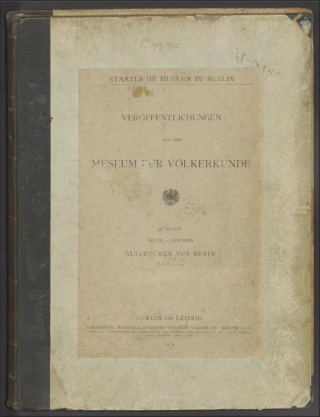
Museum Catalogue
Staatsbibliothek zu Berlin
Die Altertümer von Benin
Date
January 1, 1919 at 12:00:00 AM

Institution data

Ethnologisches Museum, Staatliche Museen zu Berlin
The data was transferred directly by the institution.
Last updated: 2021-06-14
Language: german
Institution fieldValue
ID
object id
212039
Sachbegriff
designation
Sachbegriff: Reliefplatte
Titel
designation
Titel: Würdenträger
Objektref.
description
E 1151/1898, Erwerbung: I/41/1899: III C 8348-8531, Altertümer (Benin), H. Bey, Hamburg, 1898, Heinrich Bey (1882); III C 8444, Beninbronze
Texte Online
description
Online Beschreibung, Würdenträger mit eben-Schwert und Helm aus Krokodilshaut. [Benin_Königreich]
Material / Technik
material
Material: Messing; Ausgabe: Messing
Material / Technik // Alle
material
Messing, Messing
Maße
dimensions
39,00 x 28,50 x 6,00 cm; 3,90 kg
Objekttyp
object type
Allgemein
Sachbegr. Ausgabe
object type
Reliefplatte (Relief plaque)
Anzahl Teile
object count
2
Datierung
date made
16. Jh.
Geogr. Bezüge
production place
Nigeria ( Land ); Benin ( Königreich )
Geogr. Bezüge // Alle
production place
Benin, Nigeria
Beteiligte
prior source
Heinrich Bey (1882), Sammler
Beteiligte // (Name, Sortierung=kleinste)
prior source
Bey, Heinrich
Veräußerer
prior source
null
Erwerb. Notiz
provenance
Erwerbung von: H. Bey; Notiz: Rückführung Leipzig; Ausgabe: 16. Jh., im Auftrag von Oba Esigie (reg. 1517-1550) oder seines Sohnes Oba Orhogbua (reg. 1550-1570), Königspalast, Benin-Stadt; durch Erbschaft an Oba Ovonramwen (ca. 1857-1914; reg. 1888-97), Königspalast, Benin-Stadt; geplündert im Zusammenhang mit der britischen Eroberung von Benin, 1897; in unbekanntem Besitz nach der Eroberung des Königreichs Benin; gesammelt im Auftrag der Firma Bey & Co., zwischen 1897 und 1898 im Gebiet des späteren kolonialen Nigeria; verkauft an das Königliche Museum für Völkerkunde in Berlin, 1899.
Verw. Institution
department and institution
Ethnologisches Museum, Staatliche Museen zu Berlin
Erwerb. Datum
accession date
1899
Besitzart
accession method
Erwerbungsart
accession method
Ankauf
Digital Assets
images
III C 8444.JPG, Repro Digitalisat
Erwerb. Nr.
I/41/1899
Ident. Nr.
III C 8444
Ident. Nr. // (Sortiernr.)
0003 C 08444
Obj. Status
vorhanden
object_images/creator
license
Claudia Obrocki
Sensitive Content

Digital Benin collates digital material from institutions, and some of this material is inherently colonial and contains words, terms and phrases that are inaccurate, derogatory and harmful towards African and African diasporic communities. Catalogue transcriptions, book titles, exhibition titles and museum titles may contain harmful terms. We recognise the potential for the material to cause physical and mental distress as well as evoke strong emotions. Owing to the scale of the collection’s data, a process to implement sensitive-content warnings in the displayed data is still incomplete. The material within the catalogue does not represent Digital Benin’s views. Digital Benin maintains a strong anti-colonial, anti-racist position and affirms its support for centring the humanity of historically marginalised and disenfranchised communities. Read more about the background of this statement here