Inventarnummer
A III c 328
Edo designations
English designations
Relief Plaque
Categories
Palace Architecture & Ornamentation
Location
Steintorwall 14, 38100 Braunschweig, Germany
Loading...
Relief Plaque
Relief Plaque

Iconographies

2 annotations
Water fern
Ebe Amẹ
Water Fern

Ebe Amẹ refers to a wide variety of plants, particularly the leaves of the water fern or river leaf, found in riverine areas of southern Nigeria ( ). Artists from the Igun-Ẹrọnmwọn used these as a decorative motif in the background of most Ama-Ẹrọnmwọn (bronze relief plaques). The petals of the Ebe Amẹ, like the points of the ἀghàdàgháda (crossroads), represent the four cardinal directions: north, east, south, and west. The number four plays a foundational role in the Edo calendar, which is structured around four market days ( ).

1 annotation
Ebe Amẹ
Ikpotoki
Portuguese Figure

Ikpotoki figures (Portuguese figures) are easily distinguished by their European-style clothing, including hats and helmets, as well as by their facial features, particularly their thin, straight noses and straight hair. The objects Ikpotoki figures are shown wearing or holding provide further indications of their relationship with the Benin Kingdom. When they hold or are positioned alongside Ugianran (manillas), for example, they indicate trade, commerce, and wealth, while weaponry such as firearms, swords, or spears indicates their role as mercenaries in the service of the Ọba. In 1515, Ọba Ẹsigie went to war against the Attah of Idah, the ruler of a neighbouring kingdom. Portuguese mercenaries and weapons assisted the Edo in winning the battle, enabling the further expansion of the Kingdom. Ẹsigie’s reign was particularly important for strengthening ties between the Benin Kingdom and the Portuguese Empire, and he is believed to have spoken fluent Portuguese. With Ẹsigie’s encouragement, Portuguese missionaries established churches in the Benin Kingdom ( ; ), while Portuguese trading factories were also established ( ). Ọba Ẹsigie allowed his son to be baptised and sent him to Portugal to be educated; following his return, he became Ọba Orhogbua ( ).

1 annotation
Ikpotoki

Provenance

4 events
Production
1504 (approximate) to 1550 (approximate)
The object was produced by Unknown member(s) of the Igun-Ẹrọnmwọn guild in Benin City.
Looted
February 22, 1897 (day approximate) to June 1899 (year approximate)
The object was looted by Unknown member of the British colonial military campaign on Benin - February 1897 from Benin Kingdom.
Unknown
February 22, 1897 (day approximate) to 1901
The object is known to have come into contact with William Downing Webster, later in London.
Purchase
1901
The object was purchased by the Städtisches Museum Braunschweig from William Downing Webster through Richard Andree from London to Brunswick.

Related archival documents

1 documents
See all
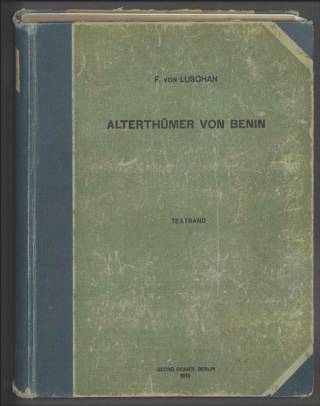
Museum Catalogue
Staatsbibliothek zu Berlin
Die Altertümer von Benin
Date
January 1, 1919 at 12:00:00 AM

Institution data

Städtisches Museum Braunschweig
The data was transferred directly by the institution.
Last updated: 2021-03-31
Language: german
Institution fieldValue
Inventarnummer
object id
A III c 328
Material
material
> Metall > Bronze > Bronzelegierung
Maße
dimensions
Höhe: 35.00 cm Breite: 19.00 cm
Titel
object type
Reliefplatte, Portuguise, Benin Nigeria
Datierungen
date made
Entstehungsdatum ca. 1500 bis exakt 1700
Provenienz/Zugang von
prior source
Webster, London
Objektgeschichte
provenance
Durch die Initiative von Richard Andree 1901 bei Webster in London angekauft
Provenienz/Zugangsdatum
accession date
1901
Provenienz/Zugangsart
accession method
Kauf
Standort
display status
> Braunschweig > Städtisches Museum Braunschweig > Braunschweig > Städtisches Museum Braunschweig > Haupthaus > 1. OG > 02
Bemerkungen
bibliography
Katalog von William Downing Webster, London, Nr. 29, Fig. 45
Geonames-Link
weblink
http://www.geonames.org/2328926
Alte Inventarnummern / andere Nummern
Vw 7.0-62/3 (Hecht-Nummer)
Beschreibung intern (deutsch)
Darstellung eines Portuguisen mit Helm, Jacke oder Rüstungshemd, Rock. Ausgeprägte Nase. Der Hintergrund ist mit Gravierungen versehen. Ethnografie A III c 328
Georeferenzierter Ort (international)
Nigeria (Herstellungsort) (altes Königreich Benin)
Sensitive Content

Digital Benin collates digital material from institutions, and some of this material is inherently colonial and contains words, terms and phrases that are inaccurate, derogatory and harmful towards African and African diasporic communities. Catalogue transcriptions, book titles, exhibition titles and museum titles may contain harmful terms. We recognise the potential for the material to cause physical and mental distress as well as evoke strong emotions. Owing to the scale of the collection’s data, a process to implement sensitive-content warnings in the displayed data is still incomplete. The material within the catalogue does not represent Digital Benin’s views. Digital Benin maintains a strong anti-colonial, anti-racist position and affirms its support for centring the humanity of historically marginalised and disenfranchised communities. Read more about the background of this statement here