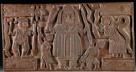


Accession Number
2006.135.1
Institution
de Young museum
Edo designations
English designations
Stool
Categories
Ceremonial Objects
Location
50 Hagiwara Tea Garden Dr, San Francisco, CA 94118, United States
Loading...
Stool
Stool

Iconographies

9 annotations
Ikoro
Armcuff

Ikoro (armcuffs) are made from different materials using different techniques, including brass sheet, cast bronze, and ivory. They were crafted by different guilds depending on the material used: artists of the Igun-Ẹrọnmwọn cast them in brass or hammered and incised them from brass sheet, whereas artists of the Igbesamwan carved ivory Ikoro. Ikoro were made in different qualities, from rather simple examples with abstract geometric decoration to finely carved ivory examples with brass or copper inlays. Ikoro are worn in pairs on both forearms by chiefs and the Ọba during ceremonies and festivals. Figures depicted on the Emwin Arhe (royal treasures) are often shown wearing such pairs.

1 annotation
Ikoro
Ẹbẹn
Ceremonial Sword

Ẹbẹn are a type of ceremonial sword of significant importance in the Benin Kingdom. During ceremonies, titled chiefs would hold them or toss them during dances, thereby paying homage to the Ọba at these public events, particularly when a chief receives a certain status. It is forbidden for Ẹbẹn to touch the ground, so the chief must take extra precautions to avoid dropping the Ẹbẹn during the dance. Therefore, the Okae-Odionmwan (head of executioners) dances with the Umozo (warfare or executioner’s sword) behind the dancing chief.

There are two central ceremonial swords used in the royal court of the Benin Kingdom, one of which is the Ẹbẹn, along with the Ada (ceremonial swords). They are distinguished by their blades: the Ẹbẹn blade reflects the shape of a leaf or an oar. Sometimes, it is decorated with openwork designs and/or brass inlays, most commonly shaped as small Ẹbẹn and Ẹkpẹn (leopards). The handle of the Ẹbẹn also has an unusual ring-shaped form, which further differentiates it from the Ada.

1 annotation
Ẹbẹn
Ahianmwẹ
Birds

A variety of different kinds of Ahianmwẹ (birds) were depicted by artists from the palace guilds on royal artefacts over the centuries. The precise identification and interpretation of these birds, and the meanings attributed to them, vary. Some of the most commonly depicted are the Akala (white-backed vulture), Oɛɣohɔ (vulturine fish eagle), and Esughusughu (owl).

The Akala is usually depicted on top of Osogan, potent staffs kept by priests for the worship of Osun. Its ewawa (beak) is associated with the azen (witches), and the Akala is associated with “death, abandonment, morbidity, and spoils” ( ). The Oɛɣohɔ is known as the “king of the day birds,” and its feathers are often worn by chiefs in their headwear as symbols of respected old age and proper chieftaincy ( ).

1 annotation
Ahianmwẹ
Colar Bead
Odigba
Coral beaded collar

Odigba (coral-beaded collar) is a rigid neck collar made of coral beads, worn as part of ceremonial attire only by senior princes who have been made Enigie (Inneh 2007, p. 107). Although Ibafe (2007, p. 43) argued that the Odigba was introduced during the Ogiso period (c. 900–c. 1170 AD) by Ogiso Ere, along with other symbolically important Emwin Arhe, such as the Ada (ceremonial sword) and the Ẹbẹn (ceremonial sword), this seems unlikely, as coral was only introduced in the late 15th century through trade with Portuguese merchants.

2 annotations
Odigba
Odigba
Ehẹn
Fish

Ehẹn is a general term used to describe various types of fish (Ọbazee 2025, p. 90; ). Although mudfish are one of the most common motifs in Benin art, other kinds of fish are also represented. According to Blackmun ( ), a greater variety of fish are represented on the Aken'ni Elao (carved tusks) than on other types of royal artefacts. According to Kathy Curnow ( ), fish appear on 70 Ama-Ẹrọnmwọn (bronze relief plaques), making them the most commonly represented animal. Despite their prevalence, the precise species of fish are not easy to identify due to their “generic renderings”, possibly indicating that artists did not always distinguish between specific varieties ( ). Fish are represented on the Ama-Ẹrọnmwọn both in profile and from above.

1 annotation
Ehẹn
Umozo
Warfare Sword

The Umozo is a type of sword with a short, broad, and curved single-edged blade that was used by warriors during warfare (Bradbury 1973, p. 260; Osadolor 2001, p. 109). According to Benson Osadolor (2001, p. 109), it is remembered in Benin City as one of the oldest kinds of weapons used in warfare and “was better for the attack than defence”.

1 annotation
Umozo
Asoro
Spears

Asoro (spears) were used as weapons in battle and for hunting ( ; Ọbazee 2025, p. 37). According to , there were two types: long and short. Figures holding Asoro are often depicted on Ama-Ẹrọnmwọn (bronze relief plaques), sometimes in battle scenes and at ceremonies and festivals.

1 annotation
Asoro
snake
Ẹyẹn
Snake

Ẹyẹn (snakes) are among the most common animals depicted by Edo artists on the Emwin Arhe (royal treasures). The varied depictions of these reptiles suggest different snake species, including the Ikpin (python), Arhunmoto (puff adder), and Olose (red-black striped snake); therefore, here we use the generic term for snake: Ẹyẹn.

The identification of snake motifs and depictions as Ikpin, as well as the importance accorded to this species, is a subject of scholarly debate. Paula Ben-Amos (1976, p. 247) argued that the Edo admired the “stature, colouration and crushing power” of the python, which was in turn associated with Olokun. She went on to identify the brass figures of snakes that formerly adorned the roof of the palace, as well as several other snakes, as pythons. Joseph Nevadomsky (1988, p. 77) argued instead that the importance of the Ikpin had been overstated.

Some of these snake representations may in fact be the Arhunmwoto (puff adder). The first to suggest this was the German curator Felix von Luschan (1919) in his early research into the Benin royal treasures. Nevadomsky (1988, pp. 79–80) suggested that the large head, narrow neck, and rough scales are indicative of either the puff adder, a symbol of “material wealth, tribute, and gifts,” or the Gaboon viper.

Another kind of snake that may be depicted is the Olose (red-black striped snake). It has the praise name “king of the snakes” in Edo. Olose is also closely connected to the deity Olokun, both because of its attractiveness and because it inhabits wet environments such as forest streams, which in turn flow into rivers and the sea, where Olokun lives (Nevadomsky 1988, pp. 76–77). Although the exact meanings of these different snakes vary, they share the characteristic of being spiritually powerful creatures.

1 annotation
Ẹyẹn

Provenance

4 events
Production
unknown to 1972
The object was produced by Unknown member(s) of the Emada in Benin City.
Unknown
1972 to December 31, 2006
The object is known to have come into contact with James W. Willis, later in San Francisco.
Purchase
1972 to December 31, 2006
The object was purchased by Helene Kuhn from James Willis Gallery and James W. Willis in San Francisco.
Gift
December 31, 2006
The object was given as a gift by Robert and Helen Kuhn Family Trust to the de Young museum in San Francisco.

Institution data

de Young museum
The data was transferred directly by the institution.
Last updated: 2021-11-02
Language: english
Institution fieldValue
Accession Number
object id
2006.135.1
DESCRIPTION
description
The central figure on the top panel is Oba Ozolua who probably reigned in the late 15 early 16 century. He is accompanied by warriors and herbalists who brandish trumpets, weapons and war charms.
Media
material
Wood
Dimensions
dimensions
45.7 x 68.6 x 35.6 cm (18 x 27.5 x 14 in.)
TITLE
object type
Ceremonial Table or Stool
Date
date made
19th century
Continent
production place
Africa
Country
production place
Nigeria
REGION
production place
Court of Benin
Credit Line
prior source
Gift of the Robert and Helen Kuhn Family Trust
Provenance/Former Ownership History
provenance
Purchased by Helen Kuhn from James Willis: Art, San Francisco, CA, in 2006.
Culture/People
ethnic attribution
Court Of Benin, Edo
Department
department and institution
Africa, Oceania, and the Americas
Acquisition Date
accession date
12/31/06
Additional notes
notes
REMARKS
notes
Illustrated in "The Art of Power/The Power of Art/Studies in Benin iconography UCLA Museum of Cultural History 1983 pp. 51-58
Exhibition History
exhibition history
Los Angeles: UCLA, Museum of Cultural History Gallery Haines Hall, Art of Power: Power of Art: Studies in Benin Iconography, March 2 to May 1, 1983 Washington DC: The National Museum of African Art, Treasures, November 17, 2004 to August 15, 2005. “Treasures” exhibition, Smithsonian Institution, National Museum of African Arts, Washington, DC
Location
display status
de Young Gallery 40
PUBLICATIONS
bibliography
Ben-Amos, Paula and Arnold Rubin, Art of Power: Power of Art: Studies in Benin Iconography, (Museum of Cultural History, UCLA, 1983), 51-58. Patton, Sharon F., Treasures, (Washington DC: Smithsonian, The National Museum of African Art, 2004) Fine Arts Museums of San Francisco. 2009. Africa, Oceania, the Americas, and the Jolika Collection of New Guinea Art: highlights from a decade of collecting. San Francisco: Fine Arts Museums of San Francisco, p20
Publication History
bibliography
“Treasures” exhibition catalogue, Smithsonian Institution, National Museum of African Arts, Washington, DC Paula Ben-Amos “The Powers of Kings: Symbolism of a Benin Ceremonial Stool” published in “The Art of Power/The Power of Art: Studies in Benin Iconography” Museum of Cultural History: UCLA, Monograph Series: Number Nineteen, 1983.
Century
19th Century AD
Object Type
Furniture
Sensitive Content

Digital Benin collates digital material from institutions, and some of this material is inherently colonial and contains words, terms and phrases that are inaccurate, derogatory and harmful towards African and African diasporic communities. Catalogue transcriptions, book titles, exhibition titles and museum titles may contain harmful terms. We recognise the potential for the material to cause physical and mental distress as well as evoke strong emotions. Owing to the scale of the collection’s data, a process to implement sensitive-content warnings in the displayed data is still incomplete. The material within the catalogue does not represent Digital Benin’s views. Digital Benin maintains a strong anti-colonial, anti-racist position and affirms its support for centring the humanity of historically marginalised and disenfranchised communities. Read more about the background of this statement here