
Inventory number
LG1964.15.3
Edo designations
English designations
Stool
Categories
Ceremonial Objects
Location
1 Adesogbe (Plymouth) Road, P.M.B. 1115, Benin City , Edo State
Loading...

Iconographies

2 annotations
Ubanu'hi / Obanu'hi
Ubanu'hi / Obanu'hi
Inifinity Symbol

The Ubanu'hi (infinity symbol) is a kind of guilloche or interlaced strapwork motif that can be angular or rounded. It was used by Edo artists in the decoration of many Emwin Arhe (royal treasures) and is ubiquitous in Benin royal arts. Ubanu'hi is a shortened form of “uba no Ọba ya de agbon ke ehimwin yi”, which means “the rope with which the Ọba ties the heaven and earth together” (pers. comm. Chief John Igbineweka Inneh n’Igbesawman, 2022). Similarly, Paula Ben-Amos Girshick (in Plankensteiner 2007, pp. 339, 341) described this as “Ọba n’iri agbon”, or the “rope of the world” pattern.

According to Ọbabanmu Ineh (in Blackmun 1984, p. 51), the use of this motif indicates that objects were carved by members of the Igbesanmwan. However, the motif is found on all types of Emwin Arhe (royal treasures), not only those made of ivory or wood. On the flanges of the Ama (relief plaques) alone, Kathryn Gunsch (2018, pp. 75–77) identified three different versions of the Ubanu'hi and, through her analysis of over 850 plaques, found that these different Ubanu'hi forms align with other characteristics, such as dimensions, the prevalence of ornamental motifs, and stylistic qualities. Together, these provide evidence, she argues, of different production groups among the plaque makers .

Kate Ezra (1992, pp. 209, 264) went on to argue that the use of these motifs indicates that certain objects were used in a “royal context” and were associated with “royal patronage”.

1 annotation
Ubanu'hi / Obanu'hi
Ewi
Mudfish

Depictions of Ewi (mudfish) are among the most frequent motifs in the Emwin Arhe (royal treasures). Mudfish hold an important place in Edo belief, both as representations of the god Olokun and as symbols of royalty (Plankensteiner 2007, p. 410), as well as of “prosperity, peace, well-being and fertility” (Ben-Amos 1976, p. 245). Mudfish are also particularly common animals for sacrifice, and mudfish-shaped Orhiẹvbẹ (kola-nut boxes) were used to make offerings or store kola nuts.

Yet, the appearance of Ewi across the Emwin Arhe is not consistent, and it has been argued that different species of mudfish were depicted by Edo artists, each with different qualities and capabilities. For example, the electric shock of Malapterurus electricus resembles the fierceness of the Ọba, while the liminal qualities of the Synodontis clarias mudfish, which lives both on land and in water, similarly reflect the Ọba’s rule over land and sea (Gallagher 1983, p. 93). With these different qualities in mind, the mudfish is an important symbol of Benin kingship and royalty.

Sometimes the Ọba was depicted by artists with mudfish rather than legs (see Ọba with Mudfish Legs).

1 annotation
Ewi

Provenance

4 events
Production
unknown to February 22, 1897 (day approximate)
The object was produced by Unknown member(s) of the Igbesamwan guild in Benin City.
Looted
February 22, 1897 (day approximate) to June 1899 (year approximate)
The object was looted by Robert B. Allman from Benin Kingdom.
Inheritance
1917
The object was inherited by Elizabeth M. Dorothy (born Allman) Hemingway from Robert B. Allman.
Auction
April 26, 1954
The object was auctioned to the Omo n'Oba n'Edo Uku Akpolokpolo, Ọba of Benin & National Commission for Museums and Monuments, Nigeria by Elizabeth M. Dorothy (born Allman) Hemingway through Sotheby's, Bernard Evelyn Buller Fagg, Daryll Forde and Colonial Government of Nigeria in London.

Institution data

Omo n'Oba n'Edo Uku Akpolokpolo, Ọba of Benin & National Commission for Museums and Monuments, Nigeria
The data was transferred directly by the institution and digitized by Digital Benin in collaboration with the NCMM
Last updated: 2023-11-30
Languages: english, bini; edo
Institution fieldValue
Inventory number
object id
LG1964.15.3
URL
weblink
Object Description
description
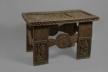
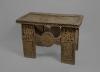
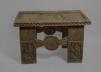
‘Ogiso ma m’ẹmwẹn ẹ fian agba’ (When the Ogiso does not have a case to judge, he will not ask for Agba to be made) The Agba is regarded as the stool of judgement, and according to oral tradition, it originated during the Ogiso dynasty. In Benin Kingdom, there are two kinds of stools with ceremonial and ritual functions: the Agba and the Ẹrhẹ. The Agba is rectangular in shape, with a carved panel forming the seat and four carved interconnected panels that serve as the legs. Agba may be used by the Ọba, chiefs and some priests, and it is believed they were carved by members of the Emada (Hess, 1983, p.41[40]). The Erhe has a circular seat and base with a central supporting column and can be cast in brass or carved in wood. Although a third kind of stool, the Ekete, has been identified in literature (e.g. Ezra 1992, p.263[20]), our own research indicates that the word means ‘throne’ and can be used to describe any kind of stool the Ọba may sit upon, thus both the Agba and Erhe could be Ekete as well. (Hess, 1983, p.41[40]).
Diameter
dimensions
Dimension L (cm)
dimensions
53.0
Dimension W (cm)
dimensions
49.0
Dimension H (cm)
dimensions
42.5
Brief Object Description
designation
Stool
Material
material
wood
Object Count
object count
1
Date Made
date made
Associated Guild
producer
Igbesamwan
Production Technique
production technique
Carving
Production Place
production place
Benin City
Inscriptions
inscriptions
Note
Inventory Book Description
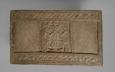
Carved wooden stool from Benin. No.105 in the sale catalog where it is described as follows: "A FINE BENIN CARVED WOOD STOOL, the rectangular top supported on slightly tapering legs and with shaped stretchers, the seat carved in the centre with a figure of a King with arms upraised and holding in each hand a triangular object, flanked by panels of trellis, the borders with a single guilloche pattern, the legs and stretchers carved with attendants, foliage and geometric designs, fine colour, 25 1/2" by 16 1/2" high." The bidding for this was made on Mr. Fagg's behalf by Professor Daryll Forde. Purchased by the Nigerian Government at the Sale by Messrs. Sotheby & Co. Bond Street, London on April 26th 1954: M. B. E. B. Fagg, assistant surveyor of antiquities, acted for the Nigerian Government at the sale and in subsequent negotiations : P.V. 5/14/54-55 and 5/15/54-55. The property of Mrs. Dorothy Hemingway. (From the collection of Dr. R. Allman, Principal Medical Officer of Southern Nigeria during the Benin Punitive of 1897).
fileNames
DSC07903.jpg, DSC07906.jpg, DSC07904.jpg, DSC07901.jpg
Sensitive Content

Digital Benin collates digital material from institutions, and some of this material is inherently colonial and contains words, terms and phrases that are inaccurate, derogatory and harmful towards African and African diasporic communities. Catalogue transcriptions, book titles, exhibition titles and museum titles may contain harmful terms. We recognise the potential for the material to cause physical and mental distress as well as evoke strong emotions. Owing to the scale of the collection’s data, a process to implement sensitive-content warnings in the displayed data is still incomplete. The material within the catalogue does not represent Digital Benin’s views. Digital Benin maintains a strong anti-colonial, anti-racist position and affirms its support for centring the humanity of historically marginalised and disenfranchised communities. Read more about the background of this statement here