


Iconographies



Provenance
Institution data
| Institution field | Value |
|---|---|
Object Number object id | AP 1970.04 |
Department department and institution | African |
Classification object type | Sculpture |
Accession Method accession method | Purchase |
Accession Date accession date | 1970-02-19 |
Object Status accession method | Accessioned Object |
Constituent production place | African |
Constituent department and institution | Kimbell Art Museum |
Title designation | Standing Oba |
Object Name object type | Bronze or brass sculpture |
Dated date made | late 18th century |
Medium material | Bronze (or brass) |
Dimensions dimensions | 22 5/8 x 7 1/8 x 7 3/4 in. (57.4 x 18.1 x 19.7 cm) height dimension shown is figure. Height from bottom of the tang to the top of the figure is 29 ¾ in. Length of the tang 7 ¼” |
Country/Culture ethnic attribution | Edo |
Label Text description | Benin City is the center of an ancient culture that has flourished for centuries in southern Nigeria. From the early seventeenth century there are accounts by Europeans of the extensive architectural use of cast metal (actually brass) relief panels and other objects. The king, known as the Oba, is the central figure in the Benin kingdom and a frequent subject of Benin royal artwork. The Oba’s ancestors were gods, and it is believed that he controls the forces that affect the well-being of the entire kingdom. The Kimbell sculpture portrays an Oba dressed in full ceremonial regalia. The beads that made up his chest covering, his high neckpiece, and the net-form headdress were actually made of coral. The gong-shaped proclamation staff in his left hand was made either of brass or ivory, while the ceremonial sword in his right hand was of brass. The Oba danced with a sword to honor his ancestors. In this work, his power is emphasized by the representation of six small swords in relief on the blade of the ceremonial sword, and by the alternating images of a sword and stylized heads of Portuguese soldiers on the Oba’s kilt. As the Portuguese arrived in Benin by sea, the inclusion of Portuguese heads in the regalia of the Oba also symbolized the wealth he gained through foreign trade and his affiliation with Olokun, god of the sea. |
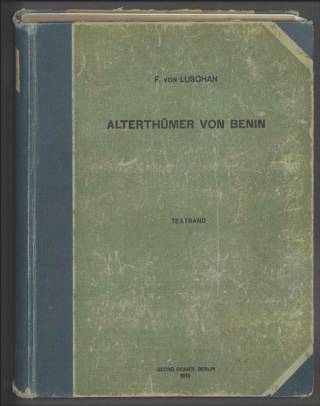
Provenance with footnotes provenance | Probably commissioned by a member of the court of Benin in the late 18th century; taken from the Royal Palace, Benin City, during the British military occupation (punitive expedition ) of Benin, 1897;[1] acquired by the Liverpool Museum, England, 1897; purchased by Lt. General Lt.-General Augustus Henry Pitt-Rivers (1827-1900) by 1900 and kept at the Pitt-Rivers Museum, Farnham, Dorset, England, until the 1960s;[2] passed by descent within the family and sold upon the dispersal of the collection; purchased by (Ben Heller, Inc., New York) by 1970; purchased by Kimbell Art Foundation, Fort Worth, 1970. [1] The Kimbell’s Standing Oba was part of the loot forcibly removed from Benin City by the British punitive expedition in 1897 (see Bulletin of Liverpool Museums, vol. 1, no. 2, pp. 49 and 59); AP 1970.04 is included among the ""spoils"" of the punitive expedition sent by Her Majesty’s Government, under Admiral Rawson. It is not confirmed that this was a purchase, since the Benin artworks are said to have been ""acquired"" or ""secured,"" nor is the agent specified. The Liverpool Museum acquired four similar standing bronze Obas; the Kimbell bronze is register number 7.10.97.1, the smallest of the four (7.10.97.1-4) and described in most detail pp. 59-65, illustrated p. 60, Fig. 10, from the front, side and rear. [2] Lt. General A. H. Pitt Rivers, Antique Works of Art from Benin (London, 1900), reprinted by Hacker Art Books, New York, 1968, p. 62, states that the Kimbell’s Oba was obtained from the Liverpool Museum; AP 1970.04 is described and illustrated plate XXI, figs 232-234. The Benin works of art are catalogued as in General Pitt Rivers’ Museum at Farnham, Dorset, at this date (1900), p. iii. The General Pitt Rivers Museum was the private collection of Lt. General A. H. Pitt Rivers. The foundation in 1884 of the Pitt Rivers Museum, University of Oxford, depended ""upon the donation of the collection amassed before 1884 by Lieutenant-General Augustus Henry Lane Fox Pitt Rivers"" as well as other collections for which see http://web.prm.ox.ac.uk/sma/index.php/articles/article-index/436-prehistory-of-the-pitt-rivers-museum.html. According to the provenance notes of certain Benin objects in the Boston Museum of Art, ""The collection of the privately-owned Pitt-Rivers Museum passed by descent through Augustus Henry Pitt-Rivers’ son Alexander Lane Fox Pitt-Rivers to his grandson, Captain George Pitt-Rivers (1890-1966) and his common law wife, Stella Howson-Clive (Pitt-Rivers). The museum closed in the 1960s and the collection was sold."" https://collections.mfa.org/objects/558361 and https://collections.mfa.org/objects/558340. |
Bibliography bibliography | Henry O. Forbes, "" On a Collection of Cast-Metal Work of High Artistic Value, from Benin, Lately Acquired for the Mayer Museum,"" Bulletin of the Liverpool Museums Under the City Council (1898): pp. 59–65, illus. fig. 10. ; Lt. Gen. A. H. Pitt Rivers, Antique Works of Art from Benin, 2nd ed. (New York, 1968), p. 62, illus. nos. 232–34, pl. 31. [1968].; Kimbell Art Museum, Kimbell Art Museum: Catalogue of the Collection 1972 (Fort Worth, 1972), pp. 310–312, illus. [1972].; Kimbell Art Museum, African Art: Recent Acquisitions, gallery brochure (May 1979), illus. [1979 May gallery brochure].; Paula Ben-Amos, The Art of Benin (London, 1980), pp. 66, 68, illus. no. 70, p. 66. [1980]; Kimbell Art Museum, Kimbell Art Museum: Handbook of the Collection (Fort Worth, 1981), p. 246, illus. [1981].; Kimbell Art Museum, In Pursuit of Quality: The Kimbell Art Museum (Fort Worth, 1987), p. 296, illus. [1987].; James W. Davidson and Mark H. Lytle, The United States: A History of the Republic (Englewood Cliffs, 1990), illus. p. 21. [1990].; Timothy Potts, ed., Kimbell Art Museum: Handbook of the Collection, (Fort Worth: Kimbell Art Museum, 2003), p. 258, illus. p. 258. [2003].; Wendy P. Gottlieb and Lindsay Elston Askins, eds. Kimbell Art Museum Calendar (Fort Worth: Kimbell Art Museum, September 2004-January 2005), p. 13. [2004/2005].; Eric M. Lee, George T. M. Shackelford, Jennifer Casler Price, Nancy E. Edwards, eds. Kimbell Art Museum: Masterworks from the Collection, (Fort Worth: Kimbell Art Museum, 2020), p. 324. [2020]. |
Exhibition History exhibition history | None known |
Country production place | Africa, Nigeria, Kingdom of Benin, Benin City |
Digital Benin collates digital material from institutions, and some of this material is inherently colonial and contains words, terms and phrases that are inaccurate, derogatory and harmful towards African and African diasporic communities. Catalogue transcriptions, book titles, exhibition titles and museum titles may contain harmful terms. We recognise the potential for the material to cause physical and mental distress as well as evoke strong emotions. Owing to the scale of the collection’s data, a process to implement sensitive-content warnings in the displayed data is still incomplete. The material within the catalogue does not represent Digital Benin’s views. Digital Benin maintains a strong anti-colonial, anti-racist position and affirms its support for centring the humanity of historically marginalised and disenfranchised communities. Read more about the background of this statement here